


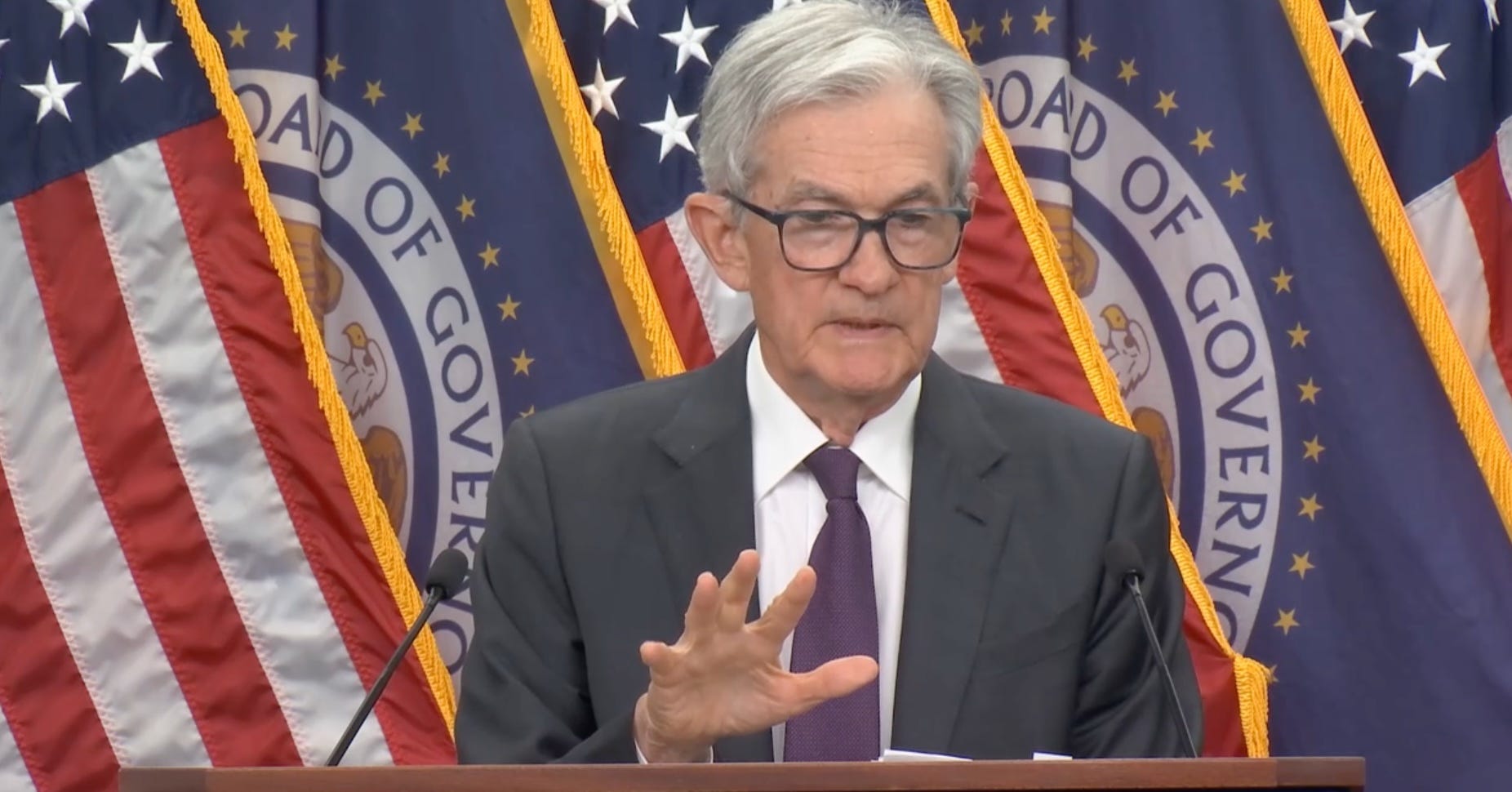
The Federal Reserve’s oppositional stance to President Trump and the decline of the intellectual diversity that used to characterize its regional banks has been a theme around here for months. See for example (“For Fed Chairman Powell, a Paradox,” April 8, 2025; “The Fed Joins the ‘Resistance,’” April 10, 2025; “Groupthink Sets in at Powell’s Federal Reserve,” April 22, 2025, “The Fed Beyond Bessent,” June 11, 2025, “President Trump Versus Fed Chairman Powell Is a Five-Dimensional Drama,” July 3, 2025; “Instead of Firing Powell, Trump Could Add New Fed Governors,” July 17, 2025, and other pieces).
It’s been something of a lonely campaign. President Trump himself has been vocal about it, and both Maria Bartiromo and Larry Kudlow of Fox Business have been encouraging. Yet I’ve also heard from some readers who don’t quite understand why I’m devoting so much attention to the arcane topic of monetary policy, and from others who think I’m wrong on the substance of it.
The new development is that the criticism of Jerome Powell’s Fed is gradually starting to get more and more high-profile mainstream traction. Here’s what I mean:
The Wall Street Journal editorial page has been defending Powell against Trump’s calls for lower interest rates, but today the Journal has a terrific piece from David Malpass.
“President Trump is right to call out the Federal Reserve for keeping interest rates too high and wasting money on extravagant renovations to its Washington headquarters,” Malpass writes. “Transforming the Fed would create an opportunity to lower interest rates, save billions of dollars in interest payments and build market confidence in U.S. investments and the dollar.”
Malpass served in both the Reagan and George H.W. Bush administrations, spent 23 years on Wall Street (including as chief economist at Bear Stearns), was president of the World Bank Group from 2019 to 2023 and was Under Secretary for International Affairs of the U.S. Treasury from 2017-2019.
Meanwhile, Bloomberg has a stunning writeup of an appearance on CNBC by David Zervos, chief market strategist at Jefferies. “A potential candidate to succeed Federal Reserve Chair Jerome Powell, David Zervos, said that it’s inaccurate to describe the US central bank as independent, and characterized the outgoing Fed chief as aligned with the political left,” the Bloomberg story says. “‘I think he’s actually quite a bit dependent,’ Zervos said of Powell. ‘He’s operating politically from the left. Or, let’s put it this way, from the anti-Trump side.’”
I guess one could claim that Malpass or Zervos are hoping Trump will name them as governors of the Fed or to succeed Powell. One could claim that they are just saying what Trump wants to hear.
But at a certain point, it’s the defenders of the status quo who are going to start looking ridiculous. That’s the category in which I place the Axios Macro newsletter, subject line “War on Fed's new phase,” reporting that, “The Trump administration is pursuing wholesale change at the Federal Reserve with a ruthlessness and creativity that few Fed watchers could have imagined….The president’s demands for lower interest rates are not just rhetoric, and his attacks aren't limited to insults of chair Jerome Powell. Rather, the administration is pursuing a sophisticated, multifront war to try to install loyalists atop the Fed much faster than normal turnover would allow.” Instead of the actual story—that a Fed governor, Lisa Cook, appears to have claimed for mortgage application purposes that two separate properties were both her principal residence—the press frames it as “ruthlessness,” “war,” “insults,” and not “normal.”
If inflation or unemployment soar after Trump gets full control of the Fed, it could be politically costly. The current situation, though, in which inflation or unemployment potentially soar and the Fed then blames Trump and his tariffs, while Trump blames the “too late” Fed, is not optimal either.
I mentioned it a few days ago, but it bears repeating, from my former New York Sun colleague Joseph Sternberg in the Wall Street Journal: “No democratic political system can tolerate an unaccountable institution that exercises such awesome economic power and also makes so many mistakes. Witness mounting bipartisan frustration with the Fed in Congress.”
Bed Bath & Beyond on California: The executive chairman of Bed Bath & Beyond, Marcus Lemonis, issued a statement explaining why his company won’t open stores in California: “We will not open or operate retail stores in California. This decision isn’t about politics — it’s about reality. California has created one of the most overregulated, expensive, and risky environments for businesses in America. It’s a system that makes it harder to employ people, harder to keep doors open, and harder to deliver value to customers. The result? Higher taxes, higher fees, higher wages that many businesses simply cannot sustain, and endless regulations that strangle growth.”
Harvard’s hiring-freeze exceptions: Back on July 22, in “Harvard Makes Exceptions to Hiring Freeze to Add Jewish Studies Professors,” we noted that Harvard has an active search for a “Tenured Professor in Near Eastern Languages and Civilizations,” “with a specialization in Jewish history, religion, and culture in antiquity and/or late antiquity. The successful candidate must have demonstrated expertise in Rabbinic and other Jewish literatures of the ancient world; facility with the relevant languages; deep knowledge of the surrounding civilization(s) in which Jews were embedded, i.e., some combination of Hellenistic, Roman, Eastern or Western Christian, and/or Zoroastrian; command of relevant disciplines in the Humanities including historical method.” The keywords for the search include “History, Religion, Judaism, Rabbinics, Biblical interpretation, Jewish society, Talmud, Midrash, Magic, Comparative Religious Law.”
It turns out there are some other, non-academic positions, that have also been authorized as exceptions to the hiring freeze. Among them: “Sous Chef, Quincy, Hillel, and Kosher,” a job that pays between $68,100 and $111,500, and “Deputy Title VI Coordinator and Case Manager,” a job for an $87,700 to $150,900 a year lawyer who will be responsible for “Consulting with ‘Local Designated Resources’ on all complaints of antisemitism and other forms of shared ancestry discrimination.” And the Harvard Business School is hiring a “Project Director/Senior Researcher, Project on Israel,” “to oversee a Project on Israel led by Professors Paul Gompers and Raffaella Sadun.”
In addition to Jewish and Israel-related areas, another area that appears to be hiring at Harvard is related to free speech and viewpoint diversity. The Harvard Faculty of Arts and Sciences is advertising for a “director, program on higher education research,” a qualification for which is “Familiarity with the Harvard community and Harvard’s administrative processes,” which, for those who think the inbred nature of Harvard is one of the problems, should be good for a chuckle. From the job description: “The Program on Higher Education Research will also house the Council on Academic Freedom at Harvard (CAFH), a Harvard-wide faculty-led group of more than 200 Harvard faculty members, dedicated to the promotion of academic freedom, civil discourse, and viewpoint diversity at Harvard. The Council is led by an executive council of seven elected faculty co-presidents but situated within the Faculty of Arts and Sciences and hosted administratively in IQSS within the newly established Program for Higher Education Research.”
Some of the dining services positions listed may be a function of seasonality where Harvard saves money by eliminating these positions over the summer months and re-listing them for each new academic year.
But it’s interesting that Harvard can find the funds for all this at a time when it’s running around to alumni and the press claiming that life-saving cancer research is jeopardized because of federal research funding cuts. Maybe the people running Harvard figure that spending some money on restoring a flourishing, vibrant, Jewish and pro-Israel community on campus, along with some intellectual diversity, could be a faster, more efficient, and more productive route to unlocking the frozen billions in federal research funding than all the money the university is spending now on lawyers, lobbyists, and public relations staff to criticize the Trump administration for its so-called unprecedented and pretextual assault on higher education.
Comment of the Day: From Jonathan Burack, on yesterday’s post about the letter from academic economists to Prime Minester Netanyahu:
I admire your temperate tone and even think it is the best one to adopt in dealing with this. I have to say, however, that these economists do not deserve this temperate response.
Blanchard's claim that Israel "is close to his heart," but that he believes Israel now "is directly responsible for the lack of food” in Gaza is hard to take seriously. If Israel were truly close to his heart, he would at least know how Israel has attempted to deliver food to Gaza, he would know how Hamas thwarts that effort, and he would know how unprecedented it is to expect a nation in the midst of a war launched against it to also care for the population of the enemy still at war with it. His "heart" would lead him to at least contend with that Israeli perspective. It would lead him to be suspicious, or at least aware, of the idea that it is an unprecedented moral inversion to transform Hamas's actual genocidal war and its cruel sacrifice of its own population into a fantasy about Israel being to blame for Gaza's suffering. I do not believe Blanchard holds Israel close to his heart, and I have to conclude that none of the other signatories do either. Their utter failure to confront even the most basic flaws in the leftwing-Hamas take on this war is a colossal betrayal of the academic standards to which I assume these economists try to hold themselves in their own academic work.
Sorry for this rant, but really, it is just too much sometimes to take.
Thanks to all the sophisticated readers who take the time to add value with comments.
Know someone who would enjoy or benefit from reading The Editors? Please help us grow, and help your friends, family members, and associates understand the world around them, by forwarding this email along with a suggestion that they subscribe. Or send a gift subscription. Thank you!
Sir, I appreciate your point of view about the Fed, intellectual conformity and the need for lower interest rates. But when I hear politicians from the president on down calling for lower interest rates I can't help but think their motivation is to spend, spend, spend at low borrowing costs. We'd all be better off if Washington spends more time bending the fiscal trajectory downward from the horrifying $36T that stands now and less time browbeating Jay Powell and Co.