

Instead of Firing Powell, Trump Could Add New Fed Governors
A better board could help the chairman, and the economy.

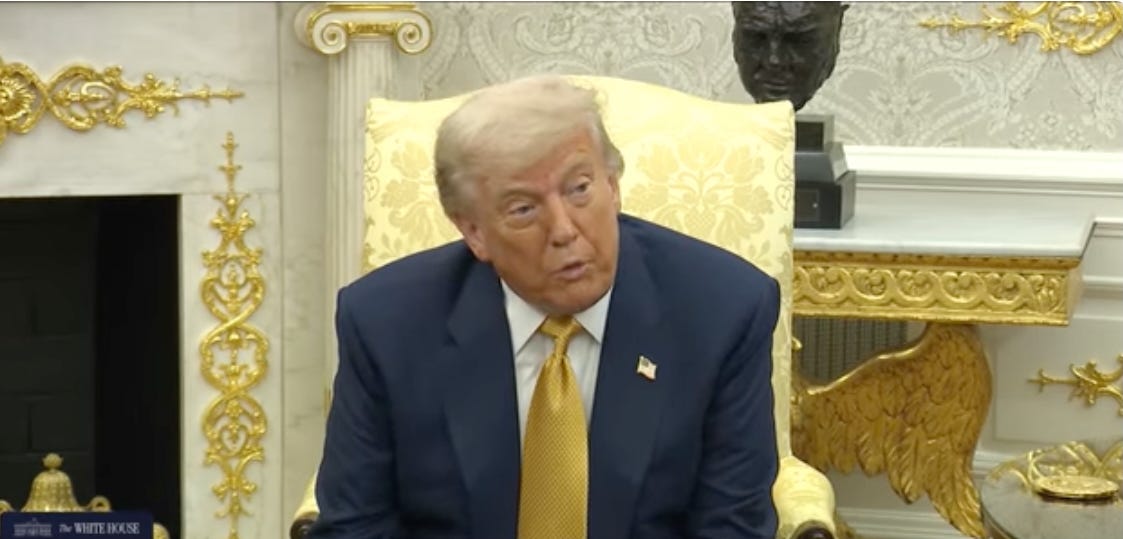
During President Trump’s colloquy with the White House press corps yesterday about whether he would fire Federal Reserve Chairman Jerome Powell (“Highly unlikely, unless he has to leave for fraud”), Trump made a shrewd and underappreciated observation.
After denouncing Powell for being “too late,” keeping interest rates too high, and overspending on the Fed’s renovation, the president added, “That goes for his board too, because his board is not doing the job, because they should try to rein this guy in.”
It got us thinking. If firing Powell, whose term as chair expires in May 2026, is too dramatic a step for Trump or for the financial markets, maybe the president—and Congress, which has the monetary policy power under the Constitution—can address the situation by adjusting the Fed’s board of governors.
The Federal Open Market Committee currently consists of 12 people: seven Fed governors, each with a 14-year term; the president of the Federal Reserve Bank of New York, and four other voting members representing the 12 regional Fed banks, whose presidents rotate annually on and off the committee.
As documented here in “Groupthink Sets In at Powell’s Federal Reserve,” (April 22, 2025) dissenting votes at the Open Market Committee have declined under Powell’s chairmanship, a period that also included one of the biggest monetary policy errors in the past half-century—a slow and late reaction to Bidenflation that kept the federal funds rate at zero all the way into March 2022 when Consumer Price Index Inflation was at 8.5 percent.
A better board might help in reining in Powell, as Trump suggests. It could also help make sure that Powell’s successor, whoever that is, doesn’t repeat Powell’s mistakes. In his comments yesterday, Trump was dismissive of the need to hire thousands of economists to advise the Fed chairman on what to do. But we’re not talking about thousands, we’re talking about adding a few more members, say, three, to a committee that currently numbers 12.
Democrats would denounce it as a power grab and as interference with the “independence” of the Fed. Yet we went over the Constitution with a magnifying glass and then with a microscope and couldn’t find an independent Fed anywhere in it. Even then-Fed Governor Kevin Warsh, reportedly now a candidate to succeed Powell as Fed chairman, conceded in his 2010 “Ode to Independence” speech that “elected representatives have every right to redraw the central bank's authority, even if a fuller reading of economic history considers it unwise.”
The Democrats are supposed to like diversity, and democracy. Why not some more of it at the Fed? Nearly 60 House Democrats backed a 2021 bill to expand the Supreme Court to 13 from nine, and Senator Markey of Massachusetts, backed by Senator Tina Smith of Minnesota and Senator Warren of Massachusetts, offered similar legislation in the Senate. President Biden appointed a Presidential Commission on the Supreme Court of the United States to consider the size of the court, the tenure of the justices, and other issues.
The comparison with the judiciary is useful in other ways. One of Trump’s first-term successes were the judicial appointments he made from lists of people who were publicly announced in advance. Trump could generate confidence along the same lines by sharing with Congress and the public the names of those he might add as Fed Governors.
One person deserving of consideration is Scott Grannis, the Calafia Beach Pundit, whose work is publicly available and has been both unconventional and on-target. Another is Ed Yardeni of Yardeni Research, who has been realistic about the limits of the Fed’s power to set the government’s borrowing interest rates versus the longer-term power of the market. John Cochrane, Alan Reynolds, and Brian Wesbury would all add fresh perspectives. Many of the names in the mix for the Fed chairmanship could also be good governors. They don’t all have to be Ph.D. economists. Someone from labor, or someone from the real estate or retail businesses, might add perspective.
Powell has been playing the Open Market Committee members like a calliope. More members might help quicken the musical rhythm from “too slow.”
If it seems like a heavy-handed intervention by Congress, remember that Paul Volcker only moved seriously to cut rates in the early 1980s, helping to fuel the Reagan boom, after Jack Kemp and Jim Wright called for his resignation and Senator Robert Byrd pushed legislation calling for lower rates.
And if it seems like it gives Trump too much power, the terms of the new governors could be limited to shorter than 14 years—say, staggered at two, four, and six years—to make sure that future presidents and Congresses have the chance to put their own stamp on the Fed.
There’s nothing that magically makes a 12-member Open Markets Committee better than a 15-member one.
After all, the Fed will have this $2.5 billion renovated vast new headquarters building. Trump’s OMB Director Russ Vought recently likened it to the Palace of Versailles, while Senator Tim Scott has compared it to the Taj Mahal. There’s plenty of office space there for a few new governors. Trump and Congress might as well fill it up with some additional Open Market Committee members that are independent thinkers. They can strengthen the Federal Reserve—and monetary policy and the U.S. economy—by adding intellectual diversity the institution has lacked. And they can adjust the balance slightly toward political accountability and democratic control, adding to the credibility and institutional legitimacy that in the end are the Fed’s most valuable assets.
Know someone who would enjoy or benefit from reading The Editors? Please help us grow by forwarding this email along with a suggestion that they subscribe. Or send a gift subscription:
Packing the Fed is just as odious as packing the Supreme Court.
What would get the Fed to relax nerves and relax rates is returning the authority to set tariffs to Congress.