

The Fed Beyond Bessent
Putting money back on a Constitutional course will take more than a single personnel move

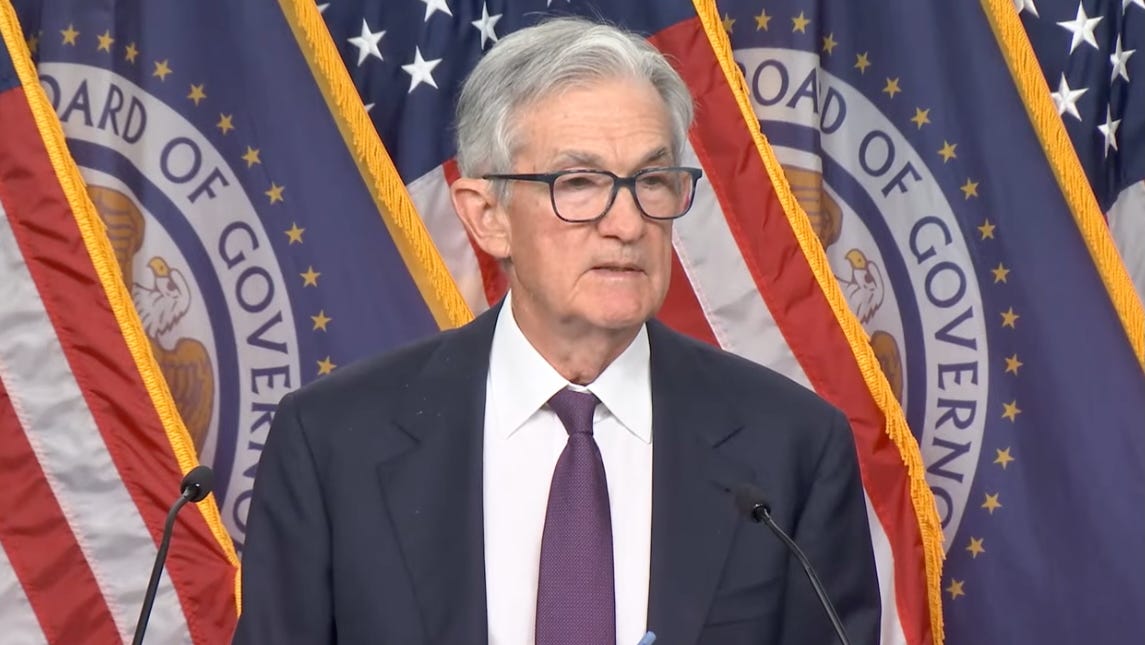
Bloomberg News is stoking speculation that the Treasury secretary, Scott Bessent, will take over from Jerome Powell at the Federal Reserve when Powell’s term expires on May 15, 2026. “Bessent Emerges as Possible Contender to Succeed Fed’s Powell,” was a Bloomberg story yesterday. “Paul Tudor Jones Sees Bessent as Pick for Fed Chair,” is a Bloomberg story today.
Bessent told Congress today that he has the best job in Washington and would like to stay through 2029 to complete the administration’s agenda. We read the leaks to Bloomberg (and before that to Stephanie Ruhle) as fantasizing by Howard Lutnick, the Commerce secretary and Trump transition co-chair, who is ambitious to amass power for himself by shoving Bessent aside.
Whether Trump nominates Bessent to succeed Powell or, whether, more likely, the president picks someone else, fixing the Federal Reserve will require more than merely a personnel change at the top.
Trump is fixated on the interest rates. “CPI JUST OUT. GREAT NUMBERS! FED SHOULD LOWER ONE FULL POINT. WOULD PAY MUCH LESS INTEREST ON DEBT COMING DUE. SO IMPORTANT!!!,” the president posted to social media this morning, referring to the Consumer Price Index release that even President Biden’s former chairman of the Council of Economic Advisers, Jared Bernstein, said showed “continued disinflation with few obvious signs of tariffs pushing prices.”
The interest rates are not set by the Fed chairman alone, despite how much it has seemed that they are under Powell’s “Disappearing Dissent” groupthink regime. There’s a 12-member Fed Open Market Committee of seven Fed governors, the president of the New York Fed, and a rotation of four of the 11 regional Reserve Bank presidents. Those regional bank presidents serve five-year terms, with a mandatory retirement at age 65 with an exception for presidents initially appointed after age 55, who can get an extension allowing them to serve until attaining 10 years of service in the office or age 75, whichever comes first.
In other words, there’s a structural issue that limits a president from simply setting interest rates by installing a new Fed chair. It’s somewhat similar to the way that nominating a new chief justice of the Supreme Court does not affect the other eight justices. As the former president of the Richmond Fed, Jeffrey Lacker, has noted, the Fed Board of Governors has started taking a stronger role in hand-selecting the regional bank presidents. Powell will leave a long wake, so the legal question of whether Trump has the power to replace the governors or the bank presidents before their terms expires is worth exploring. The easy route would be for Trump to just leave it alone, but he’d be handing a booby trap to his successor, leaving President Vance or President Buttigieg or some other leader to deal with more oppositional Powell holdovers.
Perhaps the partisanship would be less of a problem for a Democratic president—after all, the Fed was cutting rates until Trump was inaugurated, though it has since stopped cutting, notwithstanding a series of government price statistics showing minimal to nonexistent inflation. You can slice the numbers however you want—market-based, “core,” PCE, CPI, whatever—and, tariff panic-mongering aside, there just isn’t much cause for concern. True, the dollar has eroded against gold since Trump took office, but that trend has leveled off recently along with at least some of the Liberation Day apocalypticism.
At Treasury, Bessent is performing pretty well. In testimony prepared for delivery this morning before the House Ways and Means Committee, he noted:
Treasury has just completed its most successful tax filing season in years—and we did so while improving efficiencies and cutting costs at the IRS.
Critics of the President’s efforts to modernize the IRS warned that the effort would result in a 10% shortfall in receipts. Instead, the opposite happened. April receipts this year were up 9.5% over the previous year. And receipts in May were up 14.7% over the previous year. Most remarkably, the President was able to achieve these results while reducing $2 billion in waste and planned IT spending at the IRS.
Bessent helpfully provided a footnote for the “critics…warned” sentence, to a CNBC article headlined “Tax revenue collected by the IRS set to plummet, report says.” The “report” was a Washington Post article labeled “WP Exclusive” and headlined “Tax revenue could drop by 10 percent amid turmoil at IRS.” It began, “Senior tax officials are bracing for a sharp drop in revenue collected this spring, as an increasing number of individuals and businesses spurn filing their taxes or attempt to skip paying balances owed to the Internal Revenue Service, according to three people with knowledge of tax projections.”
Maybe some day people will look back at the reports about Bessent moving to the Fed with the same retrospective ridicule that they look at the reports about the supposed tax revenue declines because of DOGE hollowing out the IRS. I’m not saying Bessent wouldn’t be good at the Fed. But he’s pretty good at the job he’s in now, too. Another report, at CNBC, has Trump considering naming a “shadow” Fed chair to provide an intellectual alternative to Powell between now and May 2026. There already exists a Shadow Open Market Committee composed of estimable figures including Charles Calomiris, the aforementioned Jeffrey Lacker, and Mickey Levy.
Trump is correct to sense that the Fed could use some shaking up. It was slow to act against Bidenflation, and its vaunted “independence” has become a way of evading constitutional accountability. Change, though, will require a team effort, perhaps including Congress, which the Constitution gives the power to coin money and regulate the value of. Perhaps in their inspired genius the framers of the Constitution made that choice because the Congress is a branch with members who face voters every two years and who at least in theory, risk being replaced over either inflation or high unemployment. Change will require thinking beyond Bessent, beyond a new Fed chairman, and toward reinvigorating the intellectual energy and viewpoint diversity of the Fed itself, including more emphasis on the regional banks, which used to be interesting and have in recent years become more uniform. It is more than just a one-person job.