

President Trump Versus Fed Chairman Powell Is a Five-Dimensional Drama
Plus: Massachusetts mulls “mileage tax” to replace dwindling gas-tax revenue

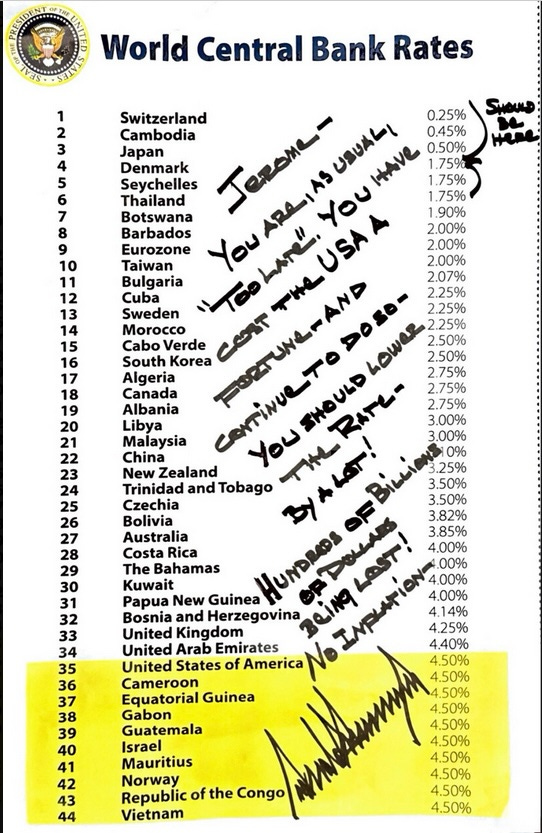
The hottest drama in Washington and on Wall Street is the fight between President Trump and Federal Reserve Chairman Jerome “Jay” Powell.
Each day brings one or more incremental twists. Today it was a jobs report that Scott Grannis characterized as “mediocre”— “Nothing in this report should give the Fed a reason to keep monetary policy tight.” Also today came interviews by Treasury Secretary Bessent with Fox Business and CNBC in which Bessent called the Fed “a little off here in their judgment,” and called the Fed’s rates “too high.” The day before it was a Bloomberg story about the possibility that Powell would remain at the Fed as a governor until January 2028 even after his term as chair expires in May 2026. The same story floated the scenario that Bessent could serve as Fed Chair and Treasury Secretary simultaneously.
On June 30, the news was President Trump’s tweet of a list of central bank rates worldwide, along with a handwritten note: “Jerome—You are, as usual, ‘too late.’ You have cost the USA a fortune and continue to do so — you should lower the rate—by a lot! Hundreds of billions of dollars being lost! No inflation.” Trump included an arrow indicating that U.S. interest rates should be between 0.50% and 1.75%.
“Jerome ‘Too Late’ Powell, and his entire Board, should be ashamed of themselves for allowing this to happen to the United States. They have one of the easiest, yet most prestigious, jobs in America, and they have FAILED — And continue to do so. If they were doing their job properly, our Country would be saving Trillions of Dollars in Interest Cost. The Board just sits there and watches, so they are equally to blame. We should be paying 1% Interest, or better!” Trump said.
To understand why this is such an important and fascinating story it’s worth taking a step back from the day-to-day and thinking about the five different levels on which the Trump-Powell fight is operating.
On the level of economics, the interest rate affects borrowing costs for individuals and businesses—mortgage rates, car loans—and for the U.S. government. When Trump talks about the “Trillions of Dollars in Interest Cost,” he’s accurately observing that the federal budget deficit and debt are sensitive to interest rates, and so the higher rates constrain his agenda. Likewise, Trump was elected in part in a backlash against Bidenflation. So part of the fight is about the technical economic question of what is the right level to be at to meet the Federal Reserve’s dual mandate of maximum employment and stable prices.
There’s a second dimension, which relates to the legal and constitutional question of whether Trump would have the right to fire Powell before Powell’s term expires, and whether the Fed’s “independence” is consistent with the Constitution. The stock market lurched in apparent reaction when Trump indicated he might oust Powell, and Trump indicated he would wait Powell out, but if Trump doesn’t test the issue directly, some future president might. The Fed Open Market Committee is more than just Powell. Similar in some ways to a staggered corporate board set up to resist a change of control by a hostile takeover, at the Fed, it will take more than a new chair alone to change the rates. If rates remain high, Trump might be tempted to move against the Fed even after Powell’s term as chair is done.
There’s a third dimension, which is the political dimension. Trump has managed to mostly get his way in Congress, in which both the House and Senate are narrowly controlled by Republicans, and, again, mostly though not always, at the Supreme Court, which currently leans rightward and is split either 6-3 or 3-3-3 depending on how you slice it. Powell and the Fed are one of the few people and institutions in Washington that Trump has not yet been able to bend to his will. No one elected Powell, while Trump can claim something of a democratic mandate. If, as Eitan Hersh says, politics is for power, the sanctimonious oppositionalism coming from Powell and the Fed is a public challenge to Trump’s otherwise immense power. It’s the economic equivalent of the “deep state” in national security.
The fourth, and closely related, dimension is that of elite, technocratic expertise versus populism. The Fed staff and some of the Open Market Committee members—though not Powell himself—are a bunch of Ph.D. economists. The rate fight has echoes of the conflicts over Covid restrictions, with the Fed economists playing the same role as the public-health lockdown enthusiasts. To a professional economist, tariffs as economic policy are the quack-medicine equivalent of bleach injections as a Covid treatment. It’s anti-science. It’s not perceived as an ordinary policy dispute; it’s perceived as earth-is-flat-level insanity. The rate dispute is a second-order consequence of the more fundamental first-order conflict over tariffs, which Ph.D. academic economists oppose. Never mind that the Fed isn’t in charge of trade or tax policy.
And the fifth dimension (not to be confused with the musical group of that name) is a psychological, almost operatic drama. Trump himself nominated Powell in 2017. He’s confronting a mistake of his own creation. Powell is 72, Trump is 79. Powell is about as deeply entrenched in the Washington establishment as you can possibly get. His maternal grandfather was the dean of the law school at Catholic University. Trump’s maternal grandfather, Malcolm MacLeod Sr., was a fisherman and crofter on the Isle of Lewis in Scotland. Powell golfs at the Chevy Chase Club, where his mom was a tennis star (“the human backboard.”) Trump also golfs, but he largely started his own clubs or built or bought them, catering in part to customers who were excluded from places like the Chevy Chase Club. Trump is a volatile personality and can turn against people he chooses for jobs. Trump is also a professional real-estate guy with a lot of attention to detail and cost control (remember that Ivanka Trump anecdote about the cooling system in the old post office building on Pennsylvania Avenue in Washington), while Powell has been overseeing a $2.5 billion expansion of the Fed headquarters in Washington that reportedly includes an extension of a private elevator used by Fed governors so that it will reach a private dining room. Powell and Trump both want credit for the economy when it’s good and compete to blame the other when it is less good.
Maybe this will all de-escalate if Powell and the Open Market Committee start cutting rates again. They had been cutting but they stopped once Trump was inaugurated. Or maybe Trump will conclude that the problem goes beyond “too late” Powell. Trump could decide that the central bank is worth addressing on a structural level—like the Iran nuclear program—so that it doesn’t haunt the next presidency.
Massachusetts mulls “mileage tax” to replace dwindling gas-tax revenue: Even electric cars and high-mileage hybrid vehicles are too much for some Massachusetts politicians, who are asking for a plan to “reduce statewide vehicle miles traveled.” The strategy could include a new miles-driven tax to help replace state gas-tax revenues lost because of increased fuel efficiency.
A bill in the Massachusetts Senate would create “an intergovernmental coordinating council to implement a vehicle miles traveled reduction plan.” The council would be charged with “discussion of programs and policies that may incentivize residents to adopt non-personal vehicle transportation options” including “discussion of present and projected future costs and methods of financing those costs” and “policies, laws and regulatory actions that may facilitate reductions in vehicle miles traveled.”
The bill is sponsored by Cynthia Creem, a Democrat who is the majority leader in the Senate and who is also the chair of the Senate Committee on Climate Change and Global Warming. It doesn’t directly create a new tax but does create a council tasked with recommending incentives and laws to reduce vehicle-miles traveled.
A similar law passed in Minnesota in 2023, and in 2021 Colorado Governor Jared Polis issued a roadmap stating, “In addition to transitioning the fleet toward zero emissions vehicles, reducing the growth in vehicle miles traveled is a critical element of reducing pollution from the transportation sector.” The California Air Resources Board also lists “reduce vehicle miles traveled” as one of its goals.
Some Republicans see an issue. “Taxing people for every mile they drive is the opposite of freedom. It punishes working families for going to work, taking their kids to practice, and living their lives,” said Brian Shortsleeve, a Republican running for governor of Massachusetts. “This Independence Day, as families hit the road to celebrate America’s freedom, Beacon Hill politicians are plotting new ways to tax that freedom. We should be making it easier to live in Massachusetts, not harder.”
Shortsleeve was reacting to a report about the legislation in the New Bedford Guide.
The Massachusetts Fiscal Alliance, a center-right advocacy group, called Creem’s proposal “textbook extreme, out-of-touch policymaking.”
Recommended reading from elsewhere: Michael Mandelbaum has a sharp piece out in the Jerusalem Strategic Tribune, “Lessons of the Middle East War”: “Only regime change in Iran will reliably guard against a recurrence of the war. …if the system of inspections that is required to assure the world that Iran is no longer pursuing nuclear weapons were possible, it would not be necessary.”
Read the whole thing, particularly the conclusion:
Amid the dramatic and spectacular military events of the Twenty-Month War, the reason that it took place has tended to get lost. It took place because Hamas, Hizbullah, and Iran devoted hundreds of billions of dollars over decades for one purpose: the destruction of the State of Israel and the murder of its eight million Jewish inhabitants because of their religion. Eight decades after the defeat of Nazi Germany, one of the animating purposes of the Third Reich remains alive and well in the Middle East. Any decent person who does not find that fact uncomfortable is incapable of discomfort….those who have made it their business to worry about the health of American democracy would be well advised to pay less attention to Donald Trump, and more attention to Zohran Mamdani.
Know someone who would enjoy or benefit from reading The Editors? Please help us grow by forwarding this email along with a suggestion that they subscribe. Or send a gift subscription:
Powell ought to write Trump back and say that he won't expect credit when the economy is benefited by his cautious approach. He's trying to avoid giving way to the worst effects of stagflation Trump's tariffs are YET TO CAUSE BUT MAY VERY WELL WILL, UNLESS HE REMAINS DISCIPLINED.
Virtually all presidents in recent times have made the mistake of jacking up the economy more than they should. This BBB (Build Back Better? Oh, right, it's the Big, Beautiful Bill!), just like the last BBB, is way too stimulative for our own good. That, plus, super-low interest rates would bring on a Trump inflation and maybe stagflation.
Powell's refusal to go along is the best gift Trump could get. And yet Trump treats the guy like a dog. I love so much of what he's doing, but sometimes it's disgusting, just disgusting.
On the Mass. mileage tax, the enviro-crazy Dems are apparently unaware that they will also disproportionately be taxing old people, who are not able to walk, ride bikes, or take the bus everywhere they need to go. Rs and rational Dems should add this to the emotional bargaining war they are conducting on Beacon Hill. Raw emotion is the only thing that can ger through to Dems in the grip of a luxury belief.