

Press Cover-Up for Jay Powell Is Like the One for Biden
Plus, China and the U.S. solar grid; Saudi Arabia and the neocons; higher-ed bloat

The publication of a new book by Jake Tapper and Alex Thompson, “Original Sin: President Biden's Decline, Its Cover-Up, and His Disastrous Choice to Run Again,” has generated a round of recriminations about the press’s giving President Biden a pass for his physical and mental frailty.
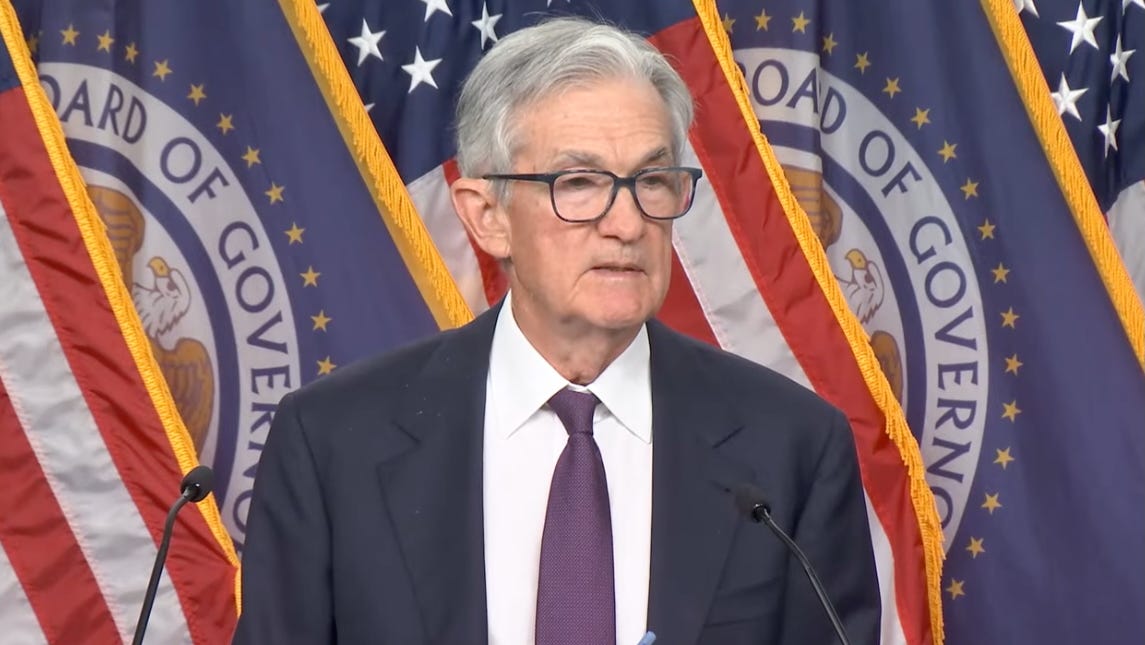
Will a similar reckoning await for the media cone of silence around the chairman of the Federal Reserve, Jerome Powell?
A Republican senator from Florida, Rick Scott, is displaying some courage by standing up to Powell. Scott is no fringe or obscure figure—he’s a former governor of Florida who built a major healthcare company, Columbia/HCA.
“Jay Powell is a trillion-dollar loser, and now he’s spending $2.5 billion on a Fed building?! That’s more than an NFL stadium! The @FederalReserve is out of control, and Powell needs to go,” Scott posted on May 8.
On May 7, Scott posted, “It’s time to put an end to the insanity & instability at the Fed we have seen under Jay Powell’s leadership.” He introduced three bills aimed at reining in the Fed, with a press release that “The Federal Reserve is out of control and has clearly lost track of its mission to provide stability for the American people. Under Chair Powell, we have seen zero accountability, a culture of corruption and questionable ethics, and a complete lack of guardrails to the Fed’s policies that have left the American people dealing with the consequences.”
On May 6, Scott joined with Senator Warren—a Democrat who is typically a media favorite—to call for an inspector general at the Fed who isn’t handpicked by Powell. “The Federal Reserve has been wildly unaccountable for years under Jay Powell’s leadership, who has overseen regulatory failures, allegations of insider trading, and unethical practices at the Fed that have been overlooked and enabled by the Board’s hand-picked Inspector General,” Scott said.
“The Fed makes critical decisions that impact our entire economy—and bank collapses, regulatory failures, and the culture of corruption at the Fed have underscored the urgent need for a truly independent Inspector General to hold Fed officials accountable,” Warren said.
The press has treated the whole story by suppressing it as if it were a pre-election suggestion of Biden senility. When Trump talks about it, it gets covered as “norm-breaking.”
And it’s not only what Warren calls the “culture of corruption” and what Scott rightly points out is the arrogant absurdity of the Fed constructing a palatial $2.5 billion headquarters building. It’s not only the group-think, diminishing the intellectual vitality of the regional Fed banks and replacing them largely with Powell yes-men-and-women.
It’s what appears to be the blatantly partisan monetary policy of a Federal Reserve that was cutting rates into the presidential election, then, once Trump was inaugurated, suddenly stopped the rate cuts and joined the resistance, even though recent Consumer Price Index and Personal Consumption Expenditures and Producer Price Index data has all showed monthly inflation at around zero, below the Fed’s two-percent goal. As Scott Grannis, the Calafia Beach Pundit, points out, M2 money supply is looking good and the April CPI looks good. Now, just in time for the Trump administration, Powell and the Fed are reviewing their whole framework in a way that will essentially make it more difficult to cut rates.
And it’s Powell who is arrogantly telling Congress, publicly, to butt out of monetary policy, even though the Constitution gives Congress the power to coin money and regulate its value. Asked about Congress at a May 7 Fed press conference, Powell replied, “they don't need my advice and our advice on how to do fiscal policy any more than we need their advice on monetary policy.”
It was Powell who started holding those press conferences after every single Fed Open Market Committee meeting. It creates a power dynamic. Powell alone—not the other members of the committee— answers the questions. The reporters want to get called on at the press conference so that they look important to their bosses and get shown on television, which itself is a ticket to career advancement.
Just like the dynamic in the White House press room changed once C-Span started televising the White House press briefings, the televised press briefing has changed the Fed beat from a backwater to a newly glamorous gig. Rather than spawning independent, skeptical watchdog journalism, however, it has generated a pliant Powell fan club.
Maybe one of the Fed press crew will someday write a Jack Tapper-like book retrospectively explaining and apologizing for the cover-up. Until then, you can find Powell- and Fed-skeptical coverage in a few rare spots—the New York Sun, Kudlow and Bartiromo at Fox Business, Jim Grant, John Carney at Breitbart, sporadically at the New York Post. And here at The Editors. Elsewhere, it’s a cover-up.
More on administrative bloat in higher education: After yesterday’s post headlined “Harvard Spends $1.4 Billion a Year on ‘Non-instructional Staff,’” one sophisticated reader of The Editors (a redundancy, because there are no unsophisticated readers of The Editors) wrote to say that the statistics should be “per student.” As with most enterprises some costs are fixed and some are variable. Most of the institutions in the comparison (with the exceptions of the University of Florida, which is a big public institution, and maybe Columbia, which has a large School of General Studies that is somewhat similar to the Harvard Extension School)—have enrollments on the same order of magnitude. But for those who would prefer to analyze the situation on that “per student,” basis, the American Council of Trustees and Alumni has built a nifty site at howcollegesspendmoney.com that lets you look at a measure they call “administrative cost per student.” You can debate whether that is an accurate or useful measure. According to the ACTA, it doesn’t include “student services or academic management.” There is plenty of fat in both those categories.
Another sophisticated reader wrote to observe that “Non-instructional staff” can actually be meaningful contributors to the educational experience of students. I wrote back that I once heard a story—I haven’t confirmed it, and I may have the details slightly off—about a Harvard Business School exam that was one question: what’s the name of the security guard in the building. If you knew it, you passed the exam. If you didn’t, you failed. It is a good point that those people are part of the educational experience. They may have practical wisdom and life experience to impart, and students may benefit from having constructive and respectful interactions with them. However, other institutions appear to be achieving this at a more reasonable expense than Harvard. And some of the ““Non-instructional staff” people are not janitors or security guards who consistently come face to face with students, but are bureaucrats who mainly interact on a day-to-day basis with other bureaucrats.
More on Saudi Arabia and the “neocons”: After the post earlier this week headlined “Trump, in Saudi Arabia, Takes Aim at ‘Neocons’—and Misses,” one sophisticated reader of The Editors (a redundancy, because there are no unsophisticated readers of The Editors) surfaced a couple more examples of American public pressure, or the threat of it, against Saudi Arabia.
Edward Luttwak, under the pseudonym Miles Ignotus, wrote in the March 1975 Harper’s, under the headline “Seizing Arab Oil,” “In the 1930s the craven men of Munich displayed not only an almost complacent defeatism, but also a constant need to justify German demands. Similarly, the modern appeasers have constantly tried to justify Arab oil extortion.” He wrote of “the military dictators and megalomaniac kings of OPEC” and a “peculiar” “redistribution of the world’s wealth”— “Americans are buying smaller cars because sheiks want bigger jets.” Luttwak/Ignotus laid out a detailed plan—Marines, the First Cavalry, staging in Israel—for America to seize the Saudi oil fields militarily. “An occupation of ten years and probably much less would suffice,” he wrote. “It must be done….If we do not do it, future generations will see through our protestations of moral restraint and recognize craven passivity.”
A free, non-paywalled version of the Harper’s article is available via the CIA Reading Room and the Internet Archive.
Also, Daniel Pipes, as Seth Castellani in the Boston Herald-Traveler and Record American, wrote on November 5, 1973, “it is imperative that Americans contemplate the possibility, however distasteful, of exerting military pressure on the oil producing states, especially Saudi Arabia….Of course, one hesitates to use such tactics, but the Arabs have deliberately politicized the oil question and it is not for us to ignore the powerful political options open to us in resolving this issue. We must dispel the preposterous idea that this super-power will allow denial of a vital commodity at the whim of desert sheikhs.”
My point is not that America should have invaded Saudi Arabia then, or that it should now. But we are by far the stronger partner in that relationship. The threat of harsher American action has probably helped to motivate such change as has occurred in the kingdom.
China and the U.S. solar grid: “Rogue communication devices not listed in product documents have been found in some Chinese solar power inverters by U.S experts who strip down equipment hooked up to grids to check for security issues,” Reuters reports. “Over the past nine months, undocumented communication devices, including cellular radios, have also been found in some batteries from multiple Chinese suppliers.”
Using the rogue communication devices to skirt firewalls and switch off inverters remotely, or change their settings, could destabilise power grids, damage energy infrastructure, and trigger widespread blackouts, experts said.
"That effectively means there is a built-in way to physically destroy the grid," one of the people said.
The Reuters piece is reliant on anonymous sources, but it certainly got my attention. People, myself included, complain about the Trump tariffs. There may be non-tariff means of inspiring a transition to electrical equipment manufactured domestically or to equipment manufactured in friendlier countries that doesn’t have the problems of the made-in-China stuff. There may even be ways to get manufactured-in-China electrical equipment that is whistle-clean and that does not function the way the Israeli beepers did with Lebanese Hezbollah. But if you think the tariffs are bad, imagine a widespread blackout generated by a Chinese-initiated destruction of the U.S. power grid. Maybe you’d prefer the tariffs?
More on Saudi Arabia and the “neocons”
Your point is not that America should have invaded Saudi Arabia then or that it should now. OK,
what should we do?
We are by far the stronger partner in that relationship - what strength to do what?
The threat of harsher American action - what action?