


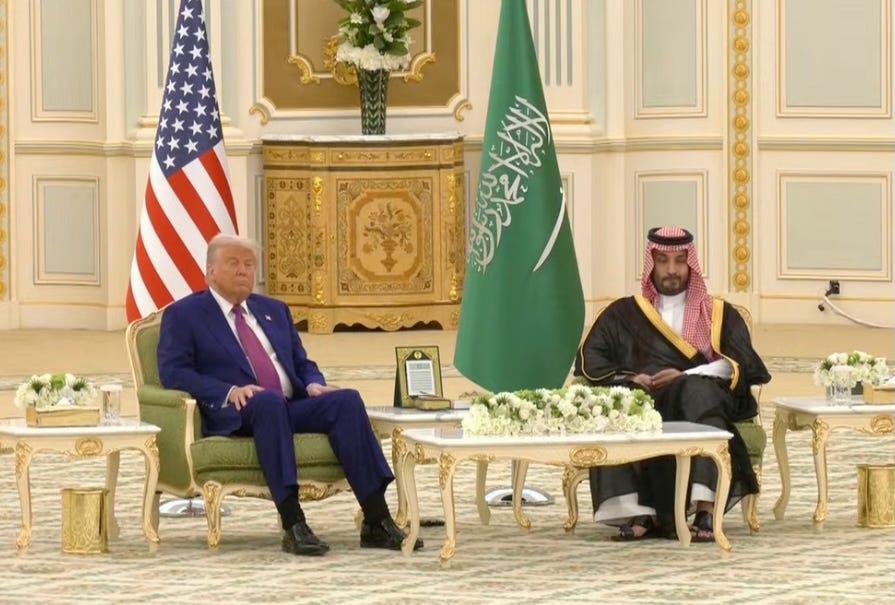
One of the highlights the White House put out from President Trump’s speech today in Saudi Arabia featured the president saying, “Before our eyes, a new generation of leaders is transcending the ancient conflicts of tired divisions of the past and forging a future where the Middle East is defined by commerce not chaos, where it exports technology, not terrorism, and where people of different nations, religions, and creeds are building cities together—not bombing each other out of existence, we don’t want that.”
Trump went on: “It’s crucial for the wider world to note, this great transformation has not come from Western intervention or flying people in beautiful planes giving you lectures on how to live and how to govern your own affairs. No, the gleaming marbles of Riyadh and Abu Dhabi were not created by the so-called nation builders, neocons, or liberal nonprofits like those who spent trillions and trillions of dollars failing to develop Kabul, Baghdad, so many other cities. Instead the birth of a modern middle east has been brought by the people of the region themselves, the people that are right here, the people that have lived here all their lives, developing your own sovereign countries, pursuing your own unique visions and charting your own destinies in your own way….In the end the so-called nation-builders wrecked far more nations than they built and the interventionalists were intervening in complex societies that they did not even understand themselves.”
Set aside the tastelessness of Trump showing up on foreign soil to attack American neocons. In the case of Saudi Arabia, it’s not even really accurate to deny the neocons some of the credit for the changes that are under way. Does Trump really believe that, left entirely to their own devices, without any external pressure or assistance, the Saudis would have modernized as rapidly as they are doing?
Let’s review the record.
In 2002, Hudson Institute cofounder Max Singer published in the Jerusalem Post and in the New York Sun an article proposing to liberate the eastern province of Saudi Arabia.
The left-wing American Prospect reported it this way: “It's also clear that the INC, the neoconservatives and oil executives are thinking beyond Iraq to Saudi Arabia. Ever since Robert W. Tucker wrote an article in Commentary in the 1970s proposing a U.S. occupation of Saudi Arabia's oil fields, such a scenario has been a cherished vision for a small but growing circle of strategists. (Last summer Perle invited a RAND Corporation analyst to speak to the Defense Policy Board on exactly that topic.) Earlier this year, in an article titled ‘Free the Eastern Province of Saudi Arabia,’ Singer suggested that the United States should help create a Muslim Republic of East Arabia. ‘I meant it seriously,’ says Singer. ‘Saudi Arabia is vulnerable not only to a U.S. seizure of their land but to U.S. unofficial participation in a rebellion by minority Shi'a in the Eastern Province.’ The Eastern Province, which is largely Shi'a, happens to include the vast bulk of Saudi Arabia's oil fields.”
A 2007 New York Sun editorial, “A Saudi Strategy,” called the Singer op-ed “one of the most remarked upon we’ve ever run,” and recalled that “He argued for splitting the Eastern Province from the rest of today’s Saudi Arabia — with our help.” The Sun argued “our own view is that the Saudis are more a part of the problem than the solution.” The Sun editorial concluded:
The better strategic line is to support a sustained effort at defeating our enemies in Iraq, work to support democratic, pro-American elements in Iran, and dismantle the Saudi tyranny. Splitting the Eastern Province from the rest of today’s Saudi Arabia would, as a strategic matter, accomplish several aims. Those living there, the liberal open-minded merchant communities who have worked with Americans for decades as well as the oppressed Shiites would welcome a liberation and support it. Among other things, an independent Eastern province could curtain the corruption of the Al Sauds, and it would defund the Wahabi movement.
Nor were the Sun or Commentary or the Hudson Institute the only outlets voicing this point of view.
In 2017, in a “Suggestions to the New Saudi Prince” piece published in the Wall Street Journal and in the “Perspectives” series of Bar-Ilan University’s Begin-Sadat Center for Strategic Studies, Singer advised, “The US should urge the Saudis to drop Indonesia and India from the payroll. That is, the US should suggest to the Saudis that it would be in the interests of both the US and Saudi Arabia for them to quietly arrange that almost no Saudi money going to the export of Salafism be used to pay for imams or mosques in Indonesia or India.” In 2018, Singer wrote, “Many elements of the royal family, certainly including MBS, must be at least ambivalent about their vast program of exporting Salafism. This will be part of the struggle now taking place in Saudi Arabia, and might give the US an opportunity to put pressure on the royal family to drastically curtail the program.”
In 2003, The Weekly Standard published a piece by Max Singer headlined “Saudi Arabia’s Overrated Oil Weapon,” advising, “When American politicians realize that the new facts of the oil industry destroy the basis for the traditional American awe of Saudi oil power, they will begin to use more normal standards in thinking about Saudi-American relations.“
Salon noticed a Wall Street Journal piece by Ralph Peters contending, “We must be prepared to seize the Saudi oil fields and administer them for the greater good. Imagine if, instead of funding corruption and intolerance, those oil revenues built clinics, secular schools and sewage systems throughout the Middle East. Far from being indispensable to our security, the Saudis are a greater menace to it than any other state, including China.”
A 2013 report from Ahmad Majidyar for the American Enterprise Institute, headlined “Saudi Arabia’s Forgotten Shi’ite Spring, reports, “In 2003, Shi’ite and Sunni opposition groups bridged the sectarian gap and launched a series of joint petitions for reform such as the ‘Vision for the Present and Future of the Country.’” It recommended, “the United States must work with the Saudi government to achieve gradual but meaningful reforms.”
Attributing causation in history is always tricky, because the counterfactual scenario doesn’t happen. I suppose it’s theoretically possible that Saudi Arabia would have reformed itself entirely on its own, and on the same timetable, had the terrorist attack of September 11, 2001, not prompted President George W. Bush to place a new emphasis on “draining the swamp” by promoting freedom, democracy, and rule of law in the Arab and Muslim world. But the Saudis are not idiots. They read the newspapers. They know what is being said about them in New York and Washington and Jerusalem. And it’s certainly possible—likely, even—that the threat of intervention helped accelerate the pace of change. The Saudis themselves realized they needed to get ahead of the situation. Otherwise the New York Sun strategy of “dismantle the Saudi tyranny” would be adopted. It might be pushed by America. Or, in a blowback, it might be accomplished by the radical extremist jihadists that the Saudi monarchs themselves had been funding since the 1979 Muslim Brotherhood takeover of Mecca.
Trump, of all people, ought to understand this. He’s in the midst of a high-stakes, $3 billion confrontation with Harvard. Harvard insists it was on the way to making the change on its own. Trump will certainly claim that the change would have happened much more slowly, and perhaps not at all, if not for Trump’s pressure. Saudi Arabia is the Harvard of the Middle East—so well endowed that change frequently seems not particularly urgent. Give Mohammad bin Salman Al Saud, “MBS,” plenty of credit for change in Saudi Arabia, as Trump rightfully did. But don’t neglect the role of Max Singer and of his editors. Trump may mock them as neocons or “interventionalists.” But without their public impatience for more freedom, Saudi Arabia might still be stuck deeper in the dark ages.
I am a bit perplexed by this take, having just listened to Trump speaking about Iran over there today.
https://www.realclearpolitics.com/video/2025/05/13/trump_to_iran_make_your_move_right_now_one_way_or_another.html
I get that it is wrong for Trump to suggest the neocons had no effect, or to drag his issues with the neocons onto the stage he was on in Saudi Arabia. However, it seems to me his praise of the Saudis as having done it all on their own is a smart way to hammer home what he wants and why what they have done, as he puts it, is so fine. Praise can be a form of pressure, too. Meanwhile, his bleak characterization of Iran and his appeal to them to change certainly contains a good amount of real pressure of a neocon sort on them. I only hope he means it about giving them one last chance.