

The New York Times “American Inertia” Series Is a Big Lie
Plus, Jewish MIT professor is murdered in Brookline

In today’s newsletter: a response to the New York Times “American Inertia” series, a publicly pro-Israel MIT professor researching nuclear fusion is shot and killed in Brookline, Mass., and corrections to two of our recent dispatches.
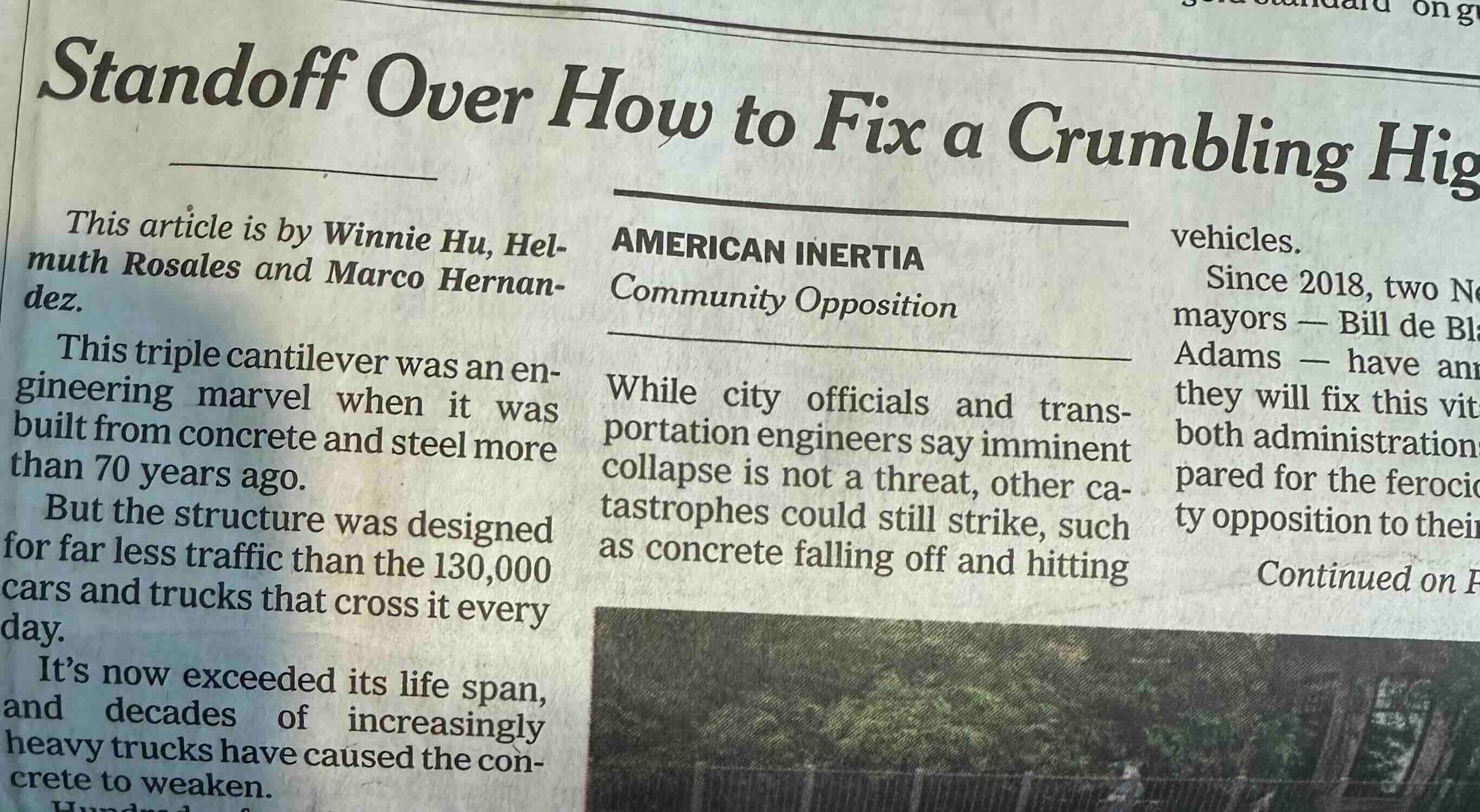
Above the fold on today’s New York Times front pages and jumping to three full broadsheet pages in the front section is the latest installment of a Times series, “American Inertia.” It focuses on a span of highway on the edge of my old neighborhood of Brooklyn Heights. “City officials declared in 2016 that this decrepit cantilever needed to be completely overhauled. It hasn’t happened,” the Times reports, blaming “community opposition.”
Yet the big picture story of Brooklyn Heights and of Interstate 278, the highway also known in this stretch as the Brooklyn-Queens Expressway, or BQE, is not of inertia, but of dynamism.
Here’s what the three-full-pages plus a front-page chunk Times article entirely omits:
In 2019, just seven miles past the section of I-278 that runs beneath the Brooklyn Heights Promenade, a new Kosciuszko Bridge opened to traffic as part of a $873 million rebuilding project.
In 2018, less than 50 miles north the new, almost $4 billion, Mario M. Cuomo Bridge opened to traffic, replacing the Tappan Zee Bridge.
Over the past quarter century, the Dumbo neighborhood neighborhood neighboring the crumbling highway has undergone a building boom generating billions of value (ask the Walentas family or my former New York Sun colleague David Lombino who works for them). The nearby waterfront of abandoned warehouses and deteriorating piers has been built into an 85-acre park that New York magazine described in July 2024 as a “miraculous” “civic masterpiece.”
It’s really a classic display of negativity bias for the Times to describe as “American inertia” highways that have seen $5 billion in two major bridge rebuildings in recent years, along with a stunning new park project and incredible residential real-estate value creation. Even a sentence or two noting these things would have given national and international readers not familiar with the local developments a more accurate and nuanced sense of the reality. The story of the delay-afflicted BQE rebuild may be technically true, but it’s such an incomplete part of the bigger story that it winds up being more fundamentally untrue. By telling only the story of the delay and the inertia and not the story of the accomplishments and dynamism, the Times winds up misleading readers. It oversimplifies the story.
A Times spokesman, Charlie Stadtlander, sent The Editors a statement in response: “The Times’s ongoing series on the persistent challenge of modernizing and rebuilding America’s crumbling infrastructure includes multiple pieces, including a recent one on signs of optimism. The reporting you’re referring to on the Brooklyn-Queens Expressway details a decaying section of roadway more than two decades beyond the duration it was designed for, running through the heart of New York City and carrying 130,000 vehicles each day. The reporting is based on firsthand observations and discussions with engineering experts, government officials and members of the community. Any fair reading of the article should recognize the public service it provides.”
Nor is this the first example of such inaccuracy-by-crude-oversimplification in this Times series. Back on December 3 (“New York Times Pushes Chinese Communist Party Line”), I noted an earlier installment of the same Times series that praised Chinese construction of high-speed rail and train stations without acknowledging that those China rail investments have been so costly and inefficient that even the Chinese Communists are now regretting them and moving in a different direction.
In another part of the Times series, by Michael Kimmelman, that I haven’t yet seen in print, there’s more unskeptical and inaccurate buying into Chinese triumphalism.
Kimmelman writes:
the cost of a mile of interstate skyrocketed, a quarter of that rise because of litigation. Environmental reviews became mandatory and were soon weaponized by NIMBYs and politicians. President Obama’s Recovery Act of 2009 triggered more than 190,000 environmental reviews.
This is at the same time that China began to surpass America in productivity. Its autocratic government required citizens to meet goals and make sacrifices for material gains.
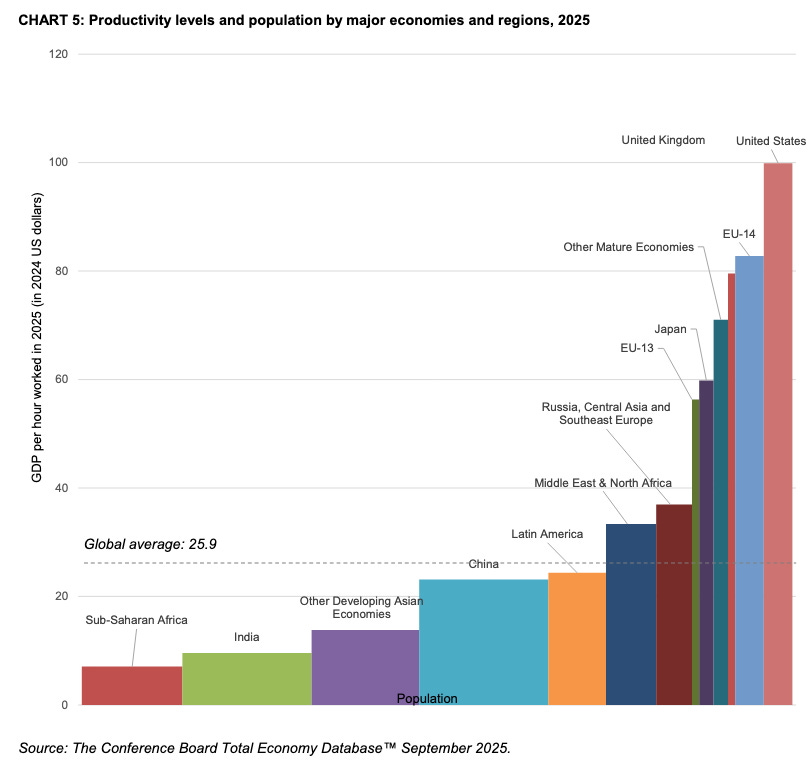
The claim that “China began to surpass America in productivity” is false. It echoes a false claim by the executive editor of the Times, Joe Kahn, that “today, it’s obvious China has taken the lead” over other East Asian countries and the West. The International Labor Organization compiles data on labor productivity, measured in GDP per hour worked. The U.S. is at $81.80, while China is down in the basement at $20.60. That’s using China’s exaggerated and overstated official statistics. The Conference Board says a person employed in China produces about 29 percent of what a person employed in the U.S. does. Here is a bar graph from the Conference Board showing GDP per hour worked in the U.S. versus other countries, including China:
The Times should run a correction of the inaccurate claim about China surpassing America in productivity. The inaccuracy of describing as “inertia” the dynamism of the New York bridges and the surroundings of Brooklyn Heights is less easily corrected, but something—maybe an editor’s note—is probably still warranted.
Jewish MIT professor researching nuclear fusion is shot and killed in his Brookline home: Local and international news accounts have reported on the fact that an MIT professor, Nuno Loureiro, who was researching nuclear fusion, was shot and killed in his apartment building last night in Brookline’s Coolidge Corner neighborhood. The Editors understands that Loureiro was Jewish. The Editors has obtained and is sharing here a social media post of an account that appears to be the professor defending Israel.

It’s worth noting also that the Brown University exam review session that got shot up was of a Jewish professor, Rachel Friedberg, who had taught at Hebrew University in Jerusalem. It’s possible it’s just a coincidence or that the shootings were unrelated to the Jewish identity or Israel connections of the professors. But it is concerning nonetheless. It’s possible the social media account belongs to someone else with the same name and a similar nose who is not the MIT professor. (In fact, since this post was published, I have heard from MIT media relations to that effect.) But if it fooled me, it could also have fooled a potential assailant.
Corrections: Kevin Roberts is president of the Heritage Foundation. Initial versions of our December 14 post got his first name incorrect.
The financial aid program is only one among many factors affecting what is happening at the Crimson, and there’s no way to tell for sure how much, or if at all, it is at fault for the state of that newspaper. Yesterday’s post was updated after publication with that observation based on reflection and reader feedback.
Chinese productivity is likely higher in things like building roads or bridges even if overall productivity is lower at a national level. I think people worry about the output gap in being able to make things.
May I ask what is the Crimson financial aid program?