

Robert J. Samuelson, 79, Independent-Minded Columnist
Warned of entitlement costs

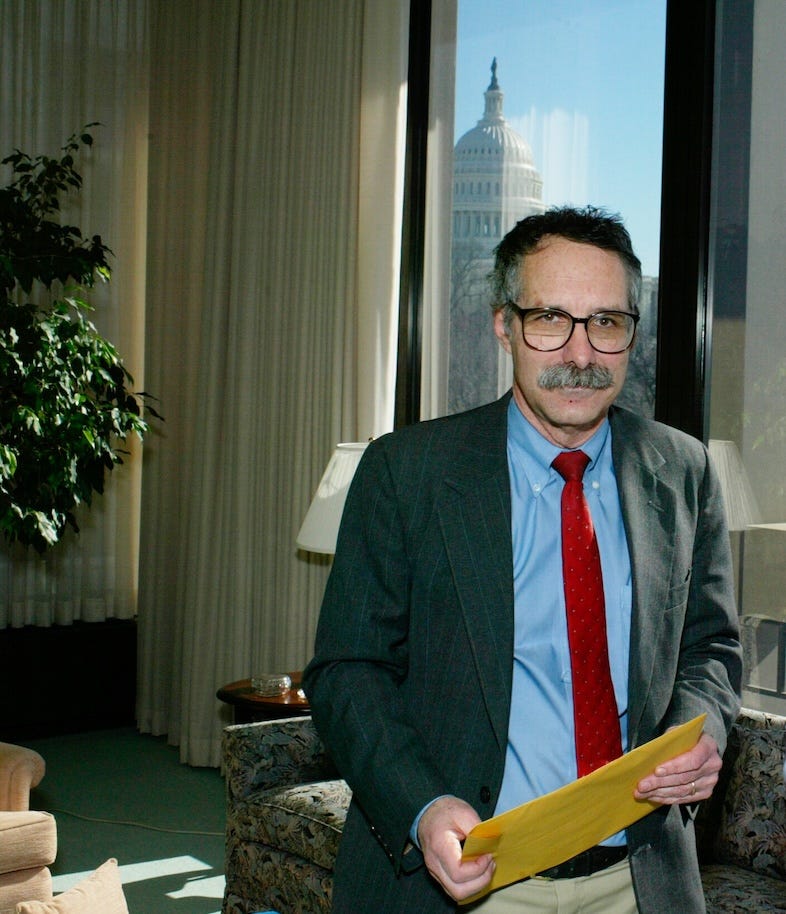
When, in October 2004, the New York Sun, of which I was then vice president and managing editor, struck an agreement with the Washington Post Writers Group to carry the column of Robert J. Samuelson, the agreement letter described Samuelson as “a columnist who helps readers comprehend swarms of facts, figures and conflicting claims in political, economic and social issues.” The Washington Post Writers Group expressed hope that “Mr. Samuelson’s ability to cut complicated debates down to reasoned ideas and common sense will attract readers to your newspapers and will help your circulation grow.”
Samuelson certainly delivered on the reasoned ideas part of the bargain. After learning this morning of his death, I went back to look at some of the columns. They hold up pretty well for 20-year-old newspaper essays—admirable for their independence of mind, for their attention to “dull but important” issues and their ability to make them less dull than they would be in less skillful journalistic hands. He was good at piercing through the spin and getting to the facts and the truth.
On entitlements, from January 12, 2005: “What’s discouraging is that, along with most Republicans and Democrats, many ‘experts’ and pundits also evade the hard questions. Their purpose is mainly to condemn or cheer Mr. Bush. The debate we need involves generational responsibility and obligation. Anyone who examines the outlook must conclude that, even allowing for uncertainties, both Social Security and Medicare benefits will have to be cut. We can either make future cuts now, with warnings to beneficiaries; or we can wait for budgetary pressures to force abrupt cuts later, with little warning.”
On gender differences and Larry Summers, from January 26, 2005: “Everyone knows there are differences between men and women, boys and girls. But let someone allude to these differences, particularly a man in a way possibly unfavorable to women, and he’ll get slammed by the sledgehammer of political correctness. He’ll be denounced as sexist, reactionary, and insensitive. Too bad. The differences need to be discussed, because they matter for government policy – especially concerning schools, jobs and families. Likewise, only open discussion can dispel ill-informed stereotypes.”
On the federal budget, from February 16, 2005: “Americans dislike deficits but dislike them less than the alternatives – higher taxes or lower spending. There’s a quiet clamor for hypocrisy and deception; and pragmatic politicians respond with massive borrowing schemes that seem to promise something for nothing.”
On the failings of journalists, from February 23, 2005: “journalists need to measure politicians’ promises against underlying realities, as represented by numbers. But many reporters detest math.”
On CEOs and management, from April 13, 2005: “the obsessive drive to improve profits, though cold-blooded, also creates often-overlooked social benefits. It’s not simply that growing profits bolster the stock market or finance new investment. The broader point is that advancing productivity – a fancy term for efficiency and a byproduct of the quest for profits – is the wellspring of higher living standards…A vibrant economy requires someone to screen out inefficiencies and promote change. In the 1980s, U.S. companies were compared unfavorably with Japanese and German rivals that supposedly focused more on the ‘long term.’ In reality, the ‘long term’ was often an excuse to stand pat. The American economy has done better – achieved higher living standards, adapted more smoothly to change – in part because most CEOs faced problems when they arose and didn’t wait for the long term.”
One of the favorite Samuelson columns I came across in my reading was one from 2019, a sensible response to an overly negative column from David Brooks. “You seem disappointed that we haven’t arrived in some Garden of Eden paradise where almost everyone is happy, fulfilled, responsible and respected. I yearn for this as well, but I have reconciled myself to the inevitability of imperfection….We have a culture of complaint…. There is no virtue in feeding this frenzy of pessimism, just because it fits the temper of the times. We need to recognize the limits of our condition. Many legitimate problems can’t be solved, and some problems aren’t worth solving….let’s keep perspective. We don’t live in an ideal world and never will. But things could be worse, maybe quite a bit worse.”
In 2012 Samuelson had a column describing President Obama’s rejection of the Keystone XL pipeline as “an act of national insanity.” In 2010 he described ObamaCare as “the illusion of reform.” In May 2012 he wrote, “The college-for-all crusade has outlived its usefulness. Time to ditch it. …it’s now doing more harm than good….We overdid it. The obsessive faith in college has backfired.”
Writing in November 2008 about Samuelson’s book “The Great Inflation and Its Aftermath: The Past and Future of American Affluence,” David Warsh said, “The Great Inflation of the second half of the twentieth century, he says, was mainly a story of expert opinion gone awry. … The implicit moral Samuelson draws from the story in The Great Inflation and Its Aftermath is, Don’t Trust the Experts. They screwed up before and they will do it again.”
Robert Samuelson wrote a lot about the limits of expert knowledge, but along the way he became an expert himself in understanding and explaining how America and its institutions work.
I had a phone call with Samuelson in 2022 or 2023. He’d already stopped his Post column and had Parkinson’s Disease. It was after the Harvard Crimson, of which he and I had both been president, endorsed a boycott of Israel. I described the conversation shortly afterward in a wire to a friend:
“There is a former Crimson president named Robert J. Samuelson who was a columnist for the Washington Post who predicted when the Crimson began its financial aid program that it would ruinously change the institution. Everyone thought he was nuts. Samuelson now has Parkinson’s but I called him up the other day to tell him that unfortunately he was correct.” (Upon reflection and based on reader feedback, it is important to note that the financial aid program is only one among many factors affecting what is happening at the Crimson, and there’s no way to tell for sure how much, or if at all, it is at fault.)
The change at the Crimson is a small part of a bigger story about a changing media environment. Samuelson made a living mainly at Newsweek and the Washington Post, where his contributions, though valued and significant, were just a small part of a big package value proposition for paying customers. Would there have been a sustainable solo market for Robert J. Samuelson’s “keep perspective…things could be worse” message in today’s “culture of complaint…frenzy of pessimism” world? Samuelson never had to find out, but as one of a small number who ever paid (via the New York Sun-Washington Post Writers Group deal) directly just for his column, I myself was a satisfied customer. My own sense of it is that with Samuelson, as with so much in media and in markets, a lot of the value was the independence.
Thank you: The Editors is a reader-supported publication that relies on paying customers to sustain its editorial independence. If you know someone who would enjoy or benefit from reading The Editors, please help us grow, and help your friends, family members, and associates understand the world around them, by forwarding this email along with a suggestion that they subscribe today. Or send a gift subscription. If it doesn’t work on mobile, try desktop. Or vice versa. Or ask a tech-savvy youngster to help. Thank you to those of who who have done this recently and thanks in advance to the rest of you.