

Surprise!
Reaction to inflation number tells more about media than markets. Yet sinking prices can carry downside risks.

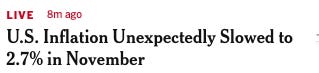
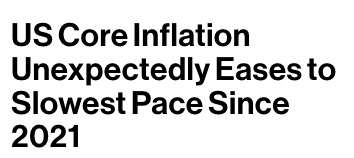
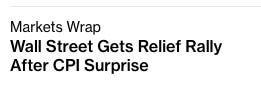
Instead of just reporting the government’s inflation data, the press made the supposedly unexpected nature of the results part of the story. “U.S. Core Inflation Unexpectedly Eases to Slowest Pace Since 2021” was one Bloomberg headline I saw yesterday morning. “Wall Street Gets Relief Rally After CPI Surprise,” was another from Bloomberg. The New York Times homepage headlined “U.S. Inflation Unexpectedly Slowed to 2.7% in November.”

Whose expectations are we talking about here? Who was surprised?
Expectations of the markets? Stocks were up slightly, but there were no wild gyrations in either stocks or bonds.
Expectations of economists? One of the observations Harvard’s Aetna professor of the practice of economic policy, Jason Furman, who was chairman of the Council of Economic Advisers during the Obama administration, made at the recent “After Neoliberalism” conference in Harvard’s David Rubenstein Treehouse is that very few economists under 45 have ever voted for a Republican for national office. For academic economists at “flagship colleges,” a 2020 study from the National Association of Scholars found Democrats outnumbered Republicans in party registration by a 3 to 1 ratio, and Democratic donors outnumbered Republican donors by a 17 to 1 ratio.
That matters, because as the famous Apollo chart on Inflation Expectations by Political Party shows, inflation expectations vary widely depending on political leaning.
If you read Breitbart or watch Maria Bartiromo’s show on Fox Business or follow Trump administration accounts on X, you’d know that Treasury Secretary Bessent is out there citing a Wharton study about how immigration influences rents, suggesting that controlling immigration is helping to bring down rents, which are part of inflation.
Nor is Trump-Vance-Noem immigration enforcement the only public policy factor at play. On the Democratic side, two of the biggest forces are Mayor-Elect Zohran “Freeze-the-Rent” Mamdani of New York City and New York Times Opinion video podcaster and author Ezra Klein, a proponent of “Abundance”—that is, increasing housing supply by reducing regulatory barriers to density and new construction. Some advocates also want to make eviction harder, so the landlord can’t throw out the tenant who isn’t paying the frozen rent. Between rents and imputed rent of owner-occupied housing, shelter is a big part of the inflation story.
Scott Grannis, the Calafia Beach Pundit, whose insights are available without paying to rent a Bloomberg terminal or to be a customer of Goldman Sachs, said it back in September: “there is little or no reason to worry that inflation is coming back to haunt us.” I said it here at The Editors back in August: “Rent Prices Fall, in Sign Inflation Is Receding.”
Also not surprised is Steve Schwarzman of Blackstone. Here he was on CNBC yesterday:
CNBC: the CPI data. It was much lower than most people had anticipated. Not lower than you were thinking, but you’re finally seeing the print of what you’ve been talking about for a time that inflation is less than than the numbers are kind of showing.
Schwarzman: Yes. Well, we’ve been quite public. When you go public and say things are going a different way than the rest of the world, you I guess you’re at some intellectual risk of some type. But we understood that the real estate component which is about a third of CPI was being measured in a way that was inconsistent with what we were seeing happening on the ground. And even still the numbers that are being used as part of CPI are still much too high in real estate inflation. And if you adjusted it, we’re actually quite close to 2%. So I think the Fed has in effect done its work, and I’d look forward to other cuts now. … the way the Fed measures they actually get to that number but it takes them 9 months to a year. We live in the real world where you have to get there right away.”
The Apartment List National Rent Report for December 2025 found “The national median rent fell 1.0% in November, and now stands at $1,367. This was the fourth consecutive month-over-month decline…Rent prices nationally are down 1.1% compared to one year ago. Year-over-year rent growth has been slightly negative for over two full years, and the national median rent has now fallen from its 2022 peak by a total of 5.2%....The national multifamily vacancy rate remains at 7.2% this month, a record high for our index. We’re past the peak of a multifamily construction surge, but a healthy supply of new units are still hitting the market and colliding with sluggish demand, causing vacancies to continue trending up.”
These numbers may even overstate rents (and understate the decline), because it’s hard to measure incentives like landlords offering new tenants incentives of up to $10,000 in furniture from Jordan’s Furniture (owned by Warren Buffett’s Berkshire Hathaway). Or no longer asking for security deposits or last month’s rent.
It’s good news for renters and for those hoping the “too late” Fed will keep easing rates, but it is not great news for owners of apartment buildings or for the banks or other lenders who financed them. Pimco and the Witkoff Group “are in default on a $400 million-plus loan tied to a luxury apartment complex in Santa Monica, California,” Bloomberg reported this morning. Wharton also has a September 2025 research paper headlined “Too-Many-to-Ignore: Regional Banks and CRE Risks.” (Check out Table 5, “Characteristics of Bank at Risk of Becoming Undercapitalized.” The banks aren’t named, but the assets and regions are given with enough specificity that you don’t have to be Sherlock Holmes to identify the institutions. I hope the risk is avoided.)
A cascade of multifamily housing loan defaults, putting stress on lenders, could be a “surprise” of an unpleasant variety. The Wall Street Journal’s Jason Zweig has a smart piece about what this means for asset values in private funds such as Bluerock Private Real Estate Fund. As Zweig put it, “For every dollar the fund manager said your shares were worth at 9:30 a.m., the stock market was willing to pay you only 60 cents by 4 p.m.” Imagine if a similar repricing based on mark-to-actual-liquid-market rather than pretend-private-valuation hit university endowments.
The press and the Federal Reserve have been focused on the risk of inflation, but inflation is not the only risk. A couple of the regional Fed banks have done bits of research about banks’ commercial real estate risks, but the work, from the Kansas City Fed and the St. Louis Fed, is focused on commercial real estate generally, driven by concern about post-pandemic downtown office buildings, not so much on multifamily rental housing. Where’s the intellectual vitality and research rigor? If the next big economic story comes as a “surprise” to the headline writers or to the central bank economists—well, it may not be such a “surprise” to those who know the pattern that the expectations of the so-called experts are useful often primarily as a contrary indicator.
Thank you: Read The Editors and avoid being surprised when the “experts” get it wrong.
How about factoring in meat and electric power price increases?
Really good stuff, Ira. Great reporting!