

Rent Prices Fall, in Sign Inflation Is Receding
Plus, New York Times falls for Crimson spin; Nuclear fusion deal

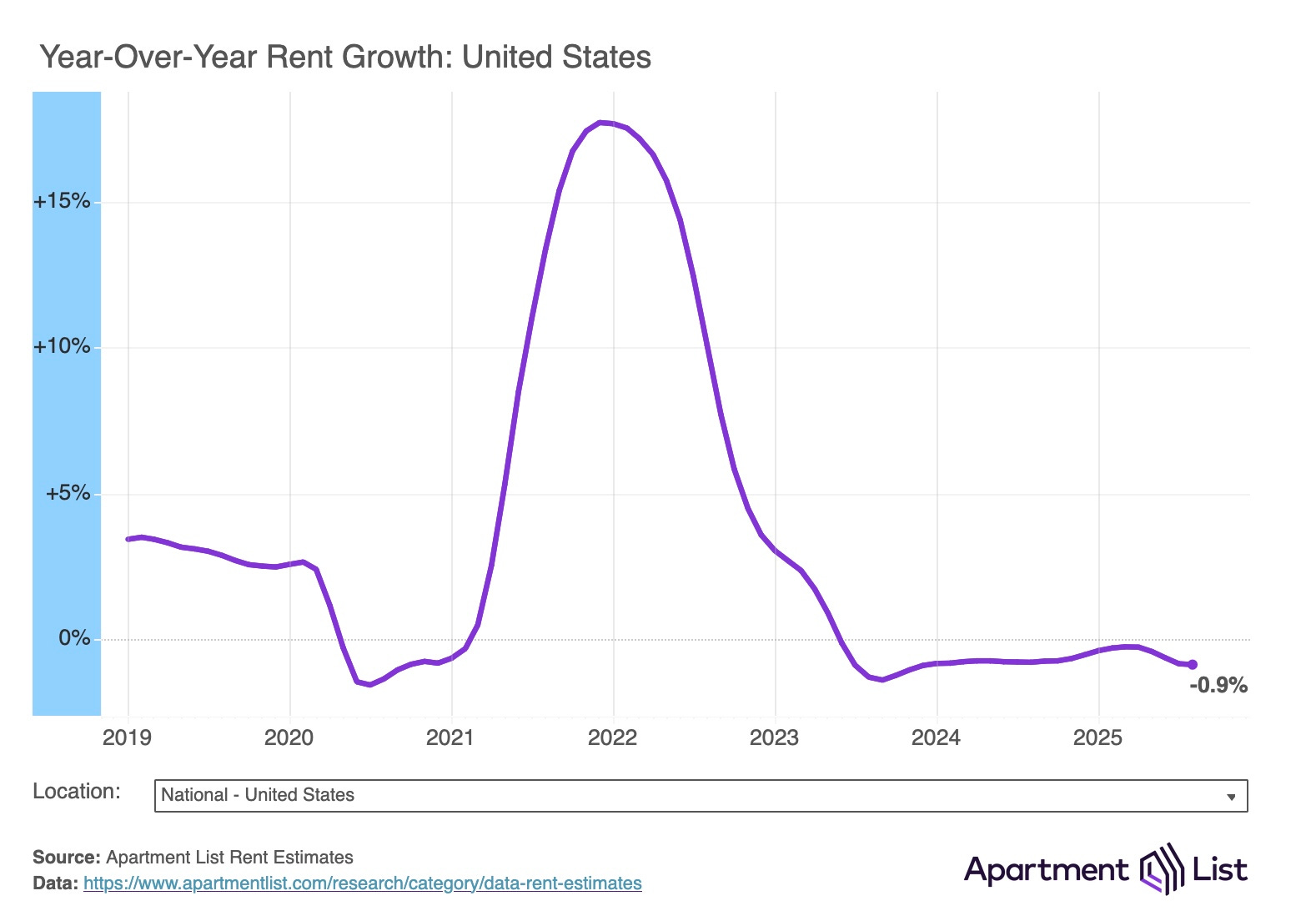
The government is scheduled Friday morning August 29 to release its personal consumption expenditures price index data for the month of July. But in a sign of how private data providers are faster and sometimes more accurate than the government, there’s already private data available for the month of August—and it shows “The national median rent dipped by 0.2% in August…Rent prices nationally are down 0.9% compared to one year ago.”
The September 2025 Rent List National Rent Report reports “the national multifamily vacancy rate now sits at 7.1%, record high for our index.”
“All of our key indicators are pointing toward ongoing sluggishness in the multifamily rental market – rent growth is slipping and the vacancy rate is at an all-time high,” the report says.
Socialist Democrat Zohran Mamdani is running for mayor of New York on a platform of freezing rent. Yet in places that, unlike New York, don’t suffer from already government-controlled prices and immense barriers to new construction, market adjustments—the ordinary working of supply and demand—are effectively freezing rents anyway.
Shelter—both rent and “imputed rent” of owner-occupied housing—makes up a lot of the government inflation numbers, so if the Rent List data are accurate, it could help drive inflation below the Federal Reserve’s 2 percent target, or at least closer to it, and strengthen the case for cutting interest rates, as President Trump has been asking the Fed’s Open Market Committee and its chairman Jerome Powell to do. Trump calls Powell “too late,” arguing that he’s been too slow to respond to changing economic conditions.
The rent numbers may understate the softness in the rental market because it’s hard to accurately account for all the incentives that landlords are offering. For example, in the Boston area, Chestnut Hill Realty is offering new tenants incentives of up to $10,000 in furniture from Jordan’s Furniture (owned by Warren Buffett’s Berkshire Hathaway). It’s also no longer asking for security deposits or last month’s rent. It’s unlikely that the government captures those changes in the rent data.
New York Times falls for Crimson spin: “How We Brought Respectful Debate Back to The Harvard Crimson’s Editorial Board,” is the headline over an August 26, 2025 New York Times opinion piece by Tommy Barone and Jacob Miller. The opinion piece praises the “principled” and “powerful” and “thoughtful” editorials that they published. If there were a Pulitzer for self-congratulation, these guys would get it.
While claiming credit for bringing “respectful debate” back to the campus, they’ve kept the comment function turned off on the Crimson website, effectively silencing the readers who used to point out the errors and biases. Compare that to the Chicago Maroon, which publishes moderated reader comments.
Barone was one of the students featured in “Harvard Rewarded Nine More Anti-Israel Activists With Prestigious Fellowships,” which pointed out that writing for the Crimson, he asserted, “Israel is committing atrocities in Gaza” and asserted, “there is nothing innately radical about protesting the indiscriminate violence Israel is inflicting on the Palestinian people. It’s the opposite, actually — you would be hard-pressed to find an injustice more unambiguous, more immediately persuasive, than the live-time, live-streamed mass death of over 13,000 children.”
Respectful debate? More like a blood libel.
Barone also wrote, “a bastion of antisemitism Harvard was and is not….I believe that the concerns about antisemitism are massively overstated.”
Respectful debate? More like a combination of a cover-up and denial.
The last time the Crimson published data, in 2023, the staff was 1.8 percent conservative, versus 77.7 percent liberal, leftist, or progressive. (Data from 2021 and 2020 are here). The idea that any institution that far off-kilter is an example of respectful debate is the sort of delusion that passes for Veritas in Cambridge these days.
These are (or were) student journalists, and because of that, I generally try to avoid picking on them in public. Miller I have had some dealings with and generally like, and his mother I know from college (find a Jewish student at Harvard who isn’t a legacy admit). Probably he did modestly improve what had been a total disaster.
But I read the Crimson editorial and opinion column or at least look at the headlines and basically it’s been taken over by Harvard faculty, mainly the left-wing ones. There was an idea that this was going to provide an example for the students of how to respectfully debate, but it wound up as a substitute for it, crowding out student voices and turning professors into opinion-writers rather than scholars. The student columnist roster reads like a parody of campus wokeness from the peak of the Black Lives Matter era. The editorials are ponderous, sophomoric, and excessively earnest. Like almost everything and everyone else at Harvard (including the alumni, and present company, too) they could benefit from some more humility.
Commonwealth Fusion raises $863 million more: Commonwealth Fusion Systems announced this week it raised an additonal $863 million “as it moves closer to being the first in the world to commercialize fusion power.”
Bob Mumgaard, CEO and Co-founder, described it as “a new technology that promises to be a reliable source of clean, almost limitless energy.” New investors included Stanley Druckenmiller. Existing investors included Google, Laurene Powell Jobs’s Emerson Collective, and Bill Gates’s Gates Frontier. The press release includes a longer list of investors and says the money will be used to complete a fusion demonstration machine in Devens, Massachusetts and to advance development of a power plant in Virginia.
There’s a lot of attention paid to how Trump’s tariffs and other policies will supposedly hurt wind and solar, but nuclear fusion is quietly moving ahead. It’s a sign that not all the energy story of the Trump era is “drill baby drill.” There may be more action on alternatives than people think. It’s speculative, but one reason so much money is behind it is that if it works, it’d be a very big deal. File it under “news that wasn’t on the front page and maybe not in your newspaper at all but could turn out to be pretty important.”
Thank you! Please forward this email to anyone you think should read it. They can sign up here. Or give a gift subscription.
I think the Fed has a tough job and there are a broad mix of variables pointing in different directions. https://www.employamerica.org/core-cast/july-2025-core-cast-post-pce/. And I also think people are forgetting that the Fed moving the rate does not have a direct impact on residential or commercial mortgages because it happened all the way back in 2024.
I regret to inform readers of The Editors about the status of the ability to enable comments on Harvard Crimson articles by changing www in the URL to api.
This no longer works.