

Harvard Adds Jeffrey Epstein’s Banker to Endowment Board
Drop from peak on university's Bitcoin bet may exceed $100 million

In today’s newsletter: the Harvard endowment, new data showing a U.S. religious revival, and a correction on the definition of the word “odious.”
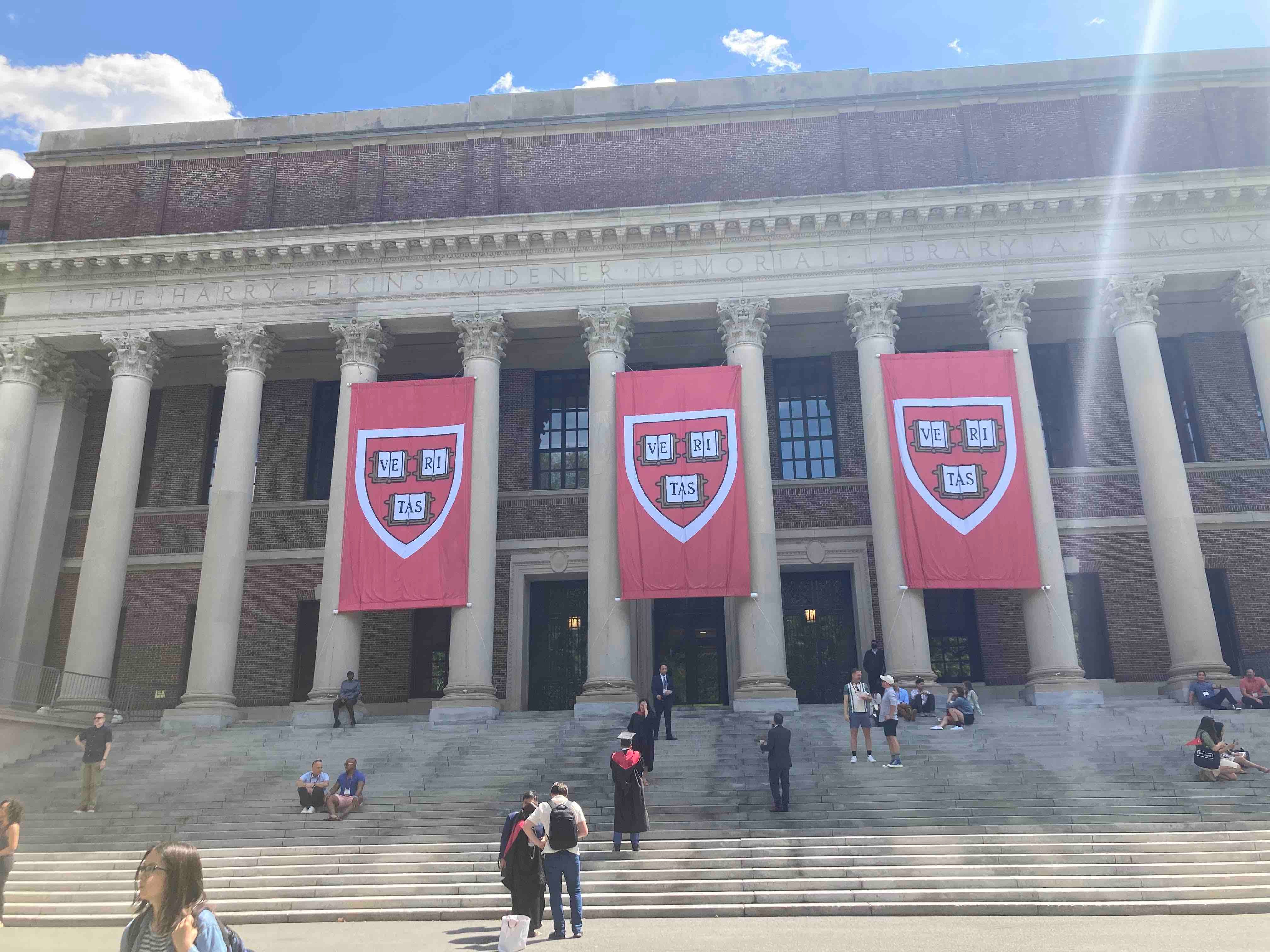
How’s this for the juxtaposition of the day?
From a November 19, 2025 memorandum to Senator Wyden, the top Democrat on the Senate Finance Committee, from his senior investigator, subject, “JPMorgan Chase & Co. underreported Epstein’s suspicious transactions to the U.S. government and should be the subject of further investigation”:
Top JPMC executive Mary Erdoes was in constant contact with Jeffrey Epstein.
On October 10, 2025, JPMC wrote a letter to the Finance Committee in response to your inquiry which stated, in part, that “with the exception of Jes Staley”, JPMC’s executives “acted with integrity” with regard to the handling of Epstein’s accounts. However, unsealed records show that several JPMC executives reporting directly to CEO Jamie Dimon closely supervised the bank’s relationship with Epstein.
Unsealed emails indicate that Mary Erdoes, JPMC’s CEO of Asset & Wealth Management and a member of the bank’s operating committee, maintained regular contact with Epstein and kept close tabs on him while he was a client of the bank. Many of these communications were often highly personal in nature and reflect a close relationship between Erdoes and Epstein.
For example, in 2006, Erdoes corresponded with an ultra-high net worth client of JPMC who was seeking her “help in lining up a meeting with Epstein.” Erdoes replied to this individual that she would be “calling him tomorrow” in reference to Epstein. An unsealed email summary produced by JPMC also identified dozens of emails between 2010 and 2011 where Epstein and Erdoes were in near constant contact and discussed numerous business initiatives. Among the things Erdoes and Epstein worked on together was a multi-million dollar settlement for Epstein and a series of potentially large projects for Bill Gates.
In one email on July 10, 2011, Epstein writes to Erdoes “There are 21 million reasons I’d like to know when you return.” A few hours later, Erdoes replies that she is traveling to Europe but available, to which Epstein immediately replies “Can we speak today.”
Similarly on May 24, 2011, after Epstein had requested Erdoes attend a meeting with him, Erdoes replied apologetically that she was unavailable because she was in an operating committee meeting with JPMC CEO Jamie Dimon:
“I am so sorry but I am just seeing this, having been in an all day OC with Jamie. I hope the meeting went well. I’m anxious to hear.”
In addition to the constant access Epstein appeared to have to Erdoes, some of Epstein’s emails to Erdoes were clearly unprofessional and inappropriate. On August 2, 2011, Erdoes administrative assistant sent Erdoes a note saying that Epstein “Called from Paris. He thought you’d appreciate that he just got out of the pool at the Ritz.”
The unsealed emails reveal that Epstein contacted Erdoes so often that Jes Staley in 2011 had to tell Epstein to “stop pushing” Erdoes. In response to Staley’s directive, Epstein responds to Staley “On Mary Erdoes, I will ease off, I thought I was following plan.” Erdoes, however, still seemed keenly interested in continuing to nurture the relationship with Epstein. The email log shows that Erdoes wrote to Epstein on January 20, 2012 to wish him a happy birthday:
Erdoes: “Not sure where you are celebrating it, but I hope you have a great birthday weekend.” Epstein replies: “Thanks, Boris said you were terrific.”
Erdoes was also intimately involved in deliberations related to Epstein’s purported work on behalf of billionaire Leon Black. In, July 2012 email, Erdoes forwarded a note from JPMC’s CEO of the Private Bank John Duffy to Jes Staley, incredulously pointing out the absurdity of Epstein serving as an intermediary for Black.
In addition to the recently released emails, internal due diligence reports prepared by JPMC bankers also make clear that Erdoes was closely involved in managing the bank’s relationship with Epstein. A February 09, 2013, due diligence report on Epstein initiated by JPMC’s private banking division noted that “Epstein’s total assets over $100 million. Both Mary Erdoes and John Duffy are aware of the relationship.”
From a November 25, 2025 announcement in the official Harvard Gazette:
Harvard Management Company (HMC) announced that Paul Edgerley, M.B.A ’83, Mary Erdoes, M.B.A. ’93, and Raymond McGuire ’79, J.D./M.B.A. ’84, have been elected to join its Board of Directors…..Mary Erdoes is CEO of J.P. Morgan Asset & Wealth Management business, with more $7 trillion in client assets, and a member of the JPMorganChase Operating Committee. Erdoes began her career at J.P. Morgan more than 25 years ago and held a number of senior roles across the Asset & Wealth Management division prior to her appointment as the division’s CEO in 2009…HMC’s Board is appointed by the Harvard Corporation (also known as the President & Fellows of Harvard College) to oversee management of the University’s endowment portfolio.
McGuire, it must be said, is a strong player, and Edgerley has done Boston a service by taking over the old Algonquin Club and remaking it as the less stodgy ‘Quin. They will have their work cut out for them; the Harvard Management Company can use all the high quality help it can get.
Epstein is a sensitive issue for Harvard because he had an appointment as a “fellow,” an office on campus, and reportedly gave the university more than $9 million.
Harvard’s most recently filed form 13F report with the Securities and Exchange Commission lists as its largest holding 6,813,612 shares of the iShares Bitcoin Trust ETF, valued at $442,884,780. Since then, the price of the ETF, which trades under the symbol IBIT, has plummeted from the $65 a share close on September 30, 2025 to about $50 today, a decline of about 23 percent, meaning that, if Harvard held onto the shares, the endowment’s paper losses on Bitcoin from the peak may have exceeded $100 million. You can say that’s trivial relative to Harvard’s overall endowment of $50 billion or $60 billion. I’m giving that overall endowment as a range, because a lot of it is in private equity or venture funds and so the valuations can sometimes be more aspirational than on a publicly traded stock or ETF. You can say also Harvard has already made money on the investment on the way up, and that it may recover in the future to new heights. But remember too that Harvard is borrowing money (some of it on a tax-exempt basis via the state of Massachusetts), some of it on a taxable basis, and that the money is fungible. If a family member took out a big loan and gambled on Bitcoin and was down $100 million, you might consider it irresponsible and get annoyed. Plenty of other institutions—MIT, Dartmouth—reported no crypto holdings in their SEC filings.
I can see both sides of the argument on crypto. In favor, you have a Trump administration with a pro-crypto regulatory policy and some indications of a weak-dollar policy, and the possibility of essentially libertarian private money that is more credible than whatever the Fed is backing. Opposed, you have the fact that unlike many stocks it’s generating no earnings or yield, no dividends or operating profits, and some of the apparent utility relates to allowing criminals and sanctioned entities to avoid law-enforcement accountability.
As for Erdoes and Epstein, my view of the Jeffrey Epstein story has been much closer to the David Brooks camp:
Why is Epstein the top issue in American life right now? Well, in an age in which more and more people get their news from short videos, if you’re in politics, the media or online it pays to focus on topics that are salacious, are easy to understand and allow you to offer self-confident opinions with no actual knowledge.
But the most important reason the Epstein story tops our national agenda is that the QAnon mentality has taken over America. The QAnon mentality is based on the assumption that the American elite is totally evil and that American institutions are totally corrupt….To Candace Owens, Epstein was not just a rancid man; he was a scheming Jew working on behalf of Israel to control assets via blackmail.
Conspiracy thinking is always present at the fringes of society.
…
I know a thing or two about the American elite, ahem, and if you’ve read my work, you may be sick of my assaults on the educated elites for being insular, self-indulgent and smug. But the phrase “the Epstein class” is inaccurate, unfair and irresponsible. Say what you will about our financial, educational, nonprofit and political elites, but they are not mass rapists.
Or to the Matthew Schmitz camp: “At the heart of the Epstein myth is the idea that an international conspiracy, notably involving Jews, relies on the destruction of innocence and the practice of blackmail to advance its power. This tradition presents sexual abuse of minors as a typically Jewish crime, an assault on innocence that amounts to ritual murder….The idea that our elites are united in a pedophilic cabal has several recent precedents, including the satanic panic of the 1980s and the QAnon phenomenon during the first Trump term. But to understand the full significance of this exchange, one must revisit the history of the blood libel.”
(For a more negative point of view, see Peggy Noonan or Anand Giridharadas).
What appears to be happening is that if you are a pro-Israel Jewish man who kept some ties with Epstein (Larry Summers, Alan Dershowitz) you get canceled, while if you are Mary Erdoes, as far as Harvard is concerned, there is no problem. It’s a double standard. I emailed a spokesperson for the Harvard Management Company to ask whether Harvard had any concerns about Erdoes and Jeffrey Epstein. I got no response. As the memo to Senator Wyden says, JP Morgan Chase’s position has been that no one at the bank other than Jes Staley did anything wrong. The bank paid a $290 million settlement to Epstein’s victims and $75 million settlement to the U.S. Virgin Islands while crediting Erdoes for eventually dropping Epstein as a client. So far, Erdoes has been doing a great impression of her predecessor as a banker and high-end Harvard volunteer, Robert Rubin—dancing through the raindrops.
U.S. Religious Revival: For some time here we’ve been predicting and noting signs of a religious revival or great awakening.
A few recent data points:
A November 18 Christian revival event at Clemson University in South Carolina drew 6,000 students, “At the end of the service, hundreds of members of Gen Z publicly professed their faith in Christ – many of them staying around to get baptized in portable tanks,” the Lion reports. “This fall alone, UniteUS events have drawn 5,500 students at the University of Cincinnati; 6,000 students at North Carolina State; 7,000 at Grand Canyon University; 8,000 at the University of Tennessee; 7,000 at the University of South Florida; and 9,000 at the University of Oklahoma. Thousands have made professions of faith – and countless college students have been baptized.” If this had happened at Columbia in New York City rather than Clemson it would be front page news, but the press tends to ignore a lot of things that don’t happen in coastal cities.
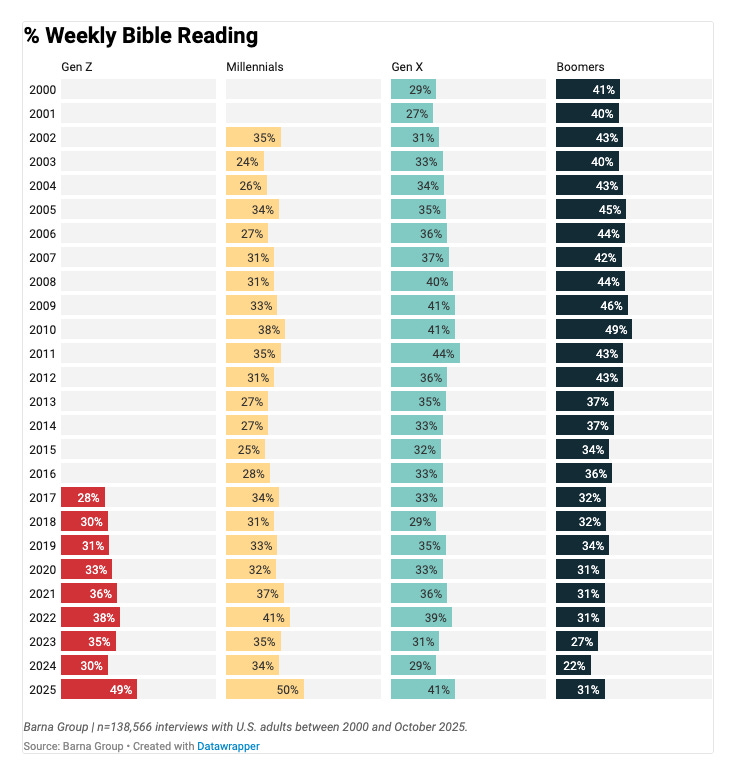
A Barna poll released November 6 found a boom in Bible-reading among young adults. “Weekly Bible reading among U.S. adults has climbed to 42 percent, up 12 points since a 15-year low in 2024. Young adults lead the way: Bible reading among Gen Z and Millennials has surged since 2024, with nearly half now engaging Scripture weekly….Millennials and Gen Z are making big moves toward the Bible. Millennials jumped an unprecedented 16 points, reaching 50 percent—half now say they read the Bible weekly. Gen Z mirrors this pattern, rising from 30 percent to 49 percent in just one year.”
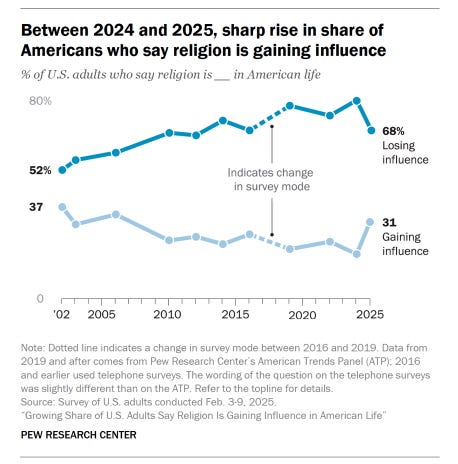
A Pew Research Center survey released October 20 found that “from February 2024 to February 2025, there was a sharp rise in the share of U.S. adults who say religion is gaining influence in American life.” It also reported, “The shares of Americans expressing positive views of religion in 2024 and 2025 are up significantly from 2022 and 2019, indicating an overall shift toward more positive views about religion’s role in American life over the past five years or so.”
And don’t forget Charles Murray’s new book “Taking Religion Seriously,” which I have been reading.
Correction: An early version of yesterday’s column (“Rich Are “Odious,” Says Column in Newspaper Owned by Billionaire John Henry”) said odious means “smelly.” That’s incorrect. After publication I looked it up in my Webster’s Second, and a correct definition is “disgusting.” Thanks to the several readers who wrote in with the accurate definition.
Thank you: The Editors is a reader-supported publication that relies on paying customers (not an endowment like Harvard) to sustain its editorial independence. If you know someone who would enjoy or benefit from reading The Editors, please help us grow, and help your friends, family members, and associates understand the world around them, by forwarding this email along with a suggestion that they subscribe today. Or send a gift subscription. If it doesn’t work on mobile, try desktop. Or vice versa. Or ask a tech-savvy youngster to help. Thank you to those of who who have done this recently and thanks in advance to the rest of you.
Yes, I've been struck by how Jewish white males-- like Summers and Dershowitz-- who rubbed elbows with Epstein but committed no crimes, have been "cancelled," whereas the biased actions of Karim Ahmad Khan, chief prosecutor of the International Criminal Court, who is accused of actual sexual abuse, have not been rescinded.
Latin for "I hate.." Odi
Spanish for "I hate..." Odio