

On Christianity’s Comeback, The Editors Told You So
Plus, Bezos sets new course at Washington Post opinion

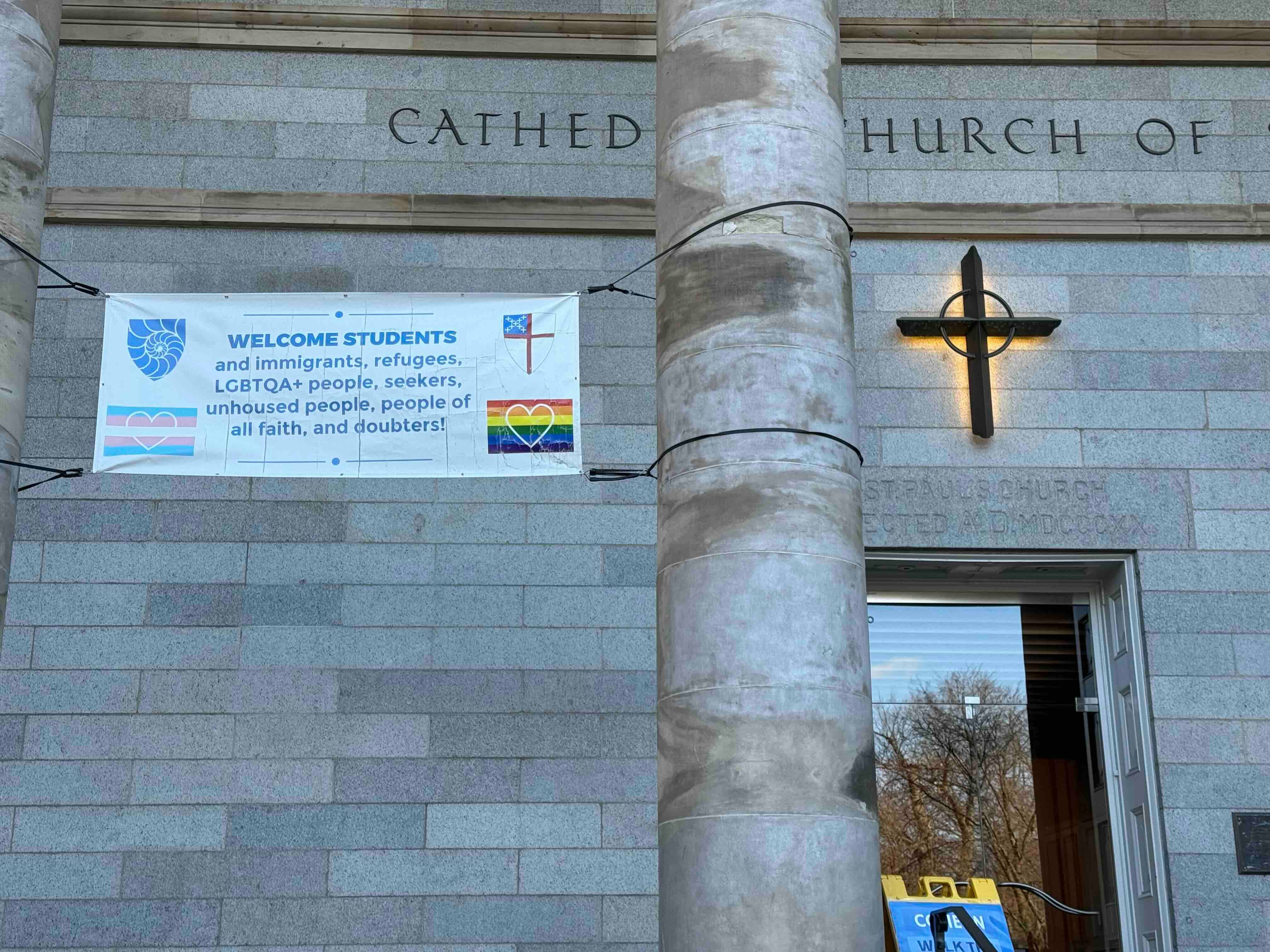
For some time here we’ve been predicting and noting signs of a religious revival or great awakening. See, for example, “Vice President J.D. Vance Could Spark a Religious Revival,” July 15, 2024, and “Joe Lieberman on Faith’s Answers to America’s Political Crisis,” December 25, 2024, and the second item in this post from February 11, 2025, “Silicon Valley’s Christian Revival.”
In a recent video discussion of the issue with Mark Oppenheimer, who is a professor of the practice at the John C. Danforth Center on Religion and Politics at Washington University in St. Louis, I said, “If you look at the trend lines of church attendance or belief in God in America, you know, so there's a downward slope probably having to do with modernity, but there's also a lot of ups and downs and, and the downward slope of, recently has been so dramatic, I think partly because of the COVID effect on church attendance, that just kind of this thermostatic effect would seem to be that we're surely due for an awakening.”
Oppenheimer said, “let’s say we’re in like month one or year one of like, what’s going to be a 10 or 20 year awakening. … What would you look for? Like what, what would be the, the stuff of it?”
I replied, in part, “look, I mean, there’s these Pew and Gallup polls are pretty robust in terms of like large sample sizes and asking the same question over time. Like there’s good longitudinal trends on those polls. Yeah. And so I think you have to see some of those numbers on questions like, do you believe in God? Have you attended a religious service in person today? in the last month yourself. And there’s another question that, how important is religion in your life, I think. And, you know, so those questions, they need to start trending up instead of down. And the church attendance one has started trending up. And it took a huge hit during the pandemic. So we’re still not above, I think, 2019 levels. But I think having a positive slope instead of a negative slope in those trend lines is one very clear trend. And then, you know, you could talk about levels, but you also could talk about rates of change. And so that's the sort of social science answer.”
An update is in order. Today the Pew Research Center released its giant “2023-24 Religious Landscape Study.”
It reports, “After many years of steady decline, the share of Americans who identify as Christians shows signs of leveling off – at least temporarily – at slightly above six-in-ten, according to a massive new Pew Research Center survey of 36,908 U.S. adults.”
The New York Times online headline on it is “Christianity’s Decline in U.S. Appears to Have Halted, Major Study Shows.”
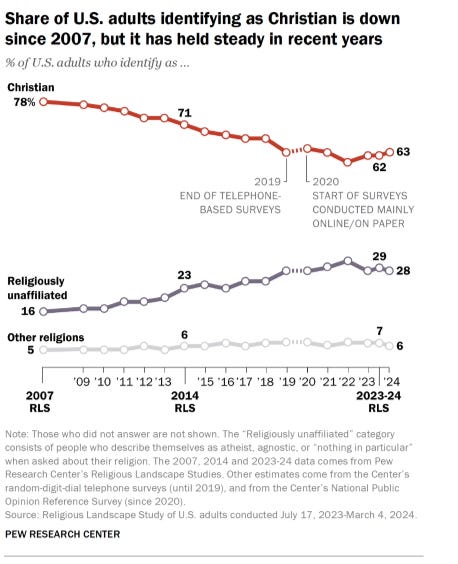
It’s not exactly a Great Awakening, and younger adults are still less likely than older adults to attend religious services in person at least monthly. But for anyone interested in these trends—which have huge implications for politics, for family size and formation, for mental health, and for all sorts of other issues—the new Pew data are worth spending some time digging into. It’s not clear whether America will ever get back to the old days in terms of religious affiliation. One key factor, in my view, will be uptake of programs that offer school choice scholarships usable in religious schools. Those schools help expose students to religious ideas and create communities and neighborhoods around them. The scholarships are increasingly common in some states, though the dominant variety of schooling remains government-run public schools where courts have stripped away most religious content.
Bezos sets new course at Washington Post Opinion: The owner of the Washington Post, Jeff Bezos, posted to X a note that he sent to the Washington Post team this morning:
I’m writing to let you know about a change coming to our opinion pages.
We are going to be writing every day in support and defense of two pillars: personal liberties and free markets. We’ll cover other topics too of course, but viewpoints opposing those pillars will be left to be published by others.
There was a time when a newspaper, especially one that was a local monopoly, might have seen it as a service to bring to the reader’s doorstep every morning a broad-based opinion section that sought to cover all views. Today, the internet does that job.
I am of America and for America, and proud to be so. Our country did not get here by being typical. And a big part of America’s success has been freedom in the economic realm and everywhere else. Freedom is ethical — it minimizes coercion — and practical — it drives creativity, invention, and prosperity.
I offered David Shipley, whom I greatly admire, the opportunity to lead this new chapter. I suggested to him that if the answer wasn’t “hell yes,” then it had to be “no.” After careful consideration, David decided to step away. This is a significant shift, it won’t be easy, and it will require 100% commitment — I respect his decision. We’ll be searching for a new Opinion Editor to own this new direction.
I’m confident that free markets and personal liberties are right for America. I also believe these viewpoints are underserved in the current market of ideas and news opinion. I’m excited for us together to fill that void.
Jeff
As a fan of free markets and personal liberties, of America, and of freedom, this strikes me as promising and encouraging news. Some newsroom types portrayed it as Bezos “infringing” or “encroaching” on the newspaper, but what’s the point of owning a newspaper if you aren’t going to have some control over what it stands for? Anyway, I wish Bezos much luck in attracting to the Washington Post—or promoting from within—an editor who can succeed at this project. It’s a rare combination of knowledge, skills, and experience, because the free-market types tend to be in business rather than in journalism.
David Folkenflik reports on X that Shipley, who came to the Post from Bloomberg, “argued WSJ already owns the personal liberties and free markets opinion space.” The Wall Street Journal opinion page is terrific—I’m lucky and pleased to contribute to it occasionally—but as an argument for an editorial strategy, this is weak. There are two separate but related issues: what’s the best policy, and what’s the best editorial policy for the newspaper. It seems like a mistake to let the fact that there’s already another pro-free-market national newspaper (the Wall Street Journal) box you into a socialist, Big Government editorial position, or into endorsing a mushy mixture. You’re better off sticking with the true principles than letting some niche marketing logic maneuver you away from standing for freedom.
I wrote last year that Bezos will eventually give up and sell the Washington Post. That prediction has not yet borne out. If he’s going to keep it, he may as well get an editorial page that he’s happy with and that stands for what he believes in.
Lawsuit against Harvard dismissed: A federal judge in the district of Massachusetts, George O’Toole Jr., has dismissed a lawsuit against Harvard filed by ten alumni. O’Toole’s order:
The plaintiffs are ten Harvard alumni who graduated between 1973 and 1996. They had previously donated monetary contributions to Harvard. They have brought this action against the defendants seeking monetary and equitable relief. What apparently has motivated them to bring this action was Harvard’s alleged failure to sufficiently address antisemitism at Harvard, especially following the attack by Hamas on Israel on October 7, 2023. The plaintiffs seek an injunction ordering Harvard to take affirmative steps to end antisemitism on its campus, restitution for the plaintiffs’ tuition payments and subsequent monetary donations to Harvard, and damages for the purported devaluation of and reputational damage to their Harvard degrees. The defendants have moved to dismiss this action for lack of standing and for failure to state a claim upon which relief can be granted. Standing consists of three well-settled requirements: (1) an injury in fact that is (a) concrete and particularized and (b) actual or imminent; (2) a causal connection between the plaintiffs’ claimed injuries and the defendant’s conduct; and (3) redressability by a favorable decision. Lujan v. Defs. of Wildlife, 504 U.S. 555, 560–61 (1992). An injury is particularized when it “affect[s] the plaintiff in a personal and individual way.” Id. at 560 n.1. The plaintiffs do not currently attend Harvard, nor are they employed by Harvard. They graduated from Harvard many years before the central events referred to in the complaint. They are not themselves directly affected by Harvard’s recent administrative actions and/or omissions, and consequently they have no cognizable legal injury that could be redressed through this suit. The defendants’ Motion to Dismiss Plaintiffs’ Amended Complaint (dkt. no. 25 ) is therefore GRANTED and the case is DISMISSED.
The case was Bauer v. President and Fellows of Harvard College. Harvard settled another couple of antisemitism-related cases earlier this year, though Alexander “Shabbos” Kestenbaum, who graduated in 2024 from Harvard Divinity School, has not settled and is pursuing his lawsuit against Harvard.
The 10 Harvard alumni plaintiffs are not alone in their feeling that their degrees are now an embarrassment. One of my Harvard roommates has turned around his 2 Harvard diplomas in his office out of such a feeling. But as with wine, the value depends on the vintage, and 1970s vintages of Harvard were impressive, as I detailed in 2004 in the WSJ, mirrored at https://segal.org/leadership/know/. To update that assessment two decades later I note that our class now also includes the Chief Justice of SCOTUS and a cabinet member.
College connoisseurs, as with wine connoisseurs, can tell the difference among various vintages.
James Taranto is an excellent Features Editor at the WSJ, but if the Washington Post snagged Ira Stoll in a similar role it could also be impressive.
One might object that the news side of the Washington Post leans left, but the news side of the WSJ also leans left.