


New personal consumption expenditure data from this morning show minimal inflation for the third month in a row.
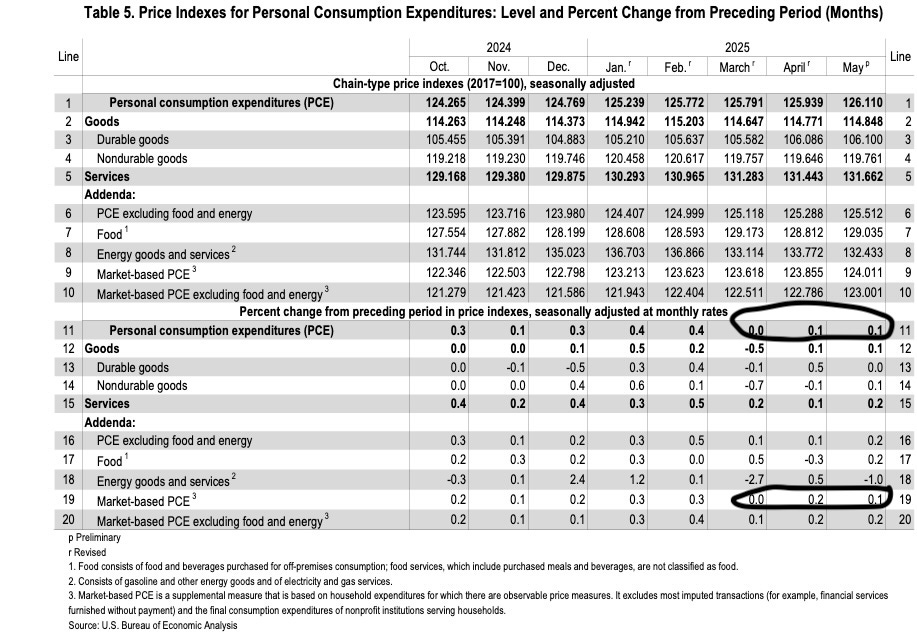
Meanwhile, a sophisticated reader passed along a June 25, 2025 podcast interview of the president of the Federal Reserve Bank of Chicago, Austan Goolsbee, with George Mason University professor Tyler Cowen. Goolsbee praises the Fed Open Market Committee, of which he is a member:
Goolsbee: I said with no irony, “I consider the FOMC to be the world’s greatest deliberative body at this point.” No offense to the US Senate or to anyone else, it’s an amazing group.
Amazing indeed.
This is the same group where, as documented here (“Groupthink Sets in at Powell’s Federal Reserve,” April 22, 2025), dissenting views are in steep decline, the members are increasingly selected with guidance from the chairman, and the interest rate stayed at effectively zero in March 2022 while Consumer Price Index inflation reached 8.5 percent. It’s the same group that suddenly stopped cutting rates after President Trump was inaugurated.
Laughs aside, there is some interesting material from Goolsbee: “Monocultures are prone to groupthink,” he says. At the last two Fed Open Market Committee meetings the votes at the “world’s greatest deliberative body” have been unanimous, 12 to zero.
Goolsbee teaches at Chicago Booth and has this to say about MBA education: “the market for MBAs, as you know, all the pressure is on the opportunity cost side, trying to shorten the programs. There are new master’s programs in finance and management and things that are one year in nature or a year and a half in nature.”
Media bias: Here is a list of news headlines about the recent U.S. strike against Iran nuclear weapons program-related sites:
“U.S. Bombing Adds to Economic Uncertainty at Home”
“U.S. Attack on Iran’s Nuclear Program Risks Emboldening North Korea’s Kim”
“Iran Attack Sparks Retaliation Concerns”
“A Weakened Iran Remains Lethal”
“For War on Terror Veterans, U.S. Strikes on Iran Leave Sinking Sense of Déjà Vu”
“Israel’s War With Iran Has Reordered the Middle East—but Not as Expected; Israel’s military success against Iran undermines one incentive for Saudi normalization and raises concerns about its growing power.”
It sounds like maybe the far-left Guardian, or the left-leaning cable news channel MSDNC, as Trump calls it. But these are from the news section of the Wall Street Journal.
It reads as if there were a memo, or a meeting—hey, when the U.S. went into Iraq and Afghanistan, we made the mistake of not being skeptical enough. Let’s not do that again. Everyone please send in three story ideas about why destroying Iran’s nuclear sites with zero American casualties might actually be bad news.
I understand the impulse to learn from past errors and to try to improve, but it looks like the Journal news section is going too far in the other direction, to the point that the headlines sound like anti-Trump talking points. Trump has been complaining loudly about how CNN and the New York Times covered the American military action, but the Journal news section is almost as bad. Instead of seeming skeptical and evenhanded, it looks like it has a negative agenda, determined to find some way, some how, to paint a stunning American and Israeli military achievement in a negative light.
The anonymously sourced article about the Israeli victory supposedly setting back chances for peace with Saudi Arabia, which ran on page one in print, is particularly weak. One could have written a similar anonymously sourced story about peace with Israel being set back if Iran had been allowed to achieve a nuclear bomb. The Iranians could have used the bomb to threaten to attack Saudi Arabia for making peace with Israel. Saudis who oppose peace with Israel will find some excuse, no matter what happens. The likelier thing is that a strong Israel and the removal of the Iranian nuclear threat increases the chances of more peace agreements between Israel and its neighbors.
The Wall Street Journal opinion pages have been excellent on the Iran-Israel war, which makes the opposition from the news pages all the more disappointing. “U.S. Attack on Iran’s Nuclear Program Risks Making Wall Street Journal News Editors Look Silly.”
“JUSTICE JACKSON decries an imperial Executive while embracing an imperial Judiciary”: Justice Barrett, joined by Roberts, Thomas, Alito, Gorsuch, and Kavanaugh, are pretty harsh on Justice Jackson’s dissent in a case about district justices issuing universal injunctions. From the sizzling opinion in Trump v. Casa, Inc., released today:
The principal dissent focuses on conventional legal terrain, like the Judiciary Act of 1789 and our cases on equity. JUSTICE JACKSON, however, chooses a startling line of attack that is tethered neither to these sources nor, frankly, to any doctrine whatsoever. Waving away attention to the limits on judicial power as a “mind-numbingly technical query,” post, at 3 (dissenting opinion), she offers a vision of the judicial role that would make even the most ardent defender of judicial supremacy blush….We will not dwell on JUSTICE JACKSON’s argument, which is at odds with more than two centuries’ worth of precedent, not to mention the Constitution itself. We observe only this: JUSTICE JACKSON decries an imperial Executive while embracing an imperial Judiciary.
No one disputes that the Executive has a duty to follow the law. But the Judiciary does not have unbridled authority to enforce this obligation—in fact, sometimes the law prohibits the Judiciary from doing so. See, e.g., Marbury v. Madison, 1 Cranch 137 (1803) (concluding that James Madison had violated the law but holding that the Court lacked jurisdiction to issue a writ of mandamus ordering him to follow it). But see post, at 15 (JACKSON, J., dissenting) (“If courts do not have the authority to require the Executive to adhere to law universally, . . . compliance with law sometimes becomes a matter of Executive prerogative”). Observing the limits on judicial authority—including, as relevant here, the boundaries of the Judiciary Act of 1789—is required by a judge’s oath to follow the law.
JUSTICE JACKSON skips over that part. Because analyzing the governing statute involves boring “legalese,” post, at 3, she seeks to answer “a far more basic question of enormous practical significance: May a federal court in the United States of America order the Executive to follow the law?” Ibid. In other words, it is unnecessary to consider whether Congress has constrained the Judiciary; what matters is how the Judiciary may constrain the Executive.
JUSTICE JACKSON would do well to heed her own admonition: “[E]veryone, from the President on down, is bound by law.” Ibid. That goes for judges too.
“Harvard Is Asking Corporations to Fill Its Federal Funding Gap”: News article via the Wall Street Journal. Harvard is too antisemitic, far-left, and inefficient for the federal government, yet corporate sponsors are supposed to be coming out of the woodwork to pitch in and sponsor the research? Put me down as skeptical that this will replace any meaningful amount of Harvard’s frozen or terminated federal funding.
Recent work: “Refrain From Rebuilding Iran” is the headline over my latest New York Sun column, which reacts to two recent comments by President Trump supporting Iran’s rebuilding. “Before enthusiastically backing reconstruction of Iran, America might consider imposing some additional conditions,” I suggest. Check it out over at the New York Sun if you are so inclined and can get access. Trump posted to social media later in the day, after the column was published, in a way that suggested he is moving toward a harder line against Ayatollah Khamenei.