

Campuses Rally in Support of Iran Protesters
Not the Ivy League, but elsewhere

Memes and social media posts all over the Internet are pointing out that Ivy League campuses are empty and quiet instead of filled with protesters denouncing the massacre of Iranians protesting against their terror-sponsoring, human-rights-abusing, nuclear-arms-aspiring corrupt theocracy.
The emptiness may have something to do with winter break, but the point stands about the Gaza protests being driven by anti-Israel or anti-Jewish sentiments rather than by principled humanitarian concern.
There’s another point, too, that’s been lost, though, which is that there are some Western campuses where students and even some teachers have indeed rallied in support of freedom and human rights and rule of law in Iran. Those protests get ignored. The press pays attention mainly to Columbia, because it’s in the press capital of New York City and has a journalism school, and to Harvard, because it generates traffic and some of the editors went to college there, too. Other schools get ignored.
At Arizona State University in Tempe, Arizona, on January 13, more than 130 people attended a protest by the Iranian Students Association, supported by Students Supporting Israel at ASU. A dispatch about the event in the student newspaper, The State Press, quotes the president of the Iranian Students Association, AmirDanial Azimi, saying, “It’s just sad to see that this government, this Islamic republic, doesn’t have the interest of its own people, and the only interest it has is murder.” Students waved American flags and the pre-Islamic-revolution Iranian flag featuring the lion. An ASU professor, Amin Mojiri, spoke at the protest, according to the dispatch: “We call on the international community and the free media. Break your silence. Break your silence. Don’t let the truth be buried.” It’s worth the click to look at the pictures, which are quite stirring and inspiring, as is fact that Iranian and pro-Israel students were able to collaborate on the event with faculty participation.
At UCLA, a “Freedom for Iran” rally was set for noon on January 14, according to a social media post by the UCLA Iranian student group. Social media images show them marching across the Westwood campus with pre-Islamic-revolution Iranian flag featuring the lion (thanks to Samantha Ettus for the sharp eye).
At Bar-Ilan University in Ramat Gan, Israel, which is an underappreciated institution, video footage I saw showed a professor of Arabic and Islamic history in the Department of Middle East Studies, Ze’ev Maghen, who also is affiliated with Shalem College in Jerusalem, Israel, energetically leading Israeli students in the same chants being used by the Iran protesters. That footage is also pretty inspiring.
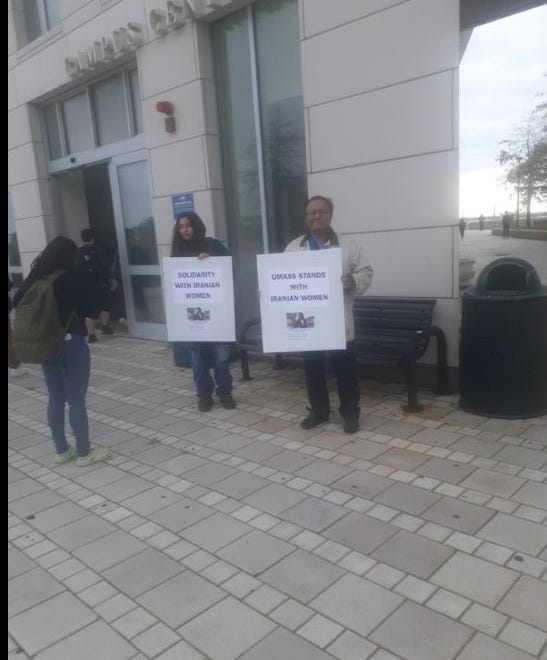
At UMass Boston, in 2023, Kaveh Afrasiabi, an Iranian with permanent resident status in the U.S. who was a consultant to the Iranian U.N. mission and won a pardon from President Biden, organized a day of solidarity with Iranian women.
At the moment, there is plenty to protest. One Iranian whose had a relative killed says the slain protesters’ parents were asked to pay the Iranian regime 1 billion tomans (approximately $10,000, though because of hyperinflation the value is constantly changing) to reimburse cost of the bullets that killed him. In other cases, families of slain protesters are even further humiliated; in addition to the bullet fee, they are forced to bring sweets and offer congratulations for the killing of their loved one before the body is handed over. Students and shopkeepers—“bazaaris”—have been some of the key anti-regime activists in Iran, though it’s difficult to know what is happening there because the regime has largely shut down the Internet and is even jamming the Elon Musk Starlink system that had provided a partial workaround.
I have mixed feelings about campuses as sites for public protest or vigils rather than research, teaching, and learning. The best service American universities can probably provide at the moment is less as marching sites for students to wave signs and flags and chant chants, more as research sites for students to learn the real history of Iran (not phony blame-America-for-everything) and of American efforts to successfully assist popular uprisings against cruel dictatorships. My personal favorite is the story of Solidarity in Poland (see, “To Advance Freedom, Remember Religion, Labor, and Technology”). But given all the anti-Israel Gaza activism over the past few years, some public attention to Iran on the campuses would not be inappropriate. It is good to see it happening in some places.
I think U.S. students are angered about injustice supported by their own government (i.e., the U.S.)
The bullet fee is only one of the many abuses of those who were killed. More details at https://www.iranintl.com/en/202601152027
In the spirit of universities being places of "research, teaching, and learning" they have a role to play in bringing such abuses to attention. And so does the mainstream media.