

“A New Age of Capitalism,” Bessent Declares, as Dells Pledge $6.25 Billion
Plus, what the New York Times’s Roger Cohen missed about “Imperial Israel”

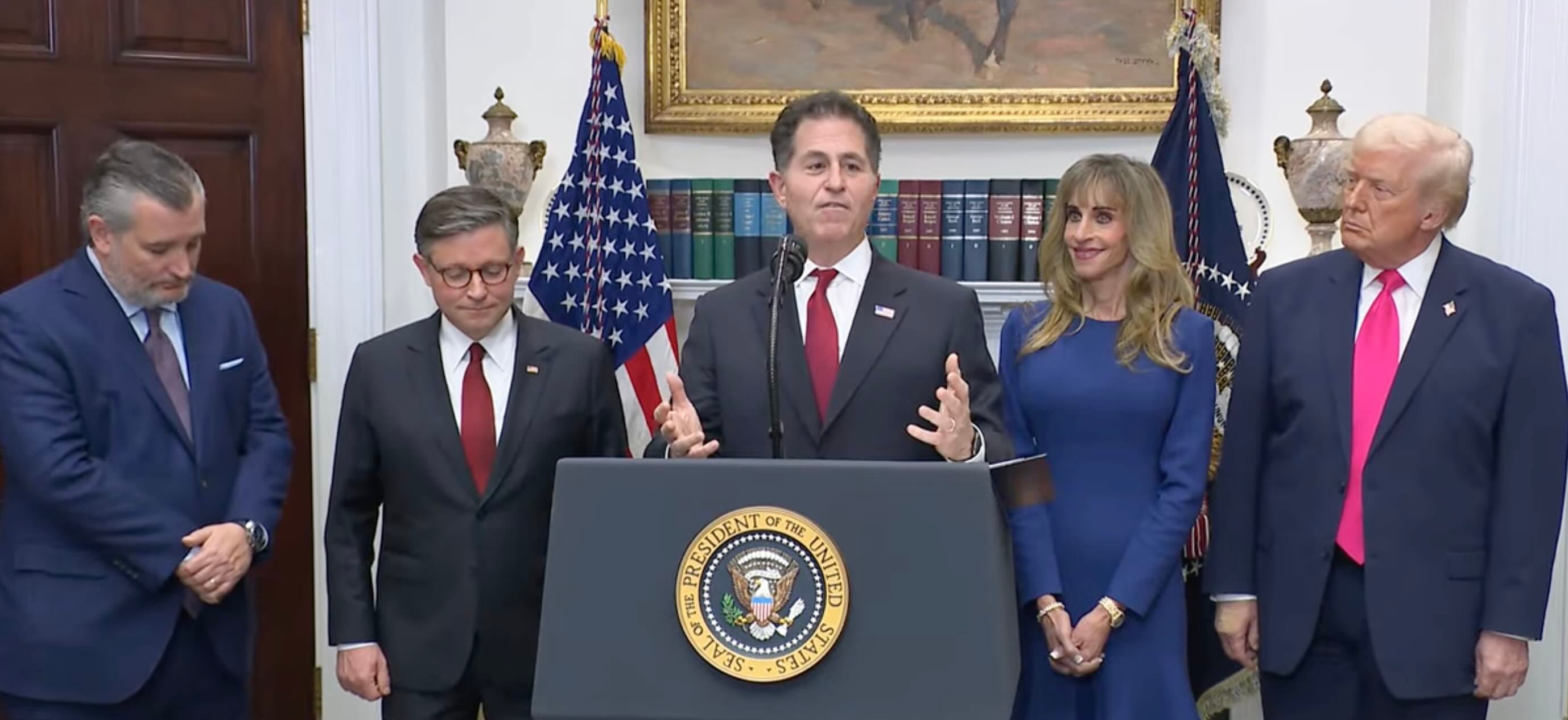
For those of us concerned about some polling and some election results showing declining levels of support for capitalism and increased levels of support for socialism among young people, this afternoon’s White House event with President Trump and Michael and Susan Dell offered some hope of a different trend emerging.
Treasury Secretary Scott Bessent explained the idea behind the “Trump Accounts,” the tax-deferred savings accounts for children that were included in the One Big Beautiful Bill and that Michael and Susan Dell expanded with a gift announced today of $6.25 billion to fund $250 Trump accounts for 25 million children.
“We are going to make sure all American families have a stake in the success of America,” Bessent said. “Every day, when the stock market goes up or down, and we believe over the 18 years, it will go up….it will be a game-changer. People who have a stake in the system and become more and more vested in the system do not want to bring down the system, they want to make it better. So I think we will look back on today and know that these Trump accounts have started a new age of capitalism and market interest for the whole country.”
“You’re now in the game. That act alone, I think reinvigorates the American Dream, it reinvigorates the idea of free market capitalism” said the founder and CEO of Altimeter Capital, Brad Gerstner.
“What I am excited about is, we are creating a new generation of capitalists,” Senator Cruz, Republican of Texas, said. “Every child in America is gonna be an owner of the biggest employers in this country.”
“We have all seen the sad statistics of how many kids are losing faith in capitalism. Ten years from now, a little boy will pull at his phone and look at his app and he’s gonna see his Trump account. Instead of thinking of big, bad, scary corporations, that little boys is gonna say, I own $50 of Apple, I own $100 of Dell, I own $75 of McDonald’s…that will transform this country,” Cruz said.
I hope it works out that way. Grover Norquist, Newt Gingrich, and others over the years have talked about the “ownership society,” and how people with retirement or other savings accounts invested in stocks are more likely to support pro-growth policies (and also support politicians who support pro-growth policies).
The question mark here is
whether with Trump equity index fund accounts funded at the outset with a $1,000 government contribution or by a distant philanthropist (or even by a family member or friend) rather than with money earned and saved directly, the effect will be more like gratitude for a welfare program or guilt about a trust fund as opposed to the pride of someone who accumulated a retirement account by working, earning, and saving. That is an empirical question, and we’ll have a chance to measure and find out, though it will take a while to get results.
At $6.25 billion from Dell plus whatever the $1,000 seed contributions and associated tax breaks cost in federal budget accounting terms, it’s an expensive experiment to run on a nationwide basis. Also substantial, though, is the cost of inaction while support for capitalism erodes among those who feel they don’t have an ownership stake in the existing system.
What the New York Times’s Roger Cohen missed about “Imperial Israel”: The front page of today’s print New York Times carries a long dispatch by Roger Cohen. Online the headline is “‘Imperial Israel’ in the New Middle East.”
Here are a few things that you can learn about that article from The Editors but not from the New York Times:
The quote about “Imperial Israel” is presented in the Times like this:
The region is adapting to what Abdulkhaleq Abdulla, a prominent political scientist in the United Arab Emirates, calls an “imperial Israel,” a country that will kill enemies anywhere: from Lebanon to Syria, Gaza to Iran, Yemen to Qatar. Pre-emptive Israeli strikes are the new norm.
There’s nothing “new” about a norm of “pre-emptive Israeli strikes.” Israel began the Six-Day War in 1967 with a pre-emptive strike and also struck Iraq’s Osirak nuclear reactor in 1981 pre-emptively. In addition, the strikes the Times describes as “pre-emptive” alas in this case are not pre-emptive, they are retaliatory, coming after the October 7 Iran-backed attack on Israel by Hamas and after missile and drone attacks on Israel from Lebanon, Yemen, Iran, and Syria.
As for Abdulkhaleq Abdulla, we reported November 3, 2025:
Harvard Mideast fellow exits abruptly: On October 27 we wrote about Abdulhaleq Abdulla:
Additional context comes from Harvard Kennedy School, where a Senior Fellow with the Middle East Initiative at the Harvard Kennedy School’s Belfer Center for Science and International Affairs, Abdulkhaleq Abdulla, on October 25 posted a public statement that, as auto-translated, says, “Some tweets I posted about the events of October 7, 2023, which were understood as praising attacks against Israel, were a misjudgment. Had I realized at the time that they targeted civilians, I would have condemned them immediately. I express my regret for any misunderstanding they caused, as violence against civilians is unacceptable and contradicts my convictions as a Muslim and an Arab. Freedom is achieved through peace, not violence.”
That statement’s careful wording suggests that Abdulla still believes (or has to for some reason maintain a public posture of believing) that Israeli soldiers, even those deployed defensively during a ceasefire at a time when Israel had entirely and unilaterally withdrawn from Gaza, are legitimate targets for attack.
“Fellows” at Harvard can mean a lot of different things, from a medical specialist in training to a member of Harvard’s governing corporation (“The President and Fellows of Harvard College”) but in these two cases, it means someone who isn’t a senior or junior professor but has some more attenuated and shorter-term affiliation with the university.
More from November 3:
Lo and behold, after that item was published, Abdulla’s status on the Harvard Kennedy School website changed.
It went from “senior fellow” to “alumni.”
The faculty chair of the Middle East Initiative at the Harvard Kennedy School’s Belfer Center for Science and International Affairs, Professor Tarek Masoud, told The Editors, “I cannot comment on personnel matters except to say that Dr. Abdullah’s non-resident, unpaid fellowship with us was ended by mutual agreement for reasons unrelated to the content of his speech.”
Reached by The Editors, Abdulla—or Abdullah, spellings vary for the name of the political scientist from the United Arab Emirates, who has been a supporter of the Abraham Accords—referred questions to Harvard.
In other words, the political scientist the New York Times relies on for its headline quote about “Imperial Israel” abruptly departed Harvard after publicly acknowledging a misjudgment about post-October 7 social media posts—and the Times doesn’t even mention it.
More gems from the Roger Cohen article: “The Palestinian people want a state, and it seems inconceivable that money will ever alter that national ambition. This issue’s capacity to ignite war at regular intervals has been demonstrated over and over.”
It’s misleading to conceive the war-igniting issue as Palestinian Arab desire for statehood. The issue is the Arab and Muslim refusal to accept the existence of a Jewish state. The issue is also various varieties of intra-Muslim and intra-Arab feuds and fanaticism (seen, for example, in the Syrian civil war, or the Iran-Iraq war, or the civil war in Lebanon, or the civil war in Yemen, or various Islamist terrorist attacks on American and European targets that had little or nothing to do with the Palestinian statehood issue).
And, also from the Roger Cohen article: “the United States will have to decide what constraints, if any, it will impose on Israel in the interests of furthering peace in the region. One way to achieve this may be strengthening the militaries of other regional players, like Saudi Arabia or Turkey, which Mr. Trump seems intent on doing.”
My view is that constraints on Israel delay peace rather than further it, because Israel is defeating terrorist extremists, and constraining those efforts leave those terrorist extremists in place to prolong the conflict. Strengthening Saudi Arabia and Turkey has its own risks—rather than creating a balance of power, it could create a tinderbox. And the U.S. is not the only power in the region—if the U.S. attempts to impose “constraints” on Israel, then Russia, Iran, and China may move to strengthen Israel’s enemies in a way that weakens America’s position.
Here at the Editors we were already describing Israel as the regional superpower back on June 13, 2025, so it’s mildly amusing to see Cohen and the Times waddle in with a somewhat similar account—lots of painstakingly reported details, but also some clumsiness as I have outlined—half a year later.
Thank you: The Editors is a reader-supported publication that relies on paying customers to sustain its editorial independence. We are doing our own little bit to reinvigorate free market capitalism, or at least to report on it in a trustworthy way. If you know someone who would enjoy or benefit from reading The Editors, please help us grow, and help your friends, family members, and associates understand the world around them, by forwarding this email along with a suggestion that they subscribe today. Or send a gift subscription. If it doesn’t work on mobile, try desktop. Or vice versa. Or ask a tech-savvy youngster to help. Thank you to those of who who have done this recently and thanks in advance to the rest of you.
What is a mystery to me, and what I wish someone would unravel and explain, is what precisely is the Trump administration's understanding of the Mideast situation and his strategy now at this point. On the one hand, there is his seemingly masterful support for Israel in its multifront war, and now his moves against the Muslim Brotherhood, his rejection of "kooky" Tucker Carlson, etc. On the other, his administration's seeming acceptance of Qatar's role and his support for strengthening the role of Turkey, etc., in whatever resolution is ultimately arrived at for the problem of Gaza. Am I right to detect a cautious effort to placate the two sides dividing the right now -- the pro-Israel side best manifested by Rubio, and the growing alt-right nuttiness putting Vance in the uncomfortable spot he is in?