

Trump Signals Weakness on Disarming Hamas
Plus, Harvard Mideast fellow exits abruptly; Heritage leader raises new doubts; WSJ misleads on UChicago

In today’s newsletter: A Trump-related scoop-of-perception, a Harvard-related scoop, an update on the Heritage Foundation’s non-Zionist CEO, and a media-accountability item about the Wall Street Journal’s UChicago coverage.
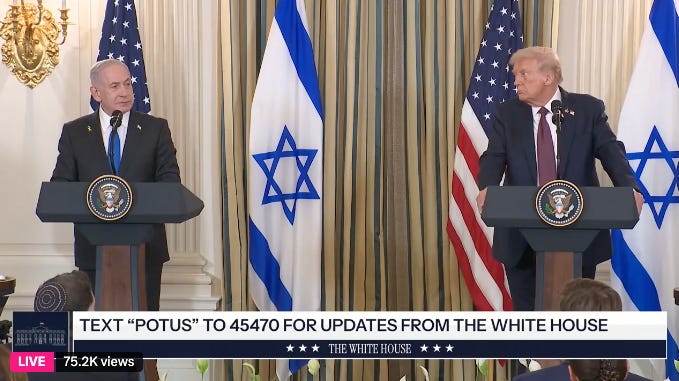
President Trump is signaling weakness when it comes to disarming Hamas, one of Israel’s key war aims and an element of the 20-point ceasefire plan the White House published September 29, 2025.
Point 13 of Trump’s plan was “Hamas and other factions agree to not have any role in the governance of Gaza, directly, indirectly, or in any form. All military, terror, and offensive infrastructure, including tunnels and weapon production facilities, will be destroyed and not rebuilt. There will be a process of demilitarization of Gaza under the supervision of independent monitors, which will include placing weapons permanently beyond use through an agreed process of decommissioning, and supported by an internationally funded buy back and reintegration program all verified by the independent monitors.”
Last night on CBS News’s “60 Minutes” program, Trump was asked by Norah O’Donnell, “How do you get Hamas to disarm?” Trump replied, “If I want ‘em to disarm, I’ll get ‘em to disarm very quickly. They’ll be-- they’ll be eliminated. They know that.” It’s a subtle point, but the addition of the word “if” is a step backward from Trump’s October 15, 2025, response to a similar question, “Well, they’re going to disarm, because they said they were going to disarm. And if they don’t disarm, we will disarm them…if they don’t disarm, we will disarm them. They know I’m not playing games.” The “if” in the “60 Minutes” answer indicates some level of uncertainty about whether Trump wants Hamas to disarm.
The natural follow-up from the CBS News reporter would have been, “what do you mean ‘if’ you want them to disarm? Do you want them to disarm now or not? And if not, why not?” Maybe once Bari Weiss has been in charge there for a few years rather than just a few weeks, CBS will up its game to that level.
Perhaps Trump just misspoke. He just got back from a long trip; maybe he was tired. Or perhaps he wants Hamas to return the remaining bodies of slain hostages before focusing, sequentially, on disarming.
But Trump’s other comments in the interview—that he “had to push” Prime Minister Netanyahu, and that “I didn’t like certain things that he did, and you saw what I did about that. I also stopped-- you know, I-- we knocked the hell out of Iran, and then it was time to stop, and we stopped”—don’t exactly inspire confidence. They recall Bernard Lewis’s quip that America is harmless as an enemy but treacherous as a friend.
In the end, whatever public doubts Trump is conveying Prime Minister Netanyahu has been clear that Hamas will be disarmed. For now, Israel is using the time to maintain its armored vehicles and rest its troops while also operating in Lebanon. Brigadier General (Reserve) Amir Avivi, the founder and chairman of Israel’s Defense and Security Forum, who has been a reliable guide to events in the war, said in this morning’s IDSF Zoom briefing, when asked about finishing off Hamas in Gaza, “It’s imminent. At one point, the IDF will go in and destroy Hamas.”
Harvard Mideast fellow exits abruptly: On October 27 we wrote about Abdulhaleq Abdulla:
Additional context comes from Harvard Kennedy School, where a Senior Fellow with the Middle East Initiative at the Harvard Kennedy School’s Belfer Center for Science and International Affairs, Abdulkhaleq Abdulla, on October 25 posted a public statement that, as auto-translated, says, “Some tweets I posted about the events of October 7, 2023, which were understood as praising attacks against Israel, were a misjudgment. Had I realized at the time that they targeted civilians, I would have condemned them immediately. I express my regret for any misunderstanding they caused, as violence against civilians is unacceptable and contradicts my convictions as a Muslim and an Arab. Freedom is achieved through peace, not violence.”
That statement’s careful wording suggests that Abdulla still believes (or has to for some reason maintain a public posture of believing) that Israeli soldiers, even those deployed defensively during a ceasefire at a time when Israel had entirely and unilaterally withdrawn from Gaza, are legitimate targets for attack.
“Fellows” at Harvard can mean a lot of different things, from a medical specialist in training to a member of Harvard’s governing corporation (“The President and Fellows of Harvard College”) but in these two cases, it means someone who isn’t a senior or junior professor but has some more attenuated and shorter-term affiliation with the university.
Lo and behold, after that item was published, Abdulla’s status on the Harvard Kennedy School website changed.
It went from “senior fellow” to “alumni.”
The faculty chair of the Middle East Initiative at the Harvard Kennedy School’s Belfer Center for Science and International Affairs, Professor Tarek Masoud, told The Editors, “I cannot comment on personnel matters except to say that Dr. Abdullah’s non-resident, unpaid fellowship with us was ended by mutual agreement for reasons unrelated to the content of his speech.”
Reached by The Editors, Abdulla—or Abdullah, spellings vary for the name of the political scientist from the United Arab Emirates, who has been a supporter of the Abraham Accords—referred questions to Harvard.
Heritage leader raises new doubts: The president of the Heritage Foundation, Kevin Roberts, did two interviews Friday with conservative media outlets. They appeared aimed at addressing the furor over Roberts’ defense of Tucker Carlson and over Roberts’ attack on critics of Carlson’s interview with Nick Fuentes as “the globalist class” and a “venomous coalition.” Rather than easing concerns, however, they made things worse, violating a basic rule of crisis communications: when you are in a hole, stop digging.
One interview was with Ben Domenech. Roberts said in that one that the Heritage staff includes, “colleagues who are Christian Zionists. We have colleagues who are Jews. We have colleagues, many Christians, myself included, who are not Zionists per se but we are certainly supportive of the state of Israel and certainly I mean 100 percent standing shoulder to shoulder against antisemitism with our Jewish brothers and sisters.”
He also said, “Anytime Heritage or anyone on the right who is a stalwart friend of the state of Israel merely asks a question about a particular policy—obviously asking a question about policy is not a question about the existence of the state of Israel or certainly not participating in the scourge of antisemitism—it’s an either-or proposition. You’re either totally for Israel or you are someone who is a total enemy. We are actually trying to foster the conversation to get away from that kind of false dichotomy. That’s imperative for us be able to do if we are going to access Fuentes’s audience.”
A second interview was with Dana Loesch. Roberts made similar points. “Someone can be a Christian and not be a Zionist, which is to say that they fully support Israel, they are certainly supportive of the Jewish people and stand shoulder to shoulder with them against antisemitism, but it doesn’t mean that we therefore have to salute to everything a particular Israeli government does. And that’s actually an important dynamic in this conversation.”
“We ought to be able to ask as friends of Israel, constructive questions about why policy x, why policy y, without being accused of being antisemites,” he said. He spoke of a “purity test,” and started talking about the bombing of a church in Gaza “by the Israeli Defense Forces.” “Just by virtue of asking that question I and Heritage were charged with antisemitism,” he said. “That’s precisely the kind thing on the other side of Fuentes that we have to address as well. And I am hopeful… that maybe we have started a conversation that’s long overdue.”
Hmmm. Tucker Carlson has on his program someone, in Fuentes, who was said, “I think the Holocaust is exaggerated. I don’t hate Hitler. I think there’s a Jewish conspiracy.” And Roberts defends Carlson as a friend and denounces Carlson’s critics as a “venomous coalition” and the “globalist class.” And now Roberts tries to change the subject to whether Israel’s supporters are too quick to charge antisemitism of Israel’s public critics—or sorry, those just “asking” questions rather than “salute to everything a particular Israeli government does”? And he says that is “a conversation that’s long overdue” and imperative to accessing Fuentes’s audience? Sorry, in the post-October 7 war between civilization and barbarism, Roberts’ talk of a “false dichotomy” itself rings false. The “salute to everything a particular Israeli government does” is a straw man. This guy openly covets Fuentes’s audience and the problem is that the Jews are too quick to complain about antisemitism? Give me a break.
Weak Wall Street Journal UChicago coverage: “Colleges Face a Financial Reckoning. The University of Chicago Is Exhibit A” is the online headline over a front-page news article in Saturday’s Wall Street Journal. The first quote in the article is from “Gabe Winant, an associate history professor at UChicago.” The Journal quotes him again lower down in the article, describing him as “a leader in faculty organizing.” What the journal doesn’t say is that this guy is a boycott-Israel advocate who has written of the anti-Israel encampments, “there has been precious little demonstrable anti-semitism at any of the encampments around the country.” On October 13, 2023, he suggested, “imagine that every shiva might become an occasion to curse the state that has made Jews, of all people, into genocidaires.” He doesn’t have much credibility.
Almost every elite higher educational institution (Harvard, Brown, Yale) is cutting back on doctoral degrees in the humanities and social sciences or considering it because there are not a lot of jobs for graduates. That is in part because not a lot of families want to pay to have students sit in the classes taught by fools like Winant, so enrollment in those fields has declined. Instead of writing about declining demand for humanities driven by performative wokeness and extreme leftism of the faculty and decreasing utility of what is being taught, the Journal tries to make this into a story about UChicago’s finances. Yet the people complaining about the finances aren’t the economists and the business school professors, who are flourishing. It’s the Gabriel Winants complaining, because demand for their product is plummeting.
The Journal story is also financially unsophisticated. It says, “The school also increased what it charged students, in step with other private colleges. UChicago’s tuition and fees have doubled over the past two decades, an increase of about 30% when adjusted for inflation.” What matters is not the list price but the tuition after discounts. UChicago actually does pretty well at getting sophisticated customers—upper-middle class and wealthy families—to pay for the education it is offering, which is very strong. In a business, that pricing power is a strength—premium product, premium price, as they used to say when selling advertising in the print Wall Street Journal, or as Warren Buffett observed in explaining his decision, a very smart one in retrospect, to buy stock in Apple, which made phones and computers that were more expensive than the competitors. Compare it to Harvard, where “For the Class of 2029, 45 percent of students are not paying tuition, and for half of them, their entire Harvard education will be free.” Which is the stronger institution, the one that has to give away its product for free, or the one that has the power to attract top students whose families are willing to pay, or borrow, because they know the education will prepare them for the workforce?
Anyway, the rise of UChicago is one of the great higher education success stories of the past few decades. It’s largely a story about a free-speech culture that a lot of the rest of higher education is now suddenly envious of. You can quibble about one decision or another, but to portray it as financially mismanaged seems silly. Some of the critics seem to back a path of starving the present to wind up with larger endowment in the future. But sometimes investments in the present pay off, especially if they attract students and faculty that will succeed in a way that builds the university’s reputation.
Thank you: The Editors is a reader-supported publication that relies on paying customers. If you know someone who would enjoy or benefit from reading The Editors, please help us grow, and help your friends, family members, and associates understand the world around them, by forwarding this email along with a suggestion that they subscribe today. Or send a gift subscription. If it doesn’t work on mobile, try desktop. Or vice versa. Or ask a tech-savvy youngster to help. Thank you to those of who who have done this recently and thanks in advance to the rest of you.
“Senior Fellows? I like to imagine one sitting in a working class bar, say, in Youngstown. “What do you do, bud?” “I’m a Senior Fellow.”
Bari Weiss will disappoint you. You see much recently at TFP on Israel?