


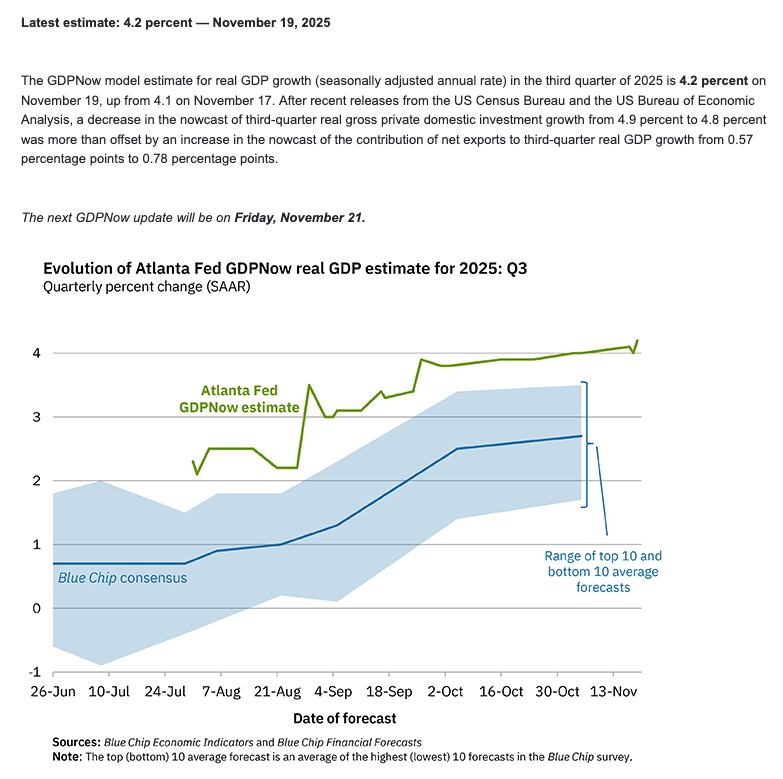
The Federal Reserve Bank of Atlanta’s GDPNow model says the U.S. economy grew at a 4.2 percent real rate in the third quarter of 2025.
That’s a significantly higher reading than most forecasters expect. The New York Fed has its own Staff Nowcast estimating that the economy grew at 2.31 percent in the third quarter. GDP nowcasts are one of the rare remaining areas where there is methodological diversity among the regional Fed banks rather than conformist groupthink.
The Atlanta Fed reading may not be that useful in understanding the economy. The last time we wrote about a 4 percent growth reading from the Atlanta Fed here was back in February 2025; the actual national numbers, when they eventually came out, showed the economy contracting at 0.5 percent. And this time around there’s even less federal data to go on than usual because of the after-effects of the government shutdown.
What the numbers are useful for is illuminating negativity bias in the press.
Earlier this year, when the Atlanta Fed GDP model showed a contraction, the press went wild. “Atlanta Fed shock sounds ‘Trumpcession’ warning,” was a Reuters headline. “The first quarter is on track for negative GDP growth, Atlanta Fed indicator says,” reported CNBC. “A forecasting model from the Federal Reserve Bank of Atlanta predicts that G.D.P. could contract sharply in the first quarter of the year,” the New York Times reported. “Economic growth is on track to almost stall in the first three months of this year, according to the latest estimate from the Atlanta Fed’s GDPNow model,” the Wall Street Journal reported.
There’s been no similar press attention to the positive signal.
You can blame the press, or you can blame the readers whose brains are designed in such a way that they will click and read and share bad-news headlines but not good-news headlines. The headline-writing editors craft language designed to appeal to those brains, and the story-assigning editors also operate that way. The federal GDP number gets reported quarterly when it comes out and then later again if it gets revised; a more obscure datapoint like the Atlanta Fed’s GDPNow, which has a record of volatility, gets attention less predictably, but it’s more likely to get that attention if it’s negative than if it’s positive. One could attribute it to political bias—the press is rooting for bad news that it can blame on Trump—but I think a bigger factor than the politics is just what gets the clicks and the attention.
Declaration of Independence is “overtly racist,” Harvard central administration says: The Harvard Gazette, the official publication of the Harvard University central administration, is using the 250th birthday of America to tell the Harvard community that the Declaration of Independence is “overtly racist.”
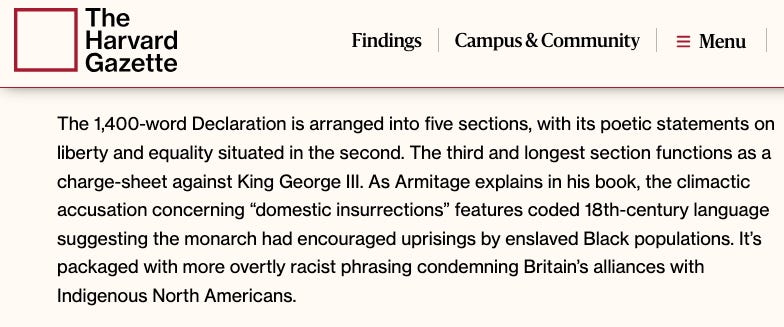
As we explained when we wrote about a recent Gazette article shortly before the New York mayoral election quoting a Harvard lecturer who said “some Israel critics like New York City mayoral candidate Zohran Mamdani have been unfairly tarred as antisemites,” the Gazette is owned by Harvard. It exists to promote Harvard. Its reporters and editors are Harvard University employees. The considerations and protections of academic freedom that might conceivably apply to an academic journal do not apply; this is a marketing organ for the university. There are plenty of things that happen at Harvard that the Gazette chooses not to cover, and there are plenty of things that it does cover in which it omits aspects selectively, or emphasizes others, to reflect the message that the university wants to get across. A job listing last month for “executive director of content and editorial strategy” at Harvard, overseeing the Gazette (paying up to $273,600 a year), describes the position as “storytelling strategies to advance the mission of Harvard University.”
How does describing the Declaration of Independence as “overtly racist” advance Harvard’s “mission”? It’s not even true. The Gazette reference to “more overtly racist phrasing condemning Britain’s alliances with Indigenous North Americans” is an apparent reference to a line in the Declaration that says George III: “has excited domestic insurrections amongst us, and has endeavoured to bring on the inhabitants of our frontiers, the merciless Indian Savages, whose known rule of warfare, is an undistinguished destruction of all ages, sexes and conditions.”
The Gazette seems to misunderstand the grievance. It wasn’t that the American founders were upset that Britain was consorting with those savage Indians; the founders themselves wanted those savage Indians on their own side of the war.
The term “racist” doesn’t really accurately apply to the situation here. It is a sweeping overgeneralization that fails to do justice to the complexity of the relations of the founding fathers to the Native Americans. My biography of Samuel Adams tells of how, in 1775, Adams drafted an appeal to the Mohawk Indians. It was addressed, “Brother” and advised them to get ready for war against England: “We therefore earnestly desire you to whet your hatchet and be prepared with us to defend our liberties and lives.” After the war, in 1790, Samuel Adams wrote to John Adams that “Even Savages might, by means of Education, be instructed to frame the best civil, and political Institutions with as much skill and ingenuity, as they now shape their arrows.” A delegation of 21 Iroquois met with Congress in May 1776 and observed for a month, giving John Hancock the name “Karanduawn, or the Great Tree.”
That’s not to whitewash America’s treatment of the Indians, which overall has been cruel and at times has indeed been racist. The language in the Declaration isn’t politically correct to modern ears. It’s condescendingly negative about Indian culture. But “racist” isn’t the right word.
As it is, the Declaration of Independence book that’s really white-hot this week is by someone with a Harvard undergraduate degree who is now the Leonard Lauder Professor of American History and Values—at Tulane. That is Walter Isaacson, and his book is “The Greatest Sentence Ever Written.” While the Harvard of today is busy trashing the Declaration of Independence as “overtly racist,” Isaacson’s title strikes a better tone.
That’s not to say that American history in universities should be all patriotic propaganda with no attention to the flaws of the founders, who were human and imperfect and some though not all of whom were indeed racist. Maybe the class and professor who are the subject of the Gazette article do a better job than the Gazette article itself at striking the right tone. (If the Gazette allowed reader comments, it might better model intellectual vitality.) But one reason history enrollment at Harvard and similar institutions has been plummeting is that the tuition-payers don’t think learning to hate America is a skill worth paying lots of money for.
The American Enterprise Institute gave its Irving Kristol Award this week to Gordon Wood, professor of history emeritus at Brown University. Wood got his Ph.D. at Harvard with a dissertation written under the direction of the great Bernard Bailyn. Wood gave a long and wise speech and talked about the Declaration of Independence and about the desire at the time for a homogenous people and managed to do it without calling the Declaration’s language “overtly racist.”
I took a class from Bailyn at Harvard on the American Revolution and somehow it did not cover that the Declaration was “overtly racist.” Bailyn was not shy in his later writing about documenting and decrying settler brutality toward Native Americans (and also Native American savagery toward European settlers), but he also—like Wood—was not a product of the era or a university where reflexively slapping a “racist” label on national treasures was somehow considered a badge of intellectual superiority and sophistication.
Danielle Allen, a Harvard professor that I like and respect, did a project a few years ago on the Declaration of Independence that resulted in “fresh takes” on the Declaration from 24 scholars. You can search the 32-page pdf and the word “racist” doesn’t appear, even in the mentions of the “merciless Indian Savages” passage. I wouldn’t want to make too much of one line in one Gazette story, but the Republicans in Washington and a lot of prospective students already think Harvard is teaching students to hate America. If that belief is unfounded, why would the central administration provide more material to support it by voluntarily publishing an article describing the Declaration of Independence as “overtly racist”? It’s overtly self-destructive.
Thank you: The Editors is a reader-supported publication that relies on paying customers to sustain its editorial independence. If you know someone who would enjoy or benefit from reading The Editors, please help us grow, and help your friends, family members, and associates understand the world around them, by forwarding this email along with a suggestion that they subscribe today. Or send a gift subscription. If it doesn’t work on mobile, try desktop. Or vice versa. Or ask a tech-savvy youngster to help. Thank you to those of who who have done this recently and thanks in advance to the rest of you.
Bernard Bailyn and Oscar Handlin were the two professors at Harvard who most led me to spend a lifetime producing k-12 history curriculum materials.
It is absolutely astounding to me that the Harvard Gazette could so completely fail to understand the Declaration as, within its times, the single most transformative moment in the American Revolution, which I believe was the single most transformative event in world history since the Old and New Testaments.
As for those “merciless Indian Savages,” yes, they often were, to one another and to European settlers, who, admittedly were often just as merciless and savage to them. And yet, I believe, there was ALWAYS another aspect to that very complicated encounter: the long, slow, subterranean reshaping of cultures, also by BOTH sides acting on the other. Adams' appeal to the Mohawks being one small example of this. Some of the best examples come from captivity narratives, accounts of or by American settlers captured and raised as Indians, some of whom escaped, others of whom choose not to. A good example is "A Narrative of the Life of Mrs. Mary Jemison," James E. Seaver, 2011. In this age of Howard Zinn, the 1619 Project, and the DEI-supervised ethnic studies ideology of "poor us" (Non-Whites of the assorted downtrodden) vs "awful them" (Whites, some Asian "Whites" and especially Jewish "Whites"), our schools today all too often teach a contempt-inspiring history that falsely claims to be critical but is highly distorted propaganda.
The observation that there are "plenty of things that happen at Harvard that the Gazette chooses not to cover" is an important one.
Here is an example.
The Harvard Crimson has an article bemoaning the disappearance of Harvard's orientation program for "activists": https://www.thecrimson.com/article/2025/11/12/fup-changes-trump/. The article lists Harvard administrators with titles such as “Director of Student Engagement and Leadership” and “Assistant Dean of Civic Engagement and Service”.
Who will write the articles about administrative bloat at Harvard? Apparently not the Harvard Gazette.