



Defeating Hamas in Gaza in 2025 will pave the way for peace deals between Israel and countries like Lebanon, Oman, Indonesia, and Saudi Arabia in 2026, an Israeli general says.
The Israeli reserve brigadier general, Amir Avivi, the founder and chairman of Israel’s Defense and Security Forum, has been a generally reliable analyst in predicting past developments in the war, including Israel’s move into Rafah and into Lebanon and an earlier ceasefire and hostage release.
In comments earlier today in a Zoom briefing, Avivi said countries have already been lined up to accept Gazan civilians who volunteer to relocate. He also said the U.S. may establish a military base in Gaza after Hamas is defeated.
The year 2026 is a midterm election year in the U.S. and is also a year when the next Israeli elections are scheduled.
Both President Trump’s Republican Party and Prime Minister Netanyahu’s Likud could potentially benefit by going to elections with new diplomatic agreements in hand instead of with an unfinished war in Gaza. Avivi said the U.S. and Israel are coordinating closely and are more advanced in planning for postwar Gaza than has been generally recognized.
Private rent data predict Consumer Price Index, economists show: “Can private-sector or tax data replace the Bureau of Labor Statistics?” I asked last week. I was writing mainly about employment data. Now a new working paper from the National Bureau of Economic Research by two Johns Hopkins University economists suggests that a model using data from ZORI—the Zillow Observed Rent Index—predicts the shelter components of the Consumer Price Index. The paper explains how the government inflation data are slow to reflect the actual changes in market rents.
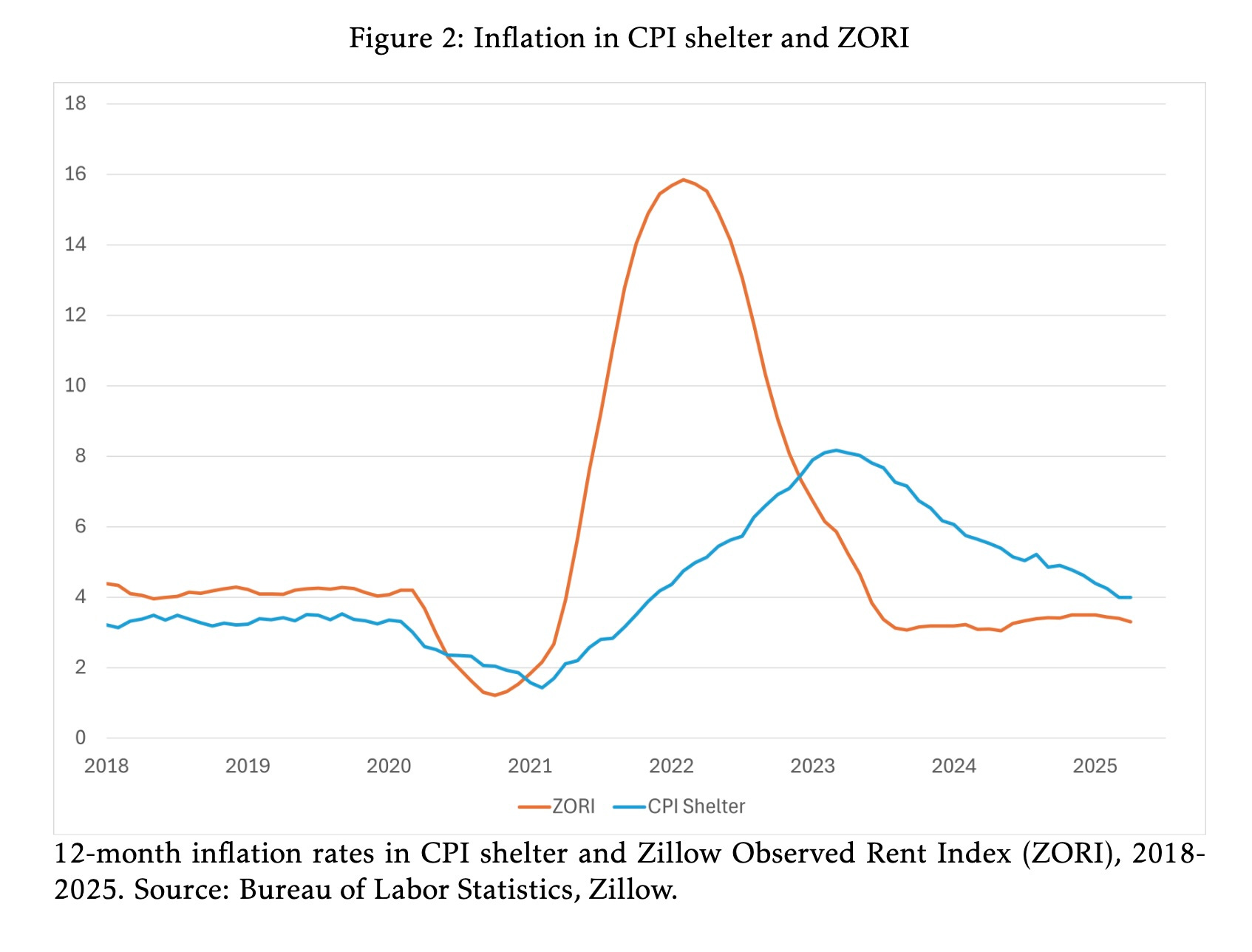
In the paper, “Market Rents and CPI Shelter Inflation,” Laurence Ball and Kyung Woong Koh explain that:
There are three reasons that it takes time for movements in market rents to influence the CPI shelter index:
• Most obviously, rents are usually set in long-term leases, most often for 12 months. The rent for a dwelling cannot react to a movement in market rents until the tenant’s current lease ends.
• Even when the lease ends, if the tenant remains in the dwelling and signs a new lease, the rent does not adjust fully to movements in market rents. That is, landlords smooth rents for continuing tenants.
• Finally, the CPI shelter index is constructed by comparing the current rent for a given dwelling to the rent six months earlier. As a result, the monthly growth rate of the index is an average of rent growth over the previous six months.
About 35 percent of the Consumer Price Index is shelter, and that portion has contributed to inflation that Federal Reserve Chairman Powell has cited in refusing to cut interest rates since President Trump was inaugurated. The authors write, “For the last two years, non-shelter inflation has generally been below 2% but shelter has pulled up overall inflation. In discussing why inflation has exceeded the Federal Reserve’s target, Mankiw (2024) says, ‘it’s all about shelter.’”
It’s newsworthy for several reasons. First, amid something of a press panic about the risk that the Trump administration will erode the credibility of government statistics, it’s a reminder that private sector data—in this case from Zillow, which offers real-estate information online—is already more accurate in some ways than the government data.
Second, it’s a reminder that the inflation data the Fed is relying on to make its interest rate decisions is often slow to reflect the underlying economic reality. President Trump has been criticizing Fed Chairman Jerome Powell as “too slow,” and this research underscores that it’s not just Powell who is slow, it’s the government inflation data that Powell and his colleagues on the Fed Open Market Committee are relying upon.
Third, if the model based on Zillow data can predict where the shelter portion of CPI is headed, it offers a possible peek into what to expect from CPI going forward. “Going forward, CPI shelter inflation will depend on what happens to market-rent inflation, which we will not try to predict. We can, however, predict shelter inflation conditional on a given path of market rents,” they write. “Since 2023, market-rent inflation has stabilized at a level a bit below its pre-pandemic level. We assume that this situation continues; specifically, we assume that market rent inflation starting in May 2025 is constant at an annual rate of 2.47%, which is the rate over the twelve months ending in April 2025….Predicted 12-month shelter inflation is 3.7% in December 2025, 3.2% in December 2026, and 2.9% in December 2027.”
Even all the attention to market rents may overstate the practical effect of shelter inflation. For people who own a home outright, or who locked in 30 years of fixed-rate mortgage payments years ago, rent increases don’t have much practical effect. And people can sometimes lower their housing costs by moving from a high-cost area to a lower-cost one.
This may seem like obscure stuff. The working paper has a lot of elaborate mathematical formulas. But President Trump won the 2024 election in part by running against “Bidenflation.” And Zohran Mamdani won the 2025 New York Democratic mayoral primary with a focus on “affordability” and a promise of a freeze on rents. So understanding what is driving the inflation numbers, and accurately measuring what’s really happening with housing costs, has real political implications. It’s not just an academic issue.
Know someone who would enjoy or benefit from reading The Editors? Please help us grow by forwarding this email along with a suggestion that they subscribe. Or send a gift subscription:
Trying to control the economy using the CPI Shelter data is like trying to control a vehicle on the moon from Earth, with a 2.5 second delay between observation and action, time needed for signals to travel back and forth at the speed of light.
Using ZORI would be better, like driving a car on Earth.