

Trump Calls for Lower Interest Rates
Plus, Columbia’s catastrophizing

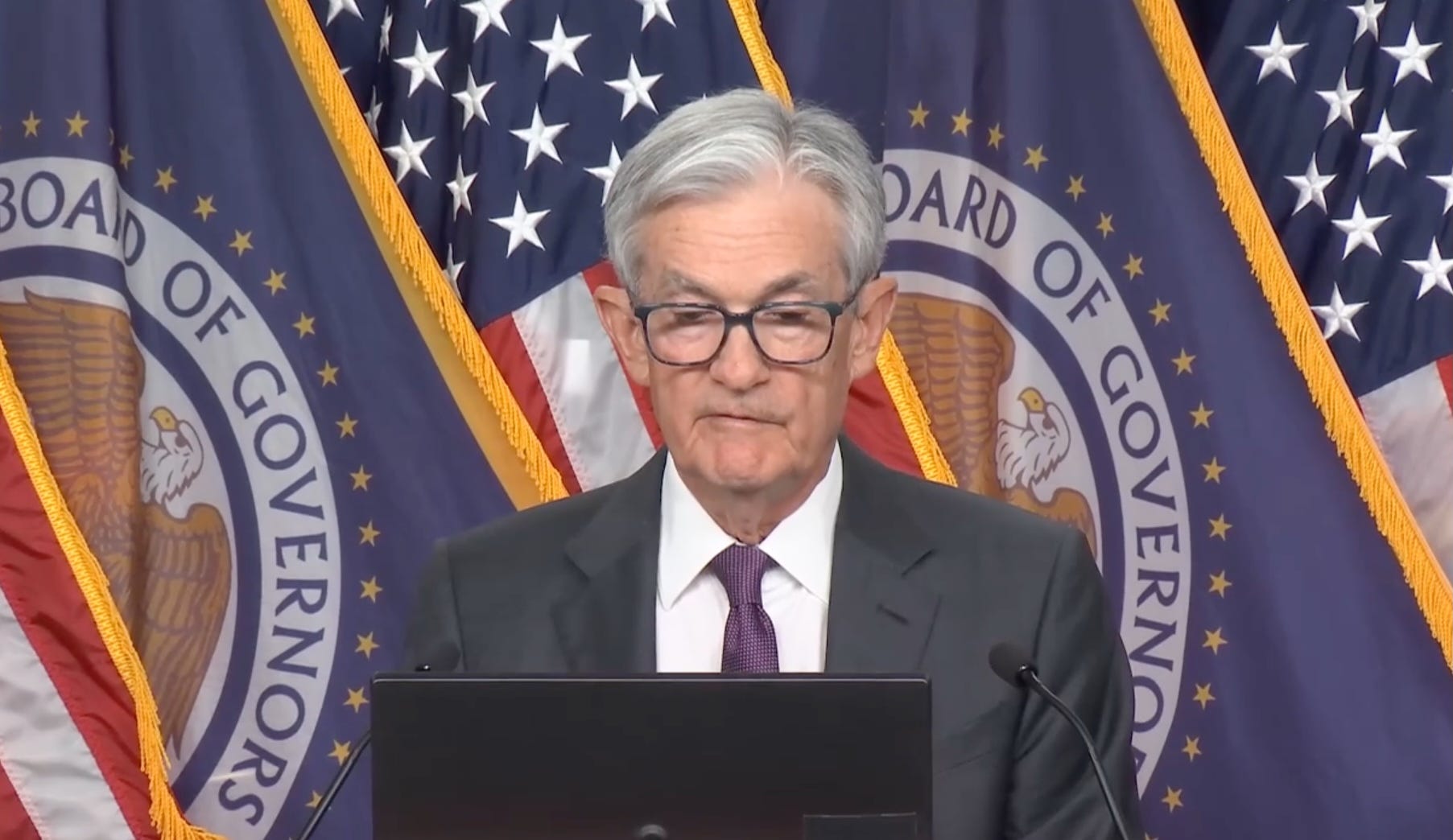
That President Trump wants interest rates lower was a point made here first back on March 14 (“Maybe Trump Is Intentionally Creating a Mini-Recession”). We followed up on March 23, quoting the Treasury secretary, Scott Bessent: “We might actually pull Treasury bill yields down by 30 to 70 basis points. Every basis point is a billion dollars a year” (“Treasury Secretary Bessent on Interest Rates, the Budget, and Growth”).
This afternoon Trump himself weighed in. “I’d like to see interest rates come down a little bit,” Trump volunteered. He wasn’t asked about interest rates. He was asked a general question about consumer confidence. He said prices of eggs and gasoline and groceries—which, in a brief example of the sort of meta-commentary that lends a postmodern feel to the whole event, he acknowledged is an “old-fashioned word”—are going down.
Cue the establishment outrage over Trump trampling on the “independence” of the central bank.
Perhaps when Trump is done with his presidency in early 2029 President Fetterman can appoint him to a stint as chairman of the Federal Reserve. Until then, the law is that Congress—which, under the Constitution, has the power to coin money and “regulate the value thereof”—mandates the Fed to aim for maximum employment and for price stability. The president’s wishes aren’t part of the dual mandate. That said, Trump isn’t the only real estate developer who’d like to be able to borrow money at lower rates. The effect isn’t only on the federal budget picture but also on mortgage rates, auto loans—the whole private economy. There are voices on the left making the same plea. Senator Warren, Democrat of Massachusetts—or as Trump calls her, Pocahontas—has also been pressing Powell to cut rates. So has the AFL-CIO.
Trump has a certain relentlessness to him. If Powell doesn’t get the message, expect to hear it again, and more assertively. The “independent” Fed setup is designed to insulate the Fed from political pressure to cut rates. That pressure, the fear is, could lead to inflation, eroding the value of the dollar that Congress is supposed to regulate the value of. As measured in gold, that value has been eroding steadily, suggesting perhaps that the market is anticipating that “weak dollar” on the way to the strong dollar.
If Trump fouls up the economic policy, the voters can punish his party at the ballot box. That is more accountability than Powell has, at least in the current set up.
Columbia’s catastrophizing: The Wall Street Journal has a news report based on what it says is a transcript of meetings between Columbia University interim president Katrina Armstrong and “about 75 faculty leaders.”
One professor said the situation wasn’t just a crisis for Columbia but was “the biggest crisis since the founding of the republic,” according to a transcript.
That made me laugh out loud. I sure hope it wasn’t a history professor, because it demonstrates a stunning lack of perspective. Think of the Civil War, Watergate, the assassinations of President Kennedy and Robert Kennedy and Martin Luther King Jr., the Vietnam War, Pearl Harbor, the Great Depression, the terrorist attacks of September 11, 2001. Against all that, the idea that the attempted deportation of a green-card holder and threatened marginal cuts to Columbia’s federal funding are “the biggest crisis since the founding of the republic” reveals either historical illiteracy or a level of self-absorption that’s typically seen only at Harvard and Yale. Maybe the professor was attempting humor and it just didn’t come through in the transcript? Maybe the professor had been relying for news only on the New York Times and the Atlantic? I wonder if it was a Pulitzer juror. Any Columbia readers who can help to identify Professor Crisis, the comments section below is open, or, if you prefer confidentiality, try emailing ira@theeditors.com.
Recent work: “‘Starving’ Gazans Reappear in New York Times, Ahead of Schedule” is the headline over my latest column for the Algemeiner. It’s available at the Algemeiner with no paywall by clicking on the hyperlinked headline.
Regarding Columbia's "catastrophizing," (never saw that word in the present continuous tense before), as well as the "starving" Gazans, I wonder when we will see the "Pro-Palestinian" encampments and street demos on behalf of the courageous Gazans now demonstrating AGAINST Hamas. I am not holding my breath.
What is the basis for your statement that Congress should regulate the U.S. dollar's value?