

Trump and Vance Could Crash the Stock Market
Warning signs flashing on economic message, national security

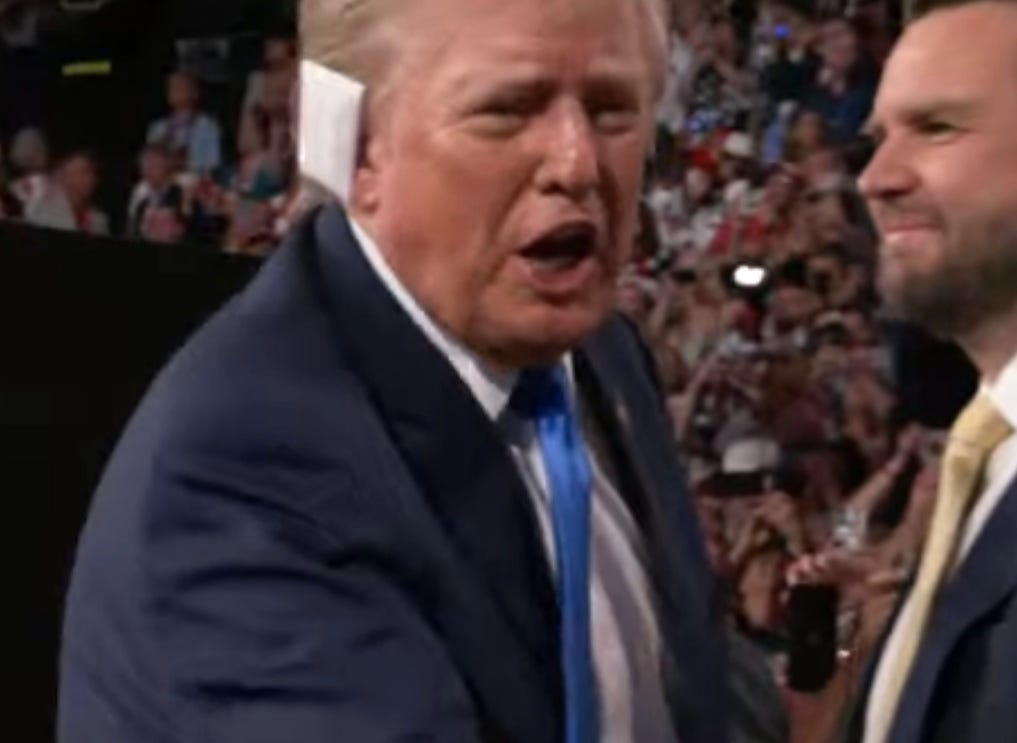
The bull market for equities that has extended along with President Trump’s climb in the polls is at least in part a sign of well-founded confidence by investors that a Trump administration—with lower taxes and less regulation—would be better for American business than another four years of Biden-Harris.
In recent weeks and days, though, some warning signs have been flashing.
•Talking down the dollar. In a June 25 Bloomberg Businessweek interview, asked about American manufacturing, Trump responded by saying, “We have currency problems…we have a big currency problem…that’s a tremendous burden on our companies that try and sell tractors and other things to other places outside of this country. It’s a tremendous burden…it is really the discrepancy as an example between the dollar and the yen and the dollar and the yuan is unbelievable. With the dollar being high and with them being very low.”
The New York Times highlights this in a business-section-front piece with a subheadline about how “Both candidates on the Republican ticket have argued that the U.S. currency should be weaker to support American exports.” For Trump and Vance to say they want to end Bidenflation while also campaigning for a weaker dollar is contradictory. The key thing is a stable dollar, whether its value is measured in gold, in groceries, in Bitcoin, or in some other country’s currency. The stability will attract foreign investment to the United States as investors in places with less predictable currencies seek the protection of a trustworthy store of value. Once word gets out that the White House, or the Treasury, wants to weaken the dollar, it’s hard to put a reliable floor back under it. If Trump or Vance don’t comprehend this, they might benefit from a chat with President Javier Milei of Argentina.
•Tariffs. Trump’s Bloomberg interview offers a good window into his thinking on this one, too:
everyone always says, look at Smoot-Hawley and oh, look what happened. Well, Smoot-Hawley was after the Depression started. So if you go back, I told you to read about William McKinley. William McKinley made this country rich. He was the most underrated president. And those that followed him took the money. Roosevelt took the money and built, you know, the whole thing with the parks and the dams. But McKinley made the money and he was truly the tariff king.
This should be good for sales of Karl Rove’s book The Triumph of William McKinley. It’s not particularly reassuring for those of us who think it’s private enterprise, not government tax revenue, that makes a country “rich.” Trump has been making two contradictory claims. Sometimes he intimates that the tariffs are just a negotiating threat to force other countries into reciprocity that will open markets for American exports. Other times he predicts they will result in windfall revenues for the Treasury. Those revenues will come from the pockets of Americans who consume imported goods. The Tax Foundation helpfully supplies a New York Times news article from 1890 that makes the point: “Let the facts, which are multiplying every day, tell who it is that pays the onerous tariff taxes. They will answer that the American people pay these taxes and that the burden of them rests most heavily upon the poor, inasmuch as there are very few of the necessities of life the prices of which are not increasing on account of the McKinley tariff.”
And on the timing of Smoot-Hawley, Trump is just plain wrong. The tariff was part of the Republican platform in 1928, and Hoover promised it again on April 15, 1929. As Amity Shlaes tells it in The Forgotten Man, “In the autumn of 1929 it became clear that a large new tariff would indeed pass the Congress.” That’s when the stock market crashed. Someone—Larry Kudlow? President George W. Bush? Scott Bessent?—should send Trump and Vance pages 95 to 99 of the hardcover of The Forgotten Man.
•Bashing Wall Street. Vice Presidential nominee J.D. Vance, in his Wednesday convention speech, blamed the high cost of housing on “Wall Street barons crashed the economy and American builders went out of business. As tradesmen scrambled for jobs, houses stopped being built. The lack of good jobs, of course, led to stagnant wages. And then the Democrats flooded this country with millions of illegal aliens. So citizens had to compete — with people who shouldn’t even be here — for precious housing.” So high housing costs started with “Wall Street barons” crashing the economy? Come on. When the economy crashes, housing prices sag. And it wasn’t “Wall Street barons” who crashed the economy but also the Fed that kept interest rates too high for too long and the Henry Paulson-Tim Geithner combine whose arbitrary actions scared capital to the sidelines.
Later in Vance’s speech, he said, “We’re done, ladies and gentlemen, catering to Wall Street. We’ll commit to the working man.”
Vance also said, “We need a leader who’s not in the pocket of big business, but answers to the working man, union and nonunion alike. A leader who won’t sell out to multinational corporations….” That comes on the heels of Monday night’s Republican convention speech by the president of the International Brotherhood of Teamsters, Sean O’Brien, who denounced “corporate vultures” and “corporate elites” and “their pillaging of working people’s pocketbooks.”
Biden’s been busy running against Park Avenue; now Trump-Vance is running against Wall Street? The last thing the American economy needs is another politician, or political party, out demonizing a financial industry that, all in all, does a pretty good job—usually, a better job than government—of allocating capital, financing innovation, fueling prosperity, incentivizing value creation, and pricing risk. Wall Street doesn’t need to be catered to, but it doesn’t need to be vilified, either. There’s enough of that coming from the Democrats and the Socialists. For the Republicans to be piling on increases the chances of punitive policies that will wind up hurting not only Wall Street but the many working people and small-and-medium-sized companies that rely on Wall Street for their retirement savings and basic business needs.
One view of this is it’s merely election-season rhetoric, a shot across the bow of anti-Trump businessmen like former Harvard Corporation member Robert Rubin and current Harvard Corporation member Kenneth Chenault. Wall Street will be fine after the campaign season is over, in that analysis. Yet, as with the weak-dollar talk, once word gets out that an administration is hostile to Wall Street, it has a way of getting a momentum of its own, and becoming self-reinforcing. It reminds me of Obama’s cracks about “fat cat bankers on Wall Street.”
Relatedly, there are national security risks. Vance attacked Biden for having “supported the disastrous invasion of Iraq.” Another speaker Wednesday night at the convention, Rep. Anna Luna of Florida, emphasized that “Hawks and globalist elites do not sway Donald Trump,” who “understands the true cost of war.” Another speaker, Kimberly Guilfoyle, pronounced, “we are fed up with the forever wars.” Newt Gingrich contrasted “weakness and war” with Biden against “strength and peace” with President Trump. When the world is watching a presidential campaign promise “peace,” America’s enemies may be tempted to interpret it as a license to do whatever they want—seize Taiwan, invade Poland, test a nuclear weapon, attack America—without fear of American action. I’m all for peace through strength, but if you talk about it too much, and not enough about freedom and democracy and allies, the rest of the world may hear the “peace” part and not the “strength” part, and calculate their actions accordingly, and aggressively. That could force America into either a war or a strategic setback that could be economically damaging.
People said before the last Trump administration that it’d be disastrous. Apart from the pandemic, which was beyond Trump’s control, his first four years turned out better than the press and the “experts” predicted, which is one reason Trump now appears to be cruising to a win over Biden.
Some of the warnings this time around, too, are surely overstated. With luck, the Trump positives on lower taxes and less regulation, including opening up more domestic energy production, will far outweigh the possible negatives. That’s the likeliest scenario. But it’s worth understanding the other scenario, too. It’s lower probability, but if it happens, it won’t be pretty.
Not-so-Green Energy: CBS News reports:
NANTUCKET – The federal government has ordered the Vineyard Wind farm to shut down until further notice because of a turbine blade failure this weekend.
Several beaches were closed on Tuesday while crews worked to clean up "large floating debris and fiberglass shards" from the broken wind turbine blade off the coast of Martha's Vineyard. A total of six south shore Nantucket beaches were closed to swimming due to debris that washed ashore.
"You can walk on the beaches, however we strongly recommend you wear footwear due to sharp, fiberglass shards and debris on the beaches," the Nantucket Harbormaster said.
President Biden touted the project in a July 2022 visit to Massachusetts:
One of the companies investing in the factory here joined me at the White House this month. Vineyard Winds, whose CEO told me about the ground-breaking project labor agreements they’ve negotiated, would create good-paying union jobs. (Applause.)
And I want to compliment Congressman Bill Keating for his work in this area.
I’m also proud to point out that my administration approved the first commercial project for offshore wind in America, which is being constructed by Vineyard Winds.
Any new-ish technology is going to have hiccups, and it may be that wind eventually ramps up in a way that doesn’t involve beach-closing fiberglass-shard accidents. Yet it’s a good reminder that pouring billions of dollars of government subsidies into “good-paying union jobs” is almost certain to result in some unforeseen consequences.
The Sue Mi Terry indictment: Washington Post columnist Max Boot’s wife, Sue Mi Terry, has been indicted in the Southern District of New York for failure to register under the Foreign Agents Registration Act and for “conspiracy to violate the Foreign Agents Registration Act.” The indictment is worth reading. It says she went to restaurants with and accepted gifts from government officials of South Korea while writing about Korea policy for Foreign Affairs and the Washington Post. It also says the South Korean government donated money to a think tank that Terry worked at. Her lawyer, Lee Wolosky, is widely quoted saying the allegations are unfounded.
In a 2021 piece for Reason, “Does America Really Need the Foreign Agents Registration Act?” I suggested that the law is due for revision or repeal, a point I also made in a 2017 column for Newsmax, “1938 Law Still Threatens First Amendment.” The indictment, and the press coverage, makes much of the fact that Terry ate at fancy restaurants or wore expensive clothing and accessories. But that is not a crime. In another recent Foreign Agents Registration Act case, against Kaveh Afrasiabi, who was pardoned by President Biden, Judge Edward Korman called the related conspiracy charge “a common form of charging to unnecessarily complicate cases.”
One of the articles the indictment mentions was published in 2014, a decade ago. The courts will decide based on the evidence. But if the Justice Department is going to consider it a crime for foreign policy types to interact over meals with government officials of friendly countries and to then write opinion pieces that offer reporting-informed opinions, there’s hardly a think tank scholar or op-ed contributor who isn’t, by this definition, a criminal. I was going to mention Brookings and Qatar; it looks like the FBI was going after that, too, and eventually dropped it. A lot of these FARA cases that prosecutors are bringing wind up resulting in acquittals.
Thank you: If you’ve gotten this far and you aren’t yet a paying subscriber, please become one today to assure yourself complete access and to support our continued growth and independence.
And if you know someone else who’d appreciate this newsletter, please forward it to them along with an encouragement that they sign up.
I'd be happy to pay higher prices for imported goods if the income tax rate were reduced proportionally. Any change in tax revenue sources will have winners and losers. It is not obvious to me why tariffs are so reviled, but 50% income taxes, property taxes, and sales taxes are just fine. It's as if our tax policy has been shaped by importers.
"The bull market for equities that has extended along with President Trump’s climb in the polls is at least in part a sign of well-founded confidence by investors that a Trump administration—with lower taxes and less regulation—would be better for American business than another four years of Biden-Harris." I am not sure how one would distinguish this explanation versus the pricing in of interest rate cuts from the Fed coming this fall (roughly 75 basis points priced in to treasuries I believe).