


There’s so much noisy resistance to the cuts in government spending being implemented by President Trump, Elon Musk, and the Department of Government Efficiency that I thought it might be clarifying and illuminating to take Trump, Musk, and DOGE out of the equation and look at a state-and-local government case-study.
“Boston Public Schools spending more per student than any other major city,” was the headline over a May 2023 report from Boston’s WHDH television, about “the 2021 Annual Survey of School System Finances released earlier this month by the U.S. Census Bureau.” The article said, “Boston tops the list of the 100 school systems with the most students, spending $31,397. New York comes in second, spending $29,931. Washington D.C. is third, spending $24,535 in per pupil expenditure.”
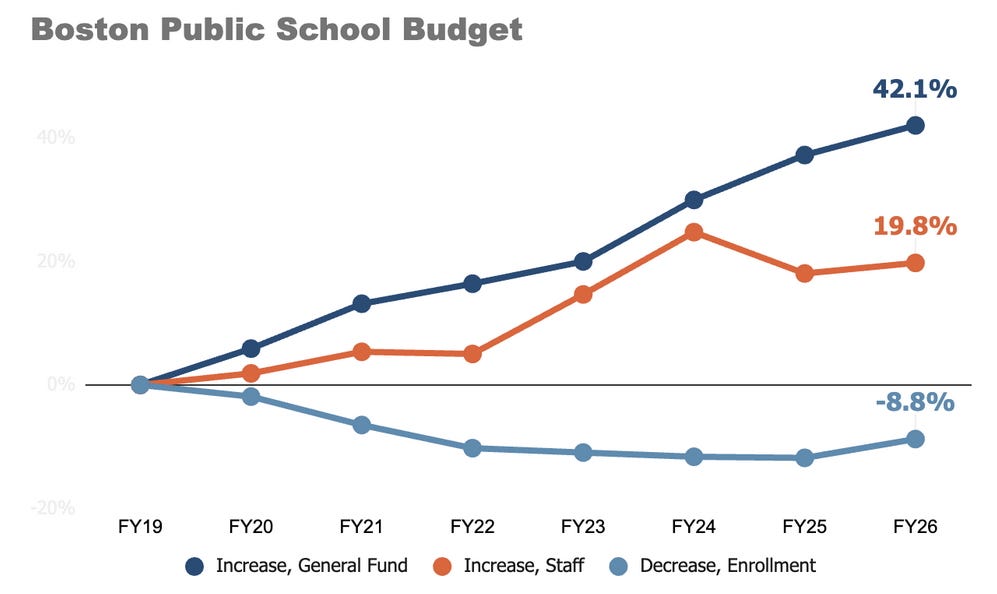
Will Austin of the Boston Focus substack, whose report alerted me to this issue, has a neat chart showing how Boston school staffing and spending has grown while the enrollment has declined.
What’s funny is that you can read Austin’s report about “big budgets, big expenses,” and then look at a letter sent this month to Governor Healey and the state legislature from the “United for Our Future Coalition,” which includes the Massachusetts Association of School Superintendents, Massachusetts Association of School Committees, Massachusetts Teachers Association, American Federation of Teachers Massachusetts, Massachusetts School Counselors Association, Massachusetts PTA, Boston Teachers Union,” and others.
That letter speaks of “the pressing funding crisis in our public schools,” and “the chronic underfunding of PreK-12 public education,” and contends, “While there are many fiscal pressures on school districts, and important fixes in school funding and school building policies are needed beyond those listed below, several financial challenges in particular have worsened the already-strained budgets.”
Leave Musk and Trump out of the picture. Massachusetts has been governed by a Democrat or a moderate Republican (Charlie Baker) and Boston has had a Democratic mayor for many years. Yes, inflation is a factor and yes, Boston and Massachusetts like other public schools are dealing with the end of the federal pandemic relief spending windfall. But the point is even with Democrats and no Musk and Trump, you can have government operations that appear in relative terms to be extremely well funded, serving diminishing populations, with more unionized government employees rather than fewer. And the interest groups backing the programs—the unionized government employees and the manager-agents—the school committees, the superintendents—can still find a way to describe the prospect of diminishing spending growth as a “crisis.”
If it’s a funding “crisis” even in Massachusetts public education, imagine the volume and intensity of the resistance when someone like Musk or Trump seriously wants to balance the federal budget. While Musk and Trump’s styles and their political opponents are factors in generating the resistance, also a factor is the fundamental underlying reality that the whole system in government tilts toward spending more, not less. It takes enormous effort to change that, whether it is Washington or Massachusetts.
A British push to accept Gazans: When President Trump floated his idea of allowing Gazans to resettle elsewhere, the “experts” and much of the media immediately dismissed it as a nonstarter.
Then a crack appeared in the dam with Jordan’s agreement to accept 2,000 Gazan children. Now dozens of members of the British Parliament, including 15 from Prime Minister Starmer’s governing Labour party, have signed on to a letter arguing that the United Kingdom should open its doors to Gazans fleeing warfare in much the same way that it resettled refugees from Afghanistan and Ukraine. “Basic humanity shouldn’t be selective,” the letter says. “If Britain supports medical evacuation and safe routes for some, why should it be any different for families fleeing conflict in Gaza?”
I can understand why some Brits would be reluctant to accept Gazans. The refugees might be terrorists or Islamist extremists. Yet it does seem cruel and unusual—a Palestine exception to ordinary practices of refugee resettlement—to insist that Palestinians remain in Gaza without any possibility of escape during a war between Israel and Hamas. In light of recent events, humanitarian sympathy for Gazans may dip, but I expect that other countries will soon join Jordan and the United Kingdom in allowing Gazans to escape.
Omar Rashid, who is in Gaza, has reportedly been admitted to the Dartmouth College class of 2029, and a January 9, 2025 oped in the Dartmouth by three of his classmates includes “a call to action: the Dartmouth community must do everything in its power to help Omar escape Gaza as soon as possible.” If Omar Rashid gets a version of the Trump plan for Gaza—”escape…as soon as possible”—why shouldn’t the 1.7 million other non-Dartmouth-admitted Gazans get a similar opportunity to evacuate from the war-torn territory? For most Gazans, Egypt and Jordan would probably be more sensible long-term destinations than New Hampshire or London. But the Trump plan has a certain logic that could be contagious.
Car dealership acquisition: Asbury Automotive Group, which trades on Nasdaq under the symbol ABG, this week announced it is buying “various automotive dealerships owned by The Herb Chambers Companies” for $1.34 billion. Herb Chambers the person is well known in the Boston area because of television commercials for the 33 dealerships. The press release says that “Asbury plans to fund the $1.34 billion purchase price with a combination of credit facility capacity, mortgage proceeds and cash.” An 8-K filing says the price “includes $750 million for goodwill and approximately $590 million for the real estate and improvements. In addition, Purchaser will acquire new vehicles, used vehicles, service loaner vehicles, fixed assets, parts and supplies for a purchase price to be determined at the closing.” At year-end 2023 Asbury reported “cash and cash equivalents of $32.5 million” and “$332.1 million of availability under our revolving credit facility.”
Deals like this don’t get a lot of national press attention, but they are an indicator of how much capital is readily available, dynamically priced, these days. Plenty of people keep saying an economic slowdown is coming, but deals like this are signs that the credit is flowing.
Recent work: “Hamas ‘Tones the Theatrics Down,’ New York Times Claims From Gaza,” is the headline over my latest column for the Algemeiner. “What kind of warped editorial mind surveys a scene that grotesque and makes the judgement that the news to be emphasized is that the theatrics have been toned down?” I ask. You can read the whole piece (no paywall) over at the Algemeiner by clicking on the headline.
After seeing the crowds in Gaza cheering over the coffins of Israeli children, I am not inclined to allow even one Gazan refugee
Boston spends more and schools quality of education keeps dropping.