

The American Revolution’s Main Idea
Plus, Feds warn on Harvard’s finances; blatant example of New York Times bias

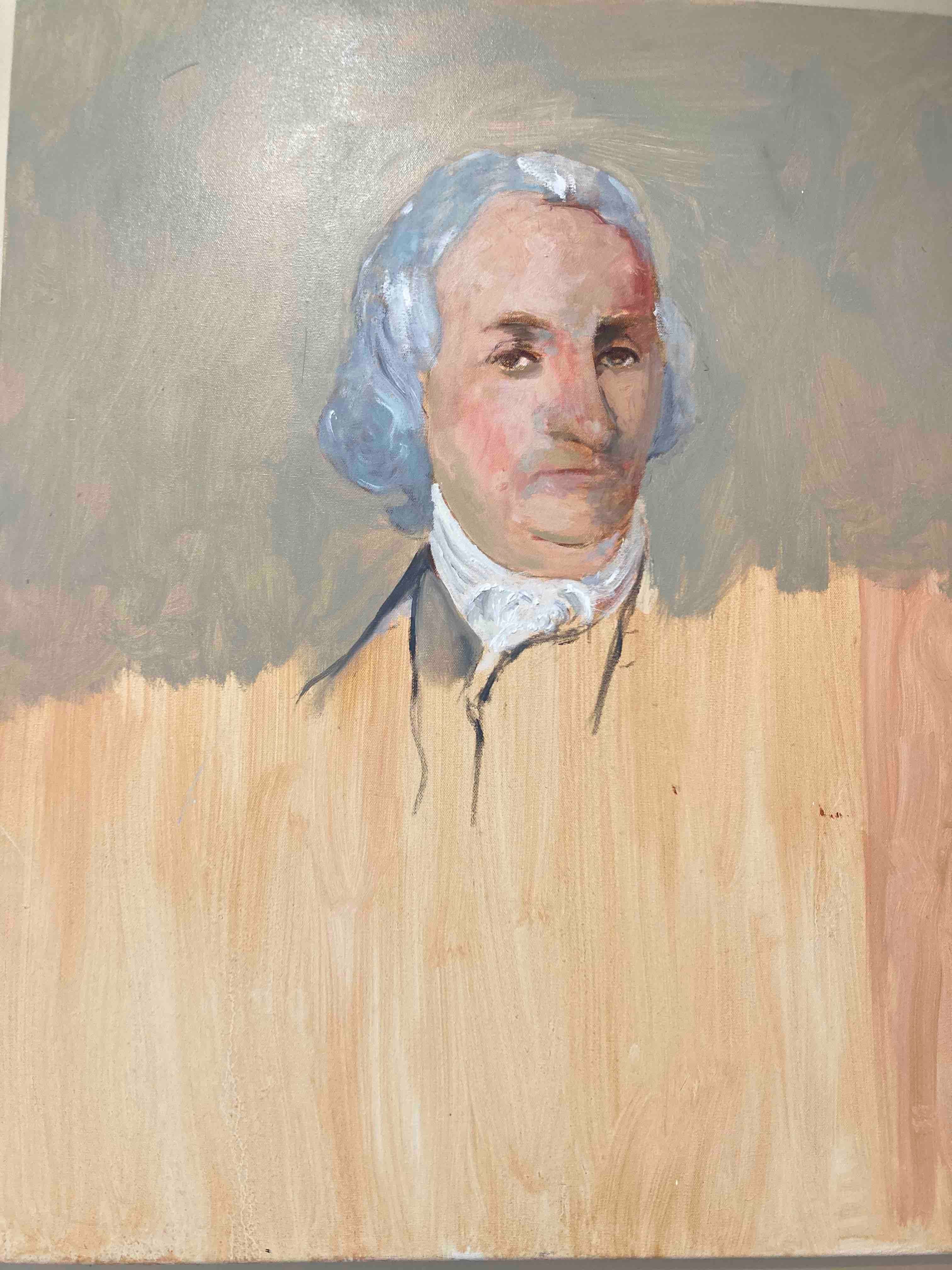
The approach of the 250th anniversary of 1776 means that my biography of Samuel Adams is getting some renewed attention. I spoke about it this afternoon at a conference in Boston, and the appearance went great, until the very end, when my interlocutor asked me—I’m paraphrasing—to name one thing that Samuel Adams said that everyone would be better off knowing.
I stammered a bit and said it was a hard question, to single out one sentence or phrase from among so many—maybe something about thanksgiving and prayer, which were Samuel Adams favorites. The book came out in 2008 so some time has passed since I was immersed in the source material, or maybe I was just running out of gas at the end of the week. My interlocutor offered his own answer, which was a good one, Adams’s rejection of an inducement from the British General Thomas Gage: “Sir, I trust I have long since made my peace with the King of kings. No personal consideration shall induce me to abandon the righteous cause of my country.”
On the commuter rail ride home I realized how I should have answered. Here’s what I should have said:
Samuel Adams was a signer of the Declaration of Independence. The Declaration’s language and arguments drew from the 1772 statement, “Rights of the Colonists,” from the Boston Committee of Correspondence, a statement for which Adams is credited as the primary drafter. The Declaration’s language—“We hold these truths to be self-evident, that all men are created equal, that they are endowed by their Creator with certain unalienable Rights, that among these are Life, Liberty and the pursuit of Happiness”— is the main idea of the American revolution, and, arguably, of America itself. (Other historians might disagree, and say that something else, such as say, no taxation without representation, was the main idea. But the ideological underpinning of the argument against taxation without representation was the idea that it violated inalienable rights.)
President Kennedy, another Bostonian, circled back to it in his own inaugural address: “And yet the same revolutionary beliefs for which our forebears fought are still at issue around the globe--the belief that the rights of man come not from the generosity of the state but from the hand of God.”
Senator Tim Kaine sparked a flap over this earlier this month when he hassled a Trump nominee in a Senate Foreign Relations Committee confirmation hearing: “The notion that rights don’t come from laws and don’t come from the government, but come from the Creator — that’s what the Iranian government believes…It’s a theocratic regime that bases its rule on Shia (sic) law and targets Sunnis, Bahá’ís, Jews, Christians, and other religious minorities. They do it because they believe that they understand what natural rights are from their Creator. So, the statement that our rights do not come from our laws or our governments is extremely troubling.”
Anyway, the nice thing about a daily newsletter as opposed to a live one-off conference interview session is that in a newsletter one has the chance to revise and extend remarks, as the members of Congress say on C-Span. So I thought I’d take this opportunity to do that.
With luck the American Revolution and Samuel Adams will get enough attention in the coming year that even Americans who haven’t written a book on the topic will be able to answer a question like that instantaneously.
A blatant example of New York Times left-wing bias: The New York Times has a news article about the Searchlight Institute, headlined “New Democratic Institute Aims to Erode Left’s Sway.” The print photo cutline says, “the think tank is subsidized by billionaire donors.” The article says “The organization is subsidized by a roster of billionaire donors highlighted by Stephen Mandel, a hedge fund manager, and Eric Laufer, a real estate investor.”
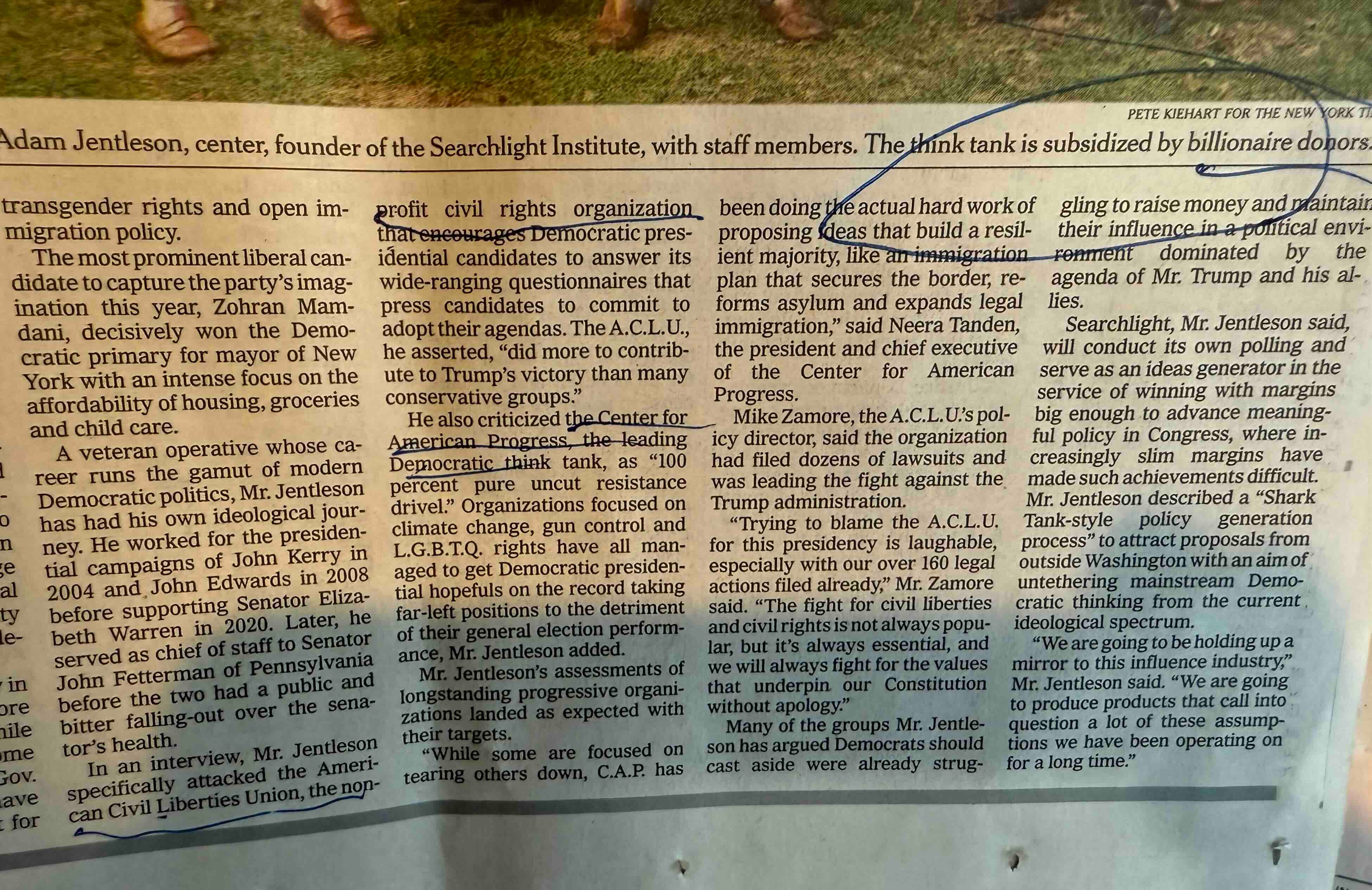
In contrast, look at how the Times describes the advocacy groups whose influence the new organization, founded by Adam Jentleson, aims to counter. The Times mentions “the American Civil Liberties Union, the nonprofit civil rights organization” and “the Center for American Progress, the leading Democratic think tank.” Yet the Times doesn’t mention that those organizations are also funded by billionaires. George and Alexander Soros’s Open Society Foundations gave $15 million to the ACLU in 2022, and the Center for American Progress was run for a while by Soros operative Patrick Gaspard (who is now advising socialist New York mayoral candidate Zohran Mamdani). Soros-Open Society reports pumping at least $9.5 million into the Center for American Progress over the years 2023 and 2024.
It’s a total double standard. When advocacy groups try to pull the Democratic Party toward the center, the Times dwells on their “billionaire donors.” When advocacy groups try to pull the Democratic Party toward the left, the Times describes them as nonprofit civil rights organizations and omits their billionaire funding (some of which also comes from dead rich people who made the mistakes of leaving their fortunes to foundations such as the Ford Foundation or the Hewlett Foundation that went far left.)
The Times has always done this with Republicans, making a front-page story out of political involvement by the Koch family or by Sheldon and Dr. Miriam Adelson while ignoring or downplaying giving from Soros, S. Donald Sussman, and other left-leaning donors. But in this case, even centrist Democrats are getting the “billionaire donor” treatment from the Times. Where were the Editors? Where are the non-far-left newsroom personnel at the Times who might catch this sort of thing before it goes in the paper and further erodes whatever remains of the Times’ credibility.
Feds warn on Harvard finances: The federal Department of Education says it is placing Harvard on “Heightened Cash Monitoring status” and will “require Harvard to post an irrevocable letter of credit for $36 million or provide other financial protection that is acceptable to the Department.”
“Harvard risks losing access to all federal student aid funding due its noncompliance with requests from the Department’s Office of Civil Rights. Moreover, the Department is concerned that Harvard has taken steps to issue over $1 billion in bonds to fund its operations,” the Department of Education said in a press release.
Thank you: At the Editors we have no funding from Soros or from the Ford or Hewlett Foundations, at least so far as we are aware. If you are a centrist billionaire or just approve of keeping a watchful eye on institutions like the New York Times and Harvard—or if you are a reader who appreciates what we are doing—please please help us grow, and help your friends, family members, and associates understand the world around them, by forwarding this email along with a suggestion that they subscribe. Or send a gift subscription. If it doesn’t work on mobile, try desktop. Or vice versa. Or ask a tech-savvy youngster to help. Thank you to those of who who have done this recently (we see the results, and they are encouraging, though sometimes it takes multiple invitations to get results, so don’t be shy) and thanks in advance to the rest of you.
The item "Feds warn on Harvard finances" would have been more complete by referencing earlier articles in The Editors on the subject of Harvard's financial health:
9 May 2024: "Harvard Bond Offering Raises Less Money Than Expected": https://www.theeditors.com/p/harvard-bond-offering-raises-less
12 Mar 2025: "Harvard Bond Offering Falls Nearly $16 Million Short of Goal":
https://www.theeditors.com/p/harvard-bond-offering-falls-nearly-16-million-short-of-goal-columbia-antisemitism-trump-pulitzer-jelani-cobb-oxford-speech-funding
The 1776 wording in the Declaration of Independence of "Life, Liberty and the pursuit of Happiness" does trace back to the 1772 “Rights of the Colonists” wording of life, liberty and property. But that was preceded by John Locke's 1689 wording of "life, liberty, and estate".
There are various hypotheses as to why the Declaration of Independence changed the wording, but since decisions were made by groups it is possible that different people favored the change for different reasons.