


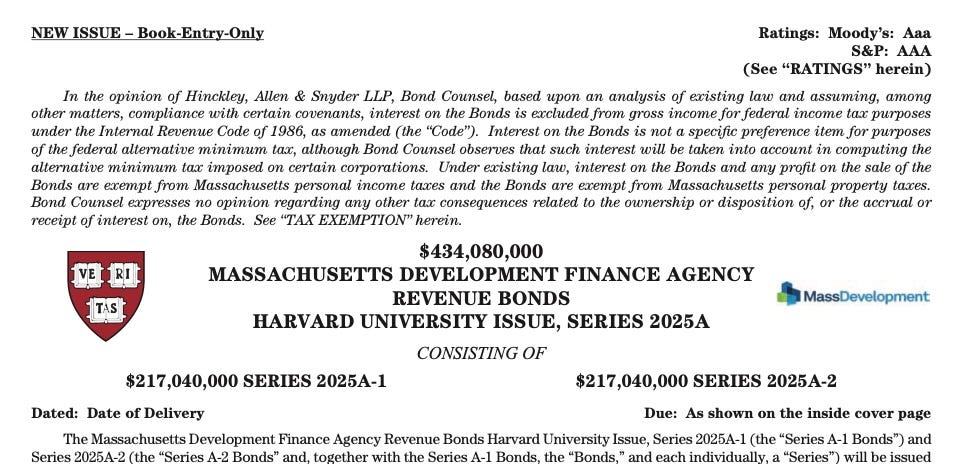
Harvard University managed to borrow $434,080,000 in its latest bond offering—$15,920,000 less than the $450 million it originally aimed for.
A “preliminary official statement” dated February 27, 2025, referred to $450 million in Massachusetts Development Finance Agency revenue bonds that, at closing, would bring Harvard’s total debt to $7.2 billion from the $6.8 billion it owed at the end of June, 2024, and up from the $5.9 billion it owed at the end of June 2023.
The final bond offering disclosure documents say Harvard raised a face-value sum short of the $450 million. They also say the $434 million in tax-exempt bonds were sold at a “premium” of $68,764,783.20, raising a total of $502.8 million, of which $2.8 million went to cover “costs of issuance” including fees for underwriters including Goldman Sachs and Morgan Stanley. The final documents and the preliminary documents both say that they’d leave Harvard with total outstanding debt of “approximately $7.2 billion.”
The bonds carry initial long-term rates of 5 percent and yields of either 2.83 percent or 3.04 percent depending on the batch. Those yields are higher than on similar tax-exempt bonds Harvard issued last year amid an acknowledged crisis in the immediate aftermath of President Claudine Gay’s resignation. The price Harvard has to pay to borrow money has to do with lots of factors, some having to do with Harvard and others having to do with the broader economy, interest rates, and bond market.
Harvard says it will use the bond proceeds to finance or refinance capital projects including “renovations to undergraduate student housing at the main campus, renovations to teaching and administrative buildings at the main campus, renovations to research facility buildings in the main campus and the Longwood campus, and renovation of the Newell Boathouse building at the Allston campus.” Actually, since money is fungible, the borrowed money eases the pressure on Harvard to draw from its endowment, which was $52 billion at the end of June, 2024, and which is largely invested in private equity and hedge funds generating mediocre performance.
The Committee on Uniform Securities Identification Procedures numbers for the latest Harvard bonds are 57585BGT9 and 57585BGU6.
How Columbia can show it is serious: Elsewhere in the Ivy League, the big news has been a federal crackdown on Columbia, including an announcement of “the immediate cancelation of approximately $400 million in federal grants and contracts to Columbia University due to the school’s continued inaction in the face of persistent harassment of Jewish students,” and the detention by immigration authorities of a former Columbia student, Mahmoud Khalil, who served as lead negotiator for a group openly supportive of “armed resistance” by Hamas. (As a New York Times subheadline put it, “Columbia University Apartheid Divest has withdrawn an apology it made last spring for a member who said ‘Zionists don’t deserve to live.’”)
“Immediate cancelation” turns out to depend on your definition of “immediate”—there’s a 30-day cure period in which Columbia might earn a reprieve. Even if Columbia does lose the $400 million, it’s hardly an existential threat to the university; it has multiple trustees and business school trustees so wealthy that they could give a quarter of a billion dollars and it would take a team of their accountants five years to realize it was gone.
If there’s a path forward to improvement for Columbia, it involves introspection about the risks of ideological narrowness. The Columbia Task Force on Antisemitism, led by Ester Fuchs, Nicholas Lemann, and David Schizer, on August 30, 2024 promised, “A separate report on academic issues related to exclusion in the classroom and bias in curriculum will be issued by the Task Force in the coming months.” That report is eagerly anticipated.
Three universities whose presidents resigned amid the campus antisemitism crisis—Columbia, Harvard, and the University of Pennsylvania—are all structurally complicated and suffered from suboptimal governance and leadership. They have all installed new medical doctor leaders, perhaps in recognition of the need for a clinical approach to healing sick institutions.
Columbia controls the Pulitzer Prizes, where an ideological tilt means that the university and its interim president Katrina Armstrong are shoveling prizes in the direction of the New York Times, including for its anti-Israel news coverage. The Pulitzer Board is a bunch of left never-Trumpers. Pulitzer board member Jelani Cobb, the dean of the Columbia Journalism School, gave a March 10, 2025 lecture at Oxford complaining, “During the first Trump administration the American press was reluctant to refer to blatant untruths as lies or to refer to outright trafficking in racial stereotypes as racist behaviour. Our own credulity led to the press treating an autocratic president in the same manner as a democratic one.” Cobb called for news organizations to boycott Trump in solidarity with the Associated Press: “It is odd that any news organisation, certainly any American one, would continue to attend White House briefings or travel with the President while a reputable outlet has been exiled for a decision made on editorial principle.”
Dean Cobb’s response to Trump and to the backlash over rampant and vile antisemitism has been strident resistance: “capitulation never resulted in salvation. Indeed it seemed only to embolden the most zealous antagonists,” he said March 10, 2025.
In September 2024 Cobb issued a statement denouncing Israel for closing an office in Ramallah of Al Jazeera, a network that is controlled by the government of Qatar and has been used as cover by terrorists. (Earlier coverage of Columbia, Qatar, and Al Jazeera: “Bollinger Plumps for Al Jazeera,” March 15, 2011, and “Columbia Honors Al Jazeera,” May 4, 2011.) The Israel Defense Forces have identified at least six Al Jazeera “journalists” as Hamas and Islamic Jihad terrorists. Cobb’s statement acknowledged neither the Qatari control nor the terrorists using Al Jazeera cover.
Dean Cobb can say or do whatever ridiculous thing he wants, but if Columbia thinks that the “academic issues” are somehow separate from the violent student protests, and that it all should be supported indefinitely, and without course adjustments, by unlimited, no strings-attached taxpayer dollars, they may want to consider decreasing their reliance on the Trump administration and Republicans in Congress and begin looking instead to alternative sources. If the federal government is losing patience for paying for this garbage and if Henry Kravis, Adam Pritzker, and Jerry Speyer aren’t going to step in with a rescue, maybe Columbia will have to resort to asking the Massachusetts Development Finance Agency for help borrowing some money.
The Wall Street Journal reports on a "Faculty-on-Faculty War" at Columbia: Humanities professors are supporting Hamas, while STEM professors are losing research grants due to the federal crackdown (https://www.wsj.com/us-news/education/columbia-university-trump-faculty-reaction-725a5e87).
Columbia President Katrina Armstrong was chosen while dean of Columbia's medical school. Armstrong has been aware all along of the danger to the medical and scientific research from the actions of humanities professors, who typically don’t have federal funding. Managing Humanities professors is clearly more difficult than managing medical school professors.
Part of the difference between Humanities professors and others may be due to who has federal grants. But similar differences in ideology among various departments were also evident when Columbia was considering whether to restore ROTC, so this is not just about grant money.
The WSJ noted that "seven Jewish faculty from the engineering, medical, and business schools, along with prominent deans and a representative for Jewish alumni, met with Columbia interim President Katrina Armstrong. They asked Armstrong to get ahead of Trump’s moves by implementing a series of restrictions on protesters, including banning masks on campus" but "Armstrong’s response was to kick the can down the road".
Harvard could show that it's serious about reform by cutting its huge number of EDIB [DEI] staff instead of having a freeze on faculty hiring. Somebody clearly thinks that 60+ Title IX coordinators + staff are more important to the university's mission than new faculty.