

Surprises From Trump’s First Week: mRNA Vaccine Investment, Abolishing Nuclear Weapons
Plus, early rising and money-manager outperformance

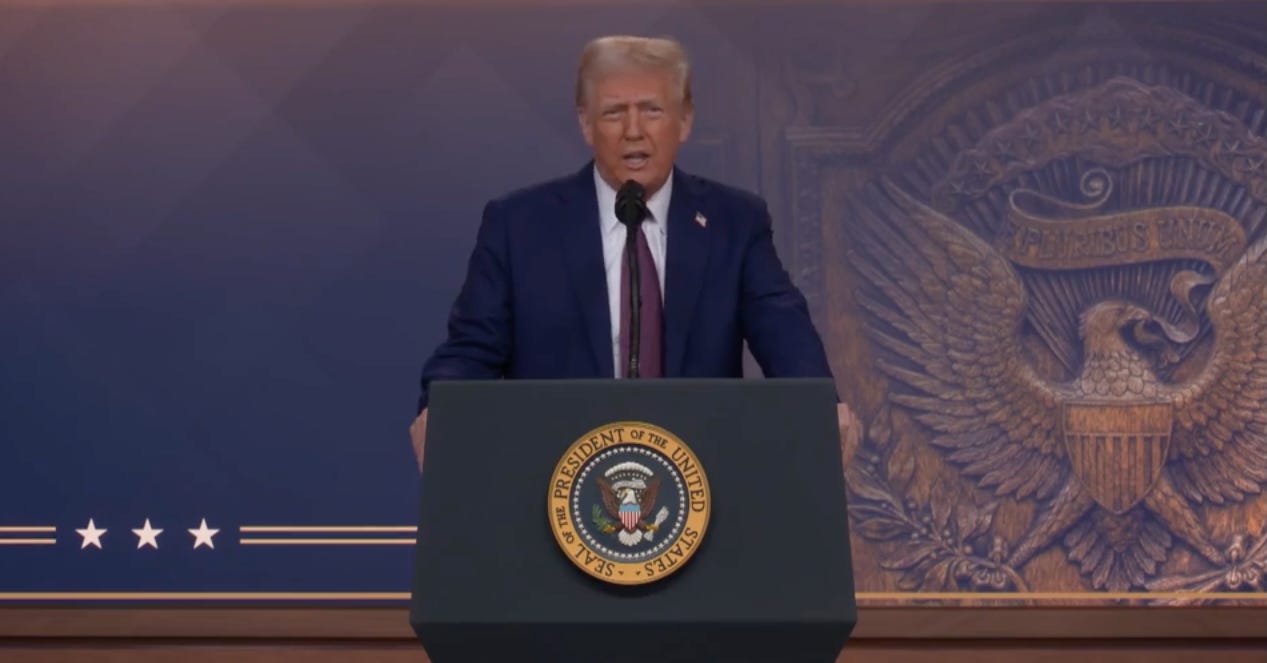
For all the extensive press coverage of President Trump’s first week back in office, at least two surprises have gotten less attention than they probably warrant.
One of Trump’s first official events in his return to the White House was to announce “Stargate,” touted as a $500 billion investment in artificial intelligence infrastructure in the U.S.
“I’m gonna help a lot through emergency declarations, because we have an emergency—we’ve got to get this stuff built,” Trump said, leaving aside the real emergency that there’s so much encrusted regulation that it’s difficult to build anything without a presidential emergency declaration.
Talking about potential practical applications of artificial intelligence, Oracle co-founder Larry Ellison spoke of early cancer detection with a blood test and development of mNRA-based vaccines against cancer.
Trump in his inaugural address had said, “This week, I will reinstate any service members who were unjustly expelled from our military for objecting to the COVID vaccine mandate with full back pay.” And Trump’s pick for secretary of health and human services, Robert F. Kennedy Jr., is a vaccine critic. So some people might have expected Trump to be against vaccines, or against mNRA vaccines in particular, or even “anti-science.” Yet here was Trump on his first full day in office standing by in apparent approval as Ellison sketched what he described as great possibilities of mNRA vaccines against cancer.
Vinay Prasad has an article expressing skepticism: “I'm not confident AI will find the right type of cancer, and I'm even less confident that mRNA vaccines are going to do anything. Spending $500 billion on AI might be a good investment. But it probably is not going to cure cancer.”
I don’t know whether Prasad is right or whether Ellison is right, but I take the White House event as an encouraging sign that Trump will welcome scientific and medical research rather than vilify it. If anti-cancer vaccines do work, government’s biggest challenge probably won’t be compelling people to take them but rather allowing the price mechanism to operate freely enough to summon adequate supplies. Moderna stock (ticker symbol MRNA) gained on the news, suggesting that even if the press isn’t paying much attention, capital allocators are.
The second surprise comment came from Trump in his video session with the World Economic Forum meeting at Davos. “We want to see if we can denuclearize,” Trump said, floating the idea of either a total ban on atomic weapons or “cutting way back.” He said he’d discussed this idea with President Putin and with China in his first term, and that it “would have been an unbelievable thing for the planet.”
Henry Kissinger and George Shultz, both of whom are no longer with us, have been pushing this idea. I’m skeptical that any such agreement would be unverifiable and concerned that it might leave the U.S. and other nuclear powers that do disarm vulnerable to outlaw nations with nuclear ambitions, such as Iran. Also, a nuclear-weapons-free world might mean disarming Israel, whose arsenal is an element of its qualitative edge over its foes.
The best arms control is the spread of freedom, democracy, and rule of law; the nuclear weapons of France and the United Kingdom pose no threat to America, because their governments are not hostile to us.
Anyway, my primary purpose here isn’t to argue the merits or disadvantages of these policies, though I probably am more enthusiastic about mNRA vaccines than I am about some sort of global “zero option” for nuclear arms control. My point is more simply to say that Trump has surprises up his sleeve, and to inform readers of some of them. Who had on their Trump first-week-back-in-office bingo card “propose to abolish all nuclear weapons” and “hold White House event promoting mNRA vaccines”? Not me, for sure. Much of the press doesn’t even report on these developments, perhaps because they don’t match the editors’ or the audience’s preconceived notions.
Early bird gets the worm: Bloomberg’s Matt Winkler has a column profiling Adam Benjamin, whose Fidelity Select Semiconductors Portfolio mutual fund “is No. 1 for the second consecutive year among 431 US-based mutual or exchange-traded funds investing at least $5 billion over the prior five years, producing a 49% total return in 2024.” In 2023 his fund was up 80 percent, the Winkler column says.
“He gets up at 4 a.m. every morning,” Bloomberg reports.
The other day we noted JPMorgan Chase CEO Jamie Dimon telling CBS News that Dimon wakes up at 4:30 a.m.
Benjamin’s Fidelity bio notes that before joining Fidelity he worked at Jefferies, and that he’s a graduate of Suffolk University Law School.
The managers who stagger out of bed at 9 a.m., or at noon, may not be volunteering the information to the press. Likewise, the articles that mention the early-morning rising times typically don’t mention what time the subjects go to bed at night.
If there were robust data linking manager wake-up time to company or fund performance, it would be fun to see. I’m not aware of any, though there is a study showing stock markets retreat on the Monday after a time change. Presumably Dimon and Benjamin are sophisticated, experienced, and self-aware enough to optimize their own wake-up times for performance, happiness, health, or some combination of those values and others.
In my experience, some people are morning people, and some people are night owls. Trying to force someone in one category into the other category leads to trouble.
The press provides these details about wake-up time because they meet a reader's desire to connect business success with virtues, in this case, those of self-control and hard work or industriousness. Maybe the worst-performing mutual fund manager, or the CEO of the failing bank, is also getting up early in the morning. Maybe the success of Dimon and Benjamin is entirely unrelated to their early wake up times but has to do with other factors. Or maybe they are excited to get out of bed each morning and start working at their jobs, and that has something to do with their success.
Benjamin Franklin, who was no slouch, addressed this in the introduction to his 1758 edition of Poor Richard’s Almanac:
How much more than is necessary do we spend in Sleep! forgetting that The sleeping Fox catches no Poultry, and that there will be sleeping enough in the Grave, as Poor Richard says. If Time be of all Things the most precious, wasting Time must be, as Poor Richard says, the greatest Prodigality, since, as he elsewhere tells us, Lost Time is never found again; and what we call Time-enough, always proves little enough: Let us then be up and be doing, and doing to the Purpose; so by Diligence shall we do more with less Perplexity. Sloth makes all Things difficult, but Industry all easy, as Poor Richard says; and He that riseth late, must trot all Day, and shall scarce overtake his Business at Night. … Early to Bed, and early to rise, makes a Man healthy, wealthy and wise.
David Brooks on Trump: New York Times columnist David Brooks writes that Trump “leads a band of arrivistes, establishment-haters, money-seekers and unreconstructed nationalists.”
Later, Brooks concedes that Trump has “accurately identified problems on issues like inflation, the border and the fallout from cultural condescension that members of the educated class have been too insular to anticipate.”
The line about “cultural condescension” in a column that describes Trump’s backers as “a band of arrivistes…money-seekers and unreconstructed nationalists” made me chuckle. Maybe I’m missing something, but it appears to me that even in a column about condescension, Brooks can’t resist a little sneering himself.
Thank you: With a few more paying subscribers, next year The Editor might be able to go to Davos himself, or at least purchase some high-quality Swiss chocolate to eat here in Boston to provide a better approximation of the experience. For less than 27 cents a day, you can send a gift subscription to a family member, business associate, or friend who might benefit from reading. We make this pitch without fear that David Brooks will denounce us as either a money-seeker or an arriviste.