

Paul Krugman Misleads About Federal Workforce
Plus, the Wall Street Journal smears a Zionist founding father

Nobel laureate economist Paul Krugman has left the New York Times for a Substack-based column, a departure he attributed in part to the fact that “in 2024, the editing of my regular columns went from light touch to extremely intrusive.”
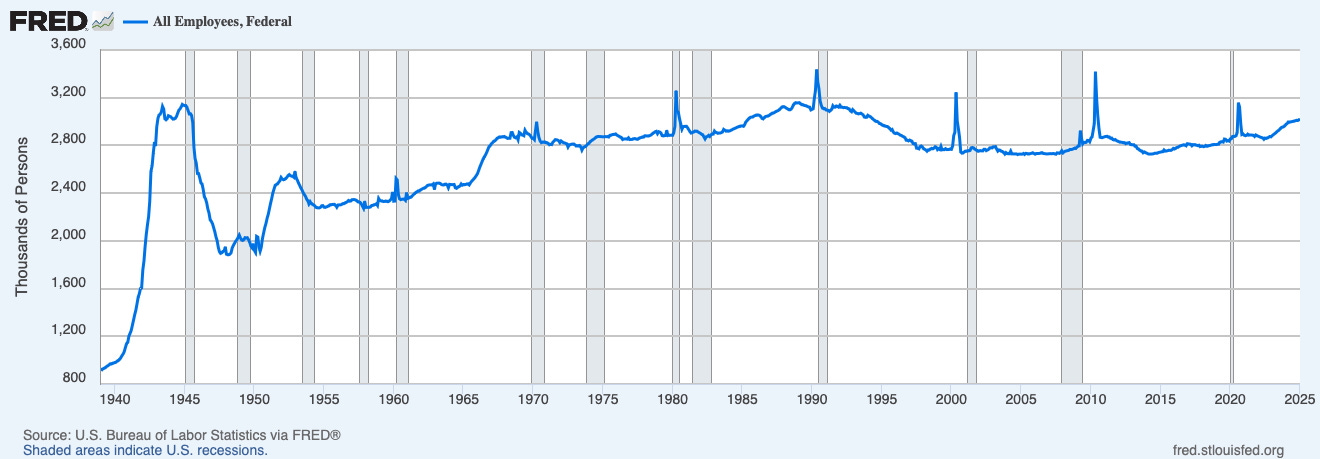
Krugman’s column today could have used some heavier editing. He complains about what he calls “DOGE’s obsession with finding ways to lay off federal workers.” He shows a pie chart to demonstrate that “This makes no sense as a priority if you know anything about where the taxpayer dollar goes.” He asserts, “The federal work force is no larger now than it was under Dwight Eisenhower.”
As the above chart from the St. Louis Fed indicates clearly, it’s not accurate that “The federal work force is no larger now than it was under Dwight Eisenhower.”
Actually the chart shows federal employment at year-end 2024 about 3 million, and the Eisenhower-era peak at about 2.5 million in 1960 or a similar level at the start of his administration at the end of the Korean War. Federal employment spikes every ten years when the census hires census-takers.
There are some nuances that can affect the count—is it just civilian employees or also uniformed military, and, if you include the uniformed military, do you count reserves or just full time. Eisenhower caught the tail end of the Korean War and certainly the Cold War with the Soviet Union.
It’s not clear that an Eisenhower-sized federal government is the right one to use as a comparison. In the Eisenhower era both the government and corporate America were full of clerical workers—typists, telephone operators, filing clerks—whose functions are now automated. It’s now possible, for example, to renew a passport online by uploading a digital photo to a portal, with the passport applicant keying in his own address and birthday. Lots of other forms—tax returns, census questionnaires, even some national park entry fee tickets or passes—have also moved online, reducing the need for labor by government employees. A lot of mail has moved to email, so if postal workers are included in the count, perhaps fewer of them are needed. On the other hand, the U.S. population is larger than it was during the Eisenhower era, so some federal agencies that serve customers might require more workers.
Liberals such as Krugman who would surely reject Eisenhower-era standards of women’s rights, racial integration, gay rights or even environmental regulation all of a sudden want to impose an Eisenhower-era floor on the size of the federal workforce? It seems arbitrary. A logical alternative approach might be to ask what functions the federal government should perform—and is authorized to perform by the Constitution—and then go from there to find the optimal number of employees and contractors to excel at the tasks. Another approach might be to ask how much the nation can afford, given the budget constraints and the risk of crowding out private sector growth. Another approach could be to look back at history at the percentage of the overall population employed by the federal government during periods of peace and prosperity, and try to duplicate that.
Anyway, if the New York Times finally figured out that Krugman could use some editing, that’s a kind of progress, I suppose.
Charles Blow: Speaking of departing New York Times columnists, Charles Blow is also headed for the exit, or more accurately, to Harvard. Here is a passage from his farewell column:
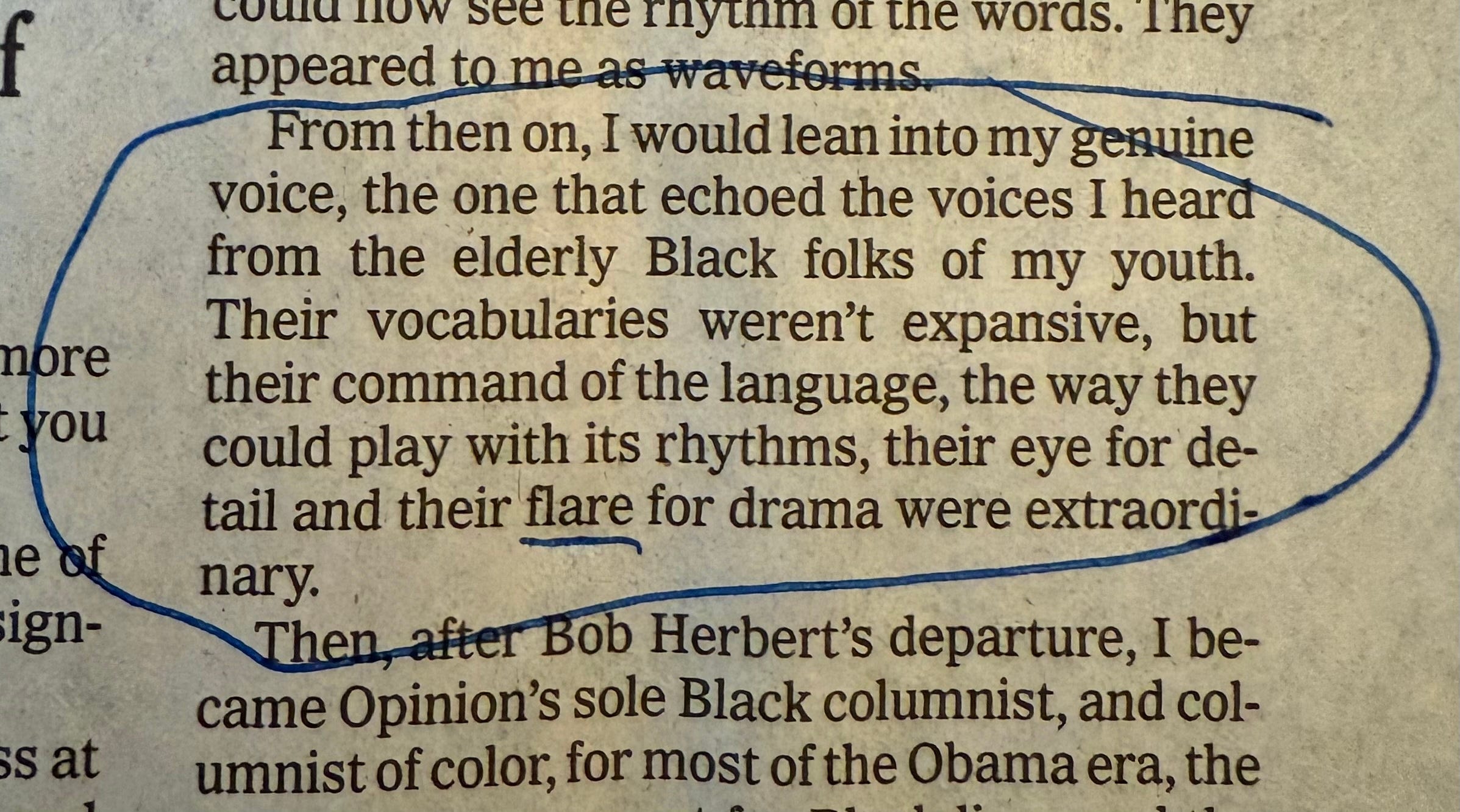
Someone seems to have caught and fixed that online post-publication, but it was ironic that in a passage about command of language the word flair was misspelled. We certainly are not perfect here at The Editors but neither do we have the editorial resources of The New York Times.
Wall Street Journal smears Herzl: A Wall Street Journal news article about President Trump’s plan to allow the residents of Gaza to resettle somewhere else includes this passage, contending, “The idea of removing Palestinians from their lands is rooted in Zionist thought starting with the founder of Zionism, Theodor Herzl. In 1948, it took shape amid war and the creation of the state of Israel, when many Palestinians were forcibly displaced by Israel from their homes and not allowed to return.”

That is just utter nonsense. Herzl’s novel, Altneuland, includes an Arab character who isn’t forcibly removed but rather sticks around and benefits from the progress and prosperity that the Jews have brought to the area. Israel’s 1948 Declaration of Independence said Israel “will foster the development of the country for the benefit of all its inhabitants…will ensure complete equality of social and political rights to all its inhabitants irrespective of religion, race or sex.” It also included an appeal “to the Arab inhabitants of the State of Israel to preserve peace and participate in the upbuilding of the State on the basis of full and equal citizenship and due representation in all its provisional and permanent institutions.” The appeal was included in part because many Arabs were voluntarily fleeing at the time with plans to return soon after, they imagined, the invading neighboring Arab countries vanquished Israel. (A memorably excellent account of this history as it pertains to Haifa in particular is given by Efraim Karsh in his July/August 2000 Commentary article, “Were the Palestinians Expelled?”)
Derek Penslar, a Harvard history professor who I’ve had my innings with, wrote a whole paper on the topic, “Herzl and the Palestinian Arabs: Myth and Counter-Myth.” It says, “the consensus among pro-Zionist historians is that Herzl….intended there to be a substantial Arab presence in the future Jewish state, which would both include Arabs as equals in civil society and respect their religious culture.”
There is a diary entry from 1895 in which Herzl speaks of “expropriation.” Penslar says it was written during a “manic fit,” and is “immediately followed by” a paragraph “guaranteeing the freedom and property rights of people of other faiths.” Penslar also mentions a draft charter for a Jewish-Ottoman Land Company, “never acted upon or even debated,” that spoke of compensating property owners for resettlement on “plots of equal size and quality” elsewhere in the Ottoman Empire.
The bottom line is that it’s a severe mischaracterization of “Zionist thought” to imagine that the mainstream Zionist program involved evicting the local Arabs. On the contrary, with some wartime misbehavior excepted, the main thrust of Zionist thought and activity involved Jewish market-based purchases of land and urging the Arabs to remain as a minority in Israel with full rights. The Wall Street Journal editorial page has been a magnificent friend of Israel, but the news columns have been less trustworthy, as we have noted here from time to time. This is a particularly egregious example.
Recent work: My two most recent columns for the Algemeiner were “New York Times Freaks Out Over Trump Gaza Plan” and “Peter Beinart Bends Truth in New York Times Essay Accusing American Jews of Idolatry.”
The “New York Times Freaks Out Over Trump Gaza Plan” one includes an example of The Editors Rule of Byline Inflation, which is that the reliability of any news article is inversely proportional to the number of reporters who have a byline on it.
Another nuance in contextualizing the number of federal government employees is that there are now many contractors working for the federal government who may be omitted from counts of federal employees.
I was aghast at the Anat Peled story in the Journal. Glad you made the right response.Jon