



The Wednesday New York Times waddles in with a news article by Kate Conger and Ryan Mac about the same Donald Trump-Elon Musk conversation that was covered in Monday’s issue of The Editors. From the Times article:
“Mr. Musk used the chat to showcase his own political views, including on climate, foreign policy and federal spending. He nudged Mr. Trump to soften his rhetoric on immigrants but also agreed with Mr. Trump’s assessment that immigration at the southern border contributed to crime, though academic studies have not supported the idea.”
What would we do without “academic studies”?
Elsewhere in the Wednesday Times comes a piece headlined “Men Charged Over Assault of Woman at Boardwalk”:
David Davon-Bonilla, 24, was charged with first-degree rape, assault, sexual abuse, menacing and fourth-degree criminal possession of a weapon, the police said. He had pleaded guilty to sexual assault in an attack at a migrant shelter last year.
Leovando Moreno, 37, was charged with third-degree assault for striking the 34-year-old boyfriend with the metal pipe, according to the criminal complaint. He was also charged with second-degree menacing, second-degree harassment and fourth-degree criminal possession of a weapon, the police said.
Both men are homeless, the police said. They had not been arraigned as of Monday afternoon, and no lawyers were listed for the two in Brooklyn Criminal Court.
Mr. Davon-Bonilla, a migrant from Nicaragua, whose previous police and court records were under the first name Daniel, was charged last year with attacking a woman at the migrant shelter in Brooklyn, according to a criminal complaint. Mr. Moreno, who is originally from Mexico, was arrested in New Jersey in 2022 for public lewdness on the Seaside Heights boardwalk, according to police records.
It’s one thing for the Times or academics to insist that immigrants commit crimes at lower rates than native-born Americans. That could be; I’m the grandson of a law-abiding immigrant, and I know and like plenty of other law-abiding immigrants. But for the Times to fact-check or Times-splain aggressively, in a political news article, in response to merely the “assessment that immigration at the southern border contributed to crime” seems excessively heavyhanded. It’s almost as if the Times is partisan against Trump and in favor of open borders, rather than an impartial, neutral platform. One senses that the Times reporters, or their editors, are worried about the danger that if any readers get the mistaken impression that migrants contribute to crime, the readers might make the error of voting for Trump.
The Conger and Mac Times team hyperlink to a Times piece headlined “The Myth of Migrant Crime.” For the victim of the alleged rape, it’s no “myth.”
The Times double standard is on display, too, in how the paper handled technical issues that delayed the event start. With the Musk-X event, the Times article dwells extensively on the tech problems. Yet when similar tech issues caused a similarly delayed start of a recent Trump interview at the National Association of Black Journalists, a front-page Times article didn’t even mention the issues or the delayed start. An online Times article about the event failed to mention the technical problems and criticized Trump: “He complained that the interview at the National Association of Black Journalists conference started late.”
Got that? Two recent situations where technical issues caused a delayed start of a Trump event. The Black journalists get a free pass from the Times, while Elon Musk and X get raked over the coals. Musk has been derisive about what he terms the “legacy media,” and the legacy media is returning the favor.
SmarterTimes — School lunch: The New York Times has a piece by Kim Severson headlined “Why Are School Lunches Becoming a Campaign Issue?” that basically warns that if Republicans are elected they plan to starve schoolchildren.
“In addition to Minnesota, Colorado, California, Maine, Massachusetts, Michigan, New Mexico and Vermont offer some form of universal school food. All but Vermont have Democratic governors,” the article says. It has a correction appended: “A correction was made on Aug. 13, 2024: An earlier version of this article misstated the party affiliation of Vermont’s governor. Gov. Phil Scott is a Republican, not a Democrat.”
You wouldn’t know it from reading the Times article, but plenty of public schools and school districts in Republican-run states other than Vermont also provide universal free school lunch and breakfast.
The NBC affiliate in South Florida reports on August 12, 2024, “Broward County Public Schools (BCPS) announced that the Food and Nutrition Services Department will continue to offer free breakfast and lunch to all students for the new school year. …Miami-Dade County Public Schools' Department of Food and Nutrition gave NBC6 a behind-the-scenes look at their Test Kitchen to showcase the District’s new menu items. Breakfast and lunch for students are also free of charge.”
An ABC affiliate in Texas reports that the Dallas Independent School District “announced that all students will eat for free during the 2024-2025 school year …Dallas ISD has been a part of the free meal program for several years, dating back before the COVID-19 pandemic.”
I also know of schools in Massachusetts that were offering universal free lunch and breakfast while Republican Charlie Baker was in charge of the state. And I know of schools in New York that were offering universal free lunch and breakfast while Republican George Pataki was governor of that state.
Education Next ran a forum on the issue back in 2022, “Expand Access to Free School Food?” that did a nice job of identifying the arguments for (“Let More Schools Offer Free Lunch for All”) and against (“There’s no Free Lunch”). Re-reading it reminded me that the maximalist position, from socialist Senator Sanders, is for universal, year-round, government-provided free breakfast, lunch, dinner and snack for all children—separate and apart from food stamps, WIC, tax credits, or other government nutrition and welfare benefits. A good question for Governor Walz, who made the universal free lunch expansion a signature issue in Minnesota, would be whether he agrees with Bernie Sanders on expanding the program to dinner and snack.
SmarterTimes — Food inflation: A news article in The New York Times by Madeleine Ngo attempts to explain why grocery costs have increased:
After the pandemic’s onset, consumers turned away from dining out and panicked shoppers stockpiled groceries. Workers became infected with Covid, making it harder to staff grocery stores, warehouses and meat processing plants, raising costs for businesses.
Then, in early 2022, Russia’s invasion of Ukraine pushed up energy prices and the cost of commodities like grains and vegetable oils. That raised the costs of producing and transporting food products. More recently, droughts and an avian flu outbreak have further strained food supplies.
The confluence of these events has made groceries more expensive as companies have passed along cost increases to consumers. The average price for a dozen large eggs, for example, has nearly doubled from four years ago, to $2.72 from $1.55. Prices for cereals and bakery products have climbed about 25 percent over the same period, while fruits and vegetables were up about 14 percent.
Those increases have largely been driven by the cost of transporting, packaging and processing food products, said David Ortega, a food economist at Michigan State University. “The vast majority of the cost of food is because of things that happen once that food leaves the farm gate.”
Totally absent from this account is any mention of the government spending binge and prolonged zero interest rate policy by the Fed that fueled economy-wide inflation even for things, like land, that don’t have to be transported, packaged or processed. Also totally absent from the Times account are the effects of animal rights regulations. Even the Associated Press acknowledged earlier this year, “government regulations play a part in lifting egg prices. Multiple states, including California and Massachusetts, have passed cage bans for egg-laying hens since 2018; this year, bans are set to take effect in Washington, Oregon and Michigan. Converting to cage-free facilities is a big investment for farmers, and consumers may not always realize that’s a factor in the higher prices they see at the grocery store, Metz said.”
SmarterTimes — Division?: A New York Times article by Jonathan Weisman about how Democrats are handling voters upset that Biden and Harris have been too supportive of Israel includes this passage: “The Republican Jewish Coalition on Monday issued a challenge to speakers at the Democratic convention seemingly designed to stoke division: Praise Israel from the podium, and the group will plant 1,800 trees in the Jewish state.”
It’s seemingly odd for the Times to describe the challenge as “seemingly designed to stoke division.” If anything, the challenge appears designed to inspire bipartisan unity by offering the Democrats an encouraging reward for joining the Republicans in praising Israel.
Civil Discourse: A Wall Street Journal editorial about the new School of Civic Life and Leadership at the University of North Carolina, Chapel Hill reports that its dean, Jed Atkins, came from Duke, where “students were also given an option to live in a civil-discourse dorm community, which made respectful debate into its own campus affinity group.” Sounds great, but how about the students living in the other Duke dorms? Are those residences discourse-free? Or incivil?
It reminded me of a recent college visit where the tour guide mentioned that students had the option to request placement in “substance-free” housing. It took considerable restraint not to ask how much substance use and abuse there was in the rest of the housing.
War on Merit Gets Results: The Boston Globe has a graphic showing the dramatic decline in applications to Boston’s exam schools, which include the nation’s oldest and arguably best high school, Boston Latin School:
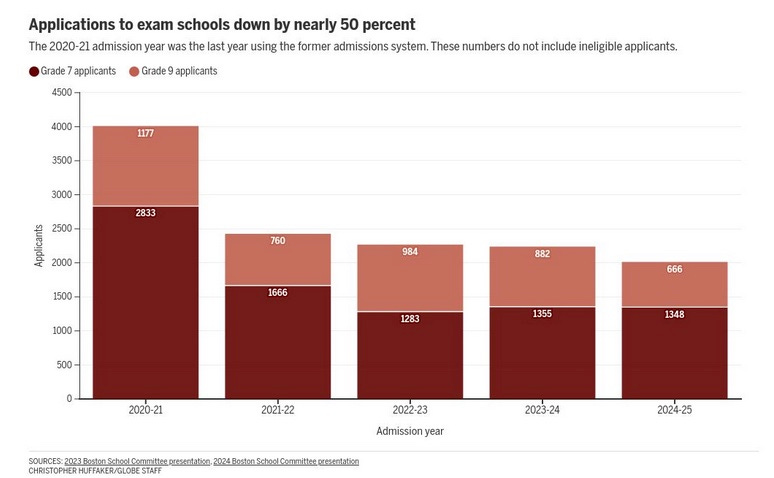
What happened? The city, backed by the Boston Red Sox and at the behest of the local NAACP and Anti-Defamation League, changed the admission process to the schools from a citywide combination of test scores and grades to a “Zip Code quota” scheme that penalized private school students and those from higher-income neighborhoods. Simultaneously, it altered the timeline so that notification about exam school admissions is now after the private school deposit deadline. Families got the message about the city’s priorities and whether they were wanted, and acted accordingly. The Globe article largely fails to convey this.
“The new policy has crystalized the challenges BPS has had for years in attracting low-income students,” the Globe story says. “The problem highlights the need for BPS to more proactively recruit disadvantaged students, said Christopher Parris, chief program and innovation officer at Steppingstone.”
But the dropoff in exam school applications isn’t mainly the result of challenges “in attracting low-income students” or “disadvantaged students.” It’s the result of middle class and private school families abandoning the schools after the school system sent a message it cared about diversity more than academic merit.
From the Globe:
“The new exam school admissions policy is undoubtedly a success,” said Oren Sellstrom, litigation director at Lawyers for Civil Rights Boston, which is defending the exam school changes in federal court. “The process is now much more fair and equitable, and the result is a student body in the exam schools that better reflects the socioeconomic, geographic, and racial diversity of the city.”
What a strange definition of “success” when half as many students as before are interested in attending the schools.
There’s still some litigation ongoing about the changes, and it’s possible that the political process would also eventually adjust the admissions process so that the schools are more broadly attractive, but at the moment, this looks like a shame. Sadly, too, this one was also fueled by a Harvard Kennedy School “policy brief,” “Increasing Diversity in Boston’s Exam Schools.” With any justice, Harvard’s own applications would also plummet in half, as word got out that the institution was fueling such misguided government policies.
The War Against the Jews is a War Against Capitalism: Also in the Globe is a story headlined, “Socialism’s at the core of pro-Palestinian movement's next phase on college campuses.” It reports from Northampton, Massachusetts, on the “Western Massachusetts Popular University for Palestine”:
The main speaker, a University of Massachusetts Amherst PhD candidate [William Chaney], took the stage. He donned a keffiyeh and a Cuban Communist Party cap emblazoned with a red star, and began discussing readings by Vladimir Lenin, Joseph Stalin, and Leila Khaled, a former Palestinian militant and first woman to hijack an airplane.
The Globe article reports on the overlap between anti-Israel and anti-capitalism, which I have been writing about for some time.
“It felt like the blueprint, [or] the mappings of a better society,” said Owen Buxton, a student who was arrested twice in the spring semester at pro-Palestinian protests near Emerson College. “It felt like living outside of this capitalist, white supremacist patriarchy could actually be possible within my lifetime, which was inspiring.
It’s nice to see the Globe waking up to the news that the anti-Israel protesters are Stalinists. Whether that will make university administrations or the Democratic Party leadership less willing to accommodate their disruptive shenanigans is another question.
Reader comments: The Editors have a fabulously brilliant group of readers. Yesterday’s issue generated five lively comments. Many people read the newsletter via email and thus may not see the comments. In cases where the comments are lively I will try to link back to them this way so that they get seen and thus help add value both for the commenters and the readers. I’m grateful to both. Also yesterday, some reader accepted my suggestion and forwarded the newsletter to a large group, which helped generate some new subscriptions. If you have a network that would appreciate the newsletter, please help us grow by spreading the word.
And if you made it this far down and aren’t yet a paying customer, please take a minute or two, if you can spare the $8 a month or $80 a year. It will assure your continued access and sustain our independent journalism. It also brings commenting privileges.
Do the academic experts and the NYT compare the crime rates of legal versus illegal immigrants? If the crime rate were significantly lower for legal immigrants, that would argue for switching to an immigration system similar to that of Canada, with high rates of legal immigration and low rates of illegal immigration.
A Trump administration, led by the son of a legal immigrant who is also the husband of a legal immigrant., would likely be open to such an approach.
When I attended BLS 1977-1983 we started with 435 students and graduated 285. There were two fights the first year and one student was expelled when fought a second time. Today, lady two years, half of the incoming class has flunking grades and should’ve been kept back. They were passed. Over 50 fights in the incoming class, police called several times. My heart breaks. It’s the school formerly known as Boston Latin School.