

New York Times Shows a Double Standard on Saudi Polling
A special Smartertimes throwback edition.

Two items are here from the same page (A5) of the Saturday, May 17 New York Times. See if you can spot the inconsistency:
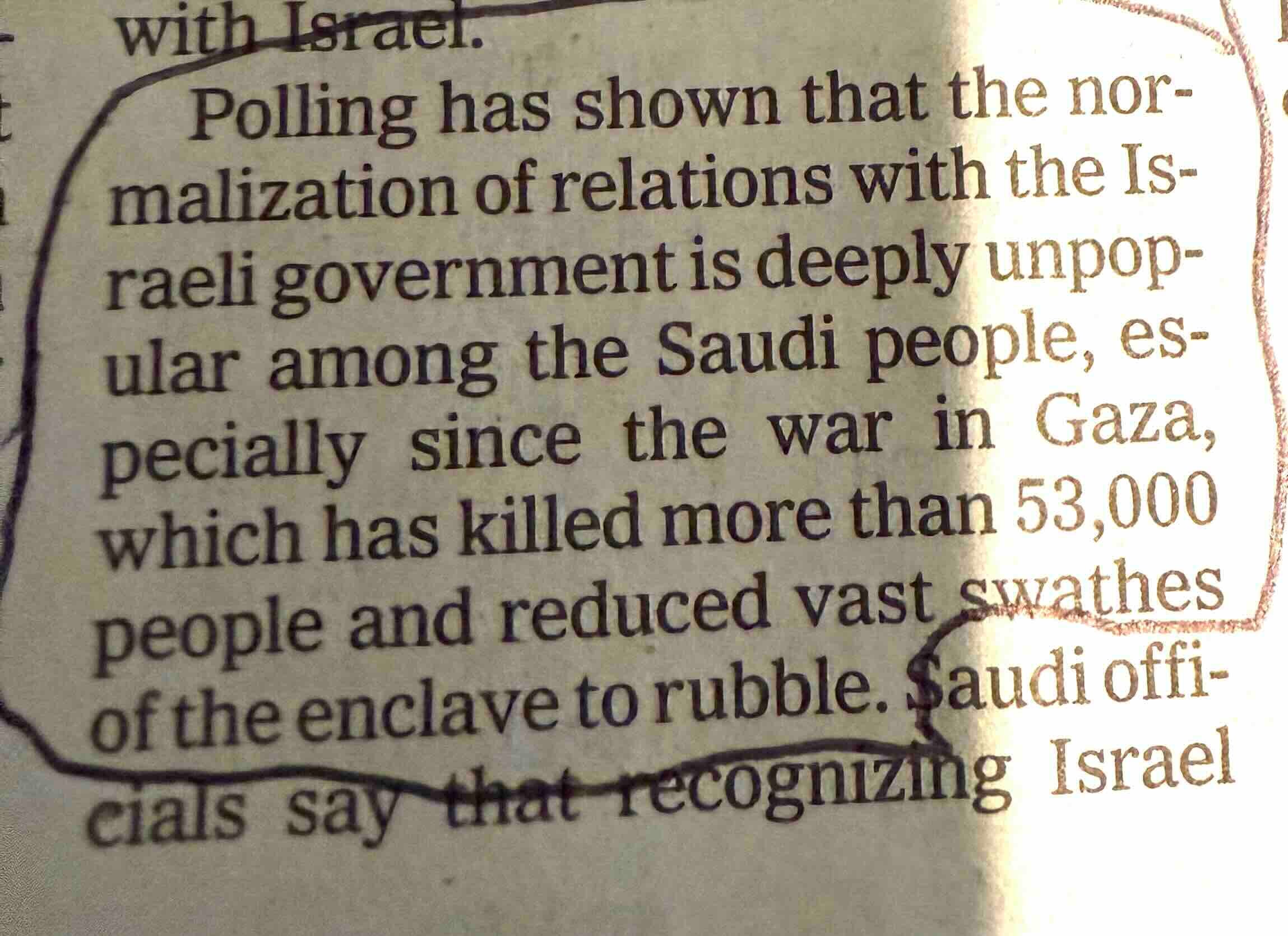
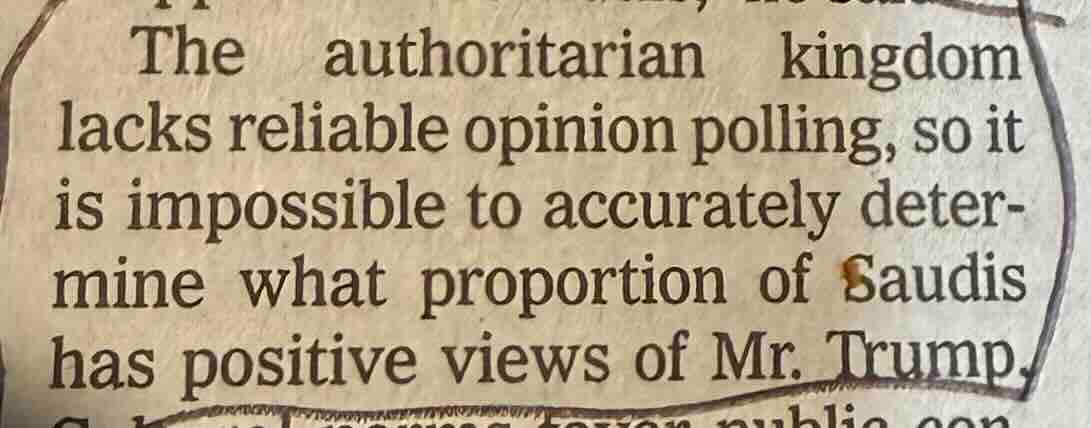
Got that? When the Saudi Arabian opinion polls detect popular hostility to Israel, the Times cites them as authoritative. When polls might show that President Trump is popular in Saudi Arabia, the Times declares that opinion polling in the kingdom is unreliable. It’s almost as if the Times view of the reliability of the polling depends on whether the Times thinks its own readers would be pleased with the outcome. And it’s almost as if the Times thinks its own readers are not sharp enough to notice the inconsistency.
The stories have different bylines. Luke Broadwater and Erika Solomon are pushing the polls, while Vivian Nereim is the one who says, more accurately, that the Saudi polls can’t be trusted. If a single editor handled both pieces, maybe he was operating inspired by the new president of the Harvard Alumni Association, William Makris. The university-published house organ Harvard Gazette reports, “Makris is building on Savard’s concept of veritates, or many truths — embracing multiple truths…”
Times sees anti-L.G.B.T.Q. Trump crusade: A May 17, 2025, Times news article by Michael C. Bender reports, “The administration’s actions are part of what it describes as an overarching cultural crusade against antisemitism and inclusive practices toward L.G.B.T.Q. people on college campuses, particularly at Harvard.”
I follow this stuff pretty closely, and if the Trump administration has publicly declared “what it describes as an overarching cultural crusade against …inclusive practices toward L.G.B.T.Q. people on college campuses, particularly at Harvard,” I missed it.
The Trump administration certainly doesn’t want men in women’s sports. There was a day one executive order on “defending women from gender ideology extremism and restoring biological truth to the federal government.” But some people who are gay or lesbian or bisexual see themselves as just that, not part of a broader identity group of “L.G.B.T.Q. people.” The Times isn’t serving the cause of accuracy or impariality with language in a news article taking a side on that one by lumping the transgender individuals in with the gays and lesbians.
James Kirchick, author of Secret City: The Hidden History of Gay Washington, spoke at that Center for Jewish History event Sunday on “The End of an Era? Jews and Elite Universities.” Kirchick, who is certainly not hostile to gays or gay rights, was quite negative about what he called the “rise of queer theory and radical transgender movements.”
The New York Post has a list of prominent Trump administration officials who are gay or lesbian, starting with Treasury Secretary Bessent.
My point here is not to defend the Trump administration’s policies on transgender matters. But the Times isn’t doing readers any favors by exaggerating the policies or by describing those policies imprecisely in the language of activist groups trying to mobilize broad support. It’s true the Trump administration is pushing against “DEI” or “Diversity, Equity and Inclusion” on campuses, but the theory there seems to be that by dividing people into oppressors and oppressed classes or treating them as group members rather than as individuals, the programs aren’t genuinely inclusive at all.
It’s a small point, but it contributes to the overall sense I have some days that the Times has become an anti-Trump newsletter that stokes panic among its readers by exaggerating what Trump is doing.
Good to see this criticism of the "LGBTQ" presumption. I have several gay guys in my immediate family. Not a one of them feels any affinity with transgender radicalism. As one of them put it bluntly to me, "I'm not attracted to any male's 'gender identity,' I am attracted to his male body." The backers of the current gender wars have imposed a terminology that presumes what is not so in order to use the gay rights movement's prestige to legitimize a truly radical, gnostic agenda. This needs to be challenged more often.
BREAKING NEWS FROM 2017: "The Times has become an anti-Trump newsletter that stokes panic among its readers by exaggerating what Trump is doing."