

At Symposium on “The End of an Era? Jews and Elite Universities,” Talmudic Wisdom and Trump-Bashing
Ackman says Harvard talent will flow to Vanderbilt, Duke; Columbia’s Lemann touts Tulane

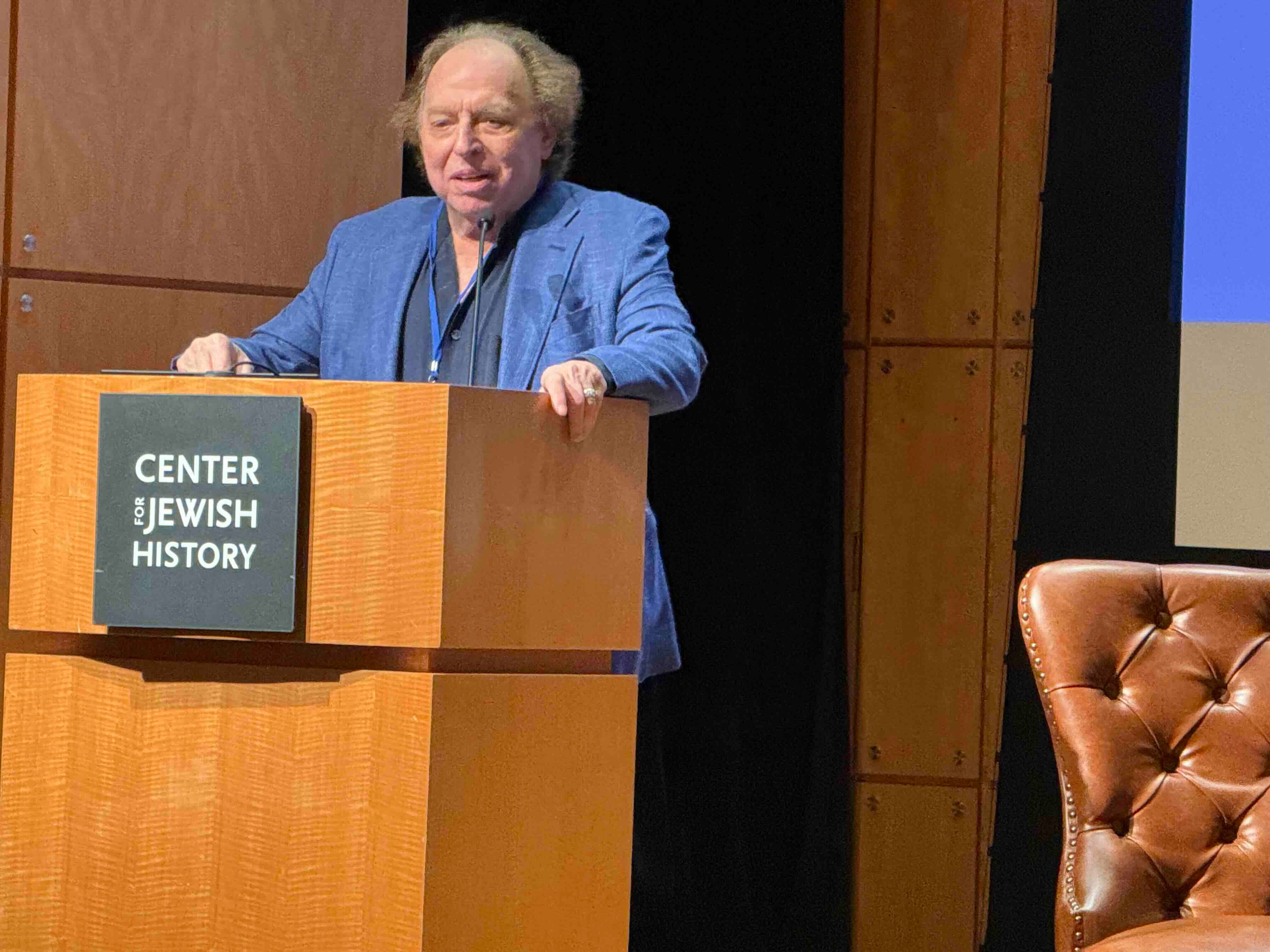
Partisan political differences spilling over into economic expectations have been a recent theme around here. Yesterday’s daylong symposium at New York’s Center for Jewish History on “The End of an Era? Jews and Elite Universities” offered evidence that President Trump looms as large over higher education and campus antisemitism as he does over nearly every other issue these days.
The event began with the president of the Center for Jewish History, Gavriel Rosenfeld, making a quick reference to how the center itself had been “adversely affected by capricious budget cuts.”
Paul Berman, a veteran of Columbia University’s Students for a Democratic Society chapter that took over the campus in April 1968, claimed that America has never seen a crisis on the scale of what Trump is doing other than “perhaps” the early 1860s Civil War. He said he was worried about an end to what began in 1776.
Susie Linfield, a professor of journalism at NYU, spoke of what she described as a “crisis…launched by Trump,” an “unprecedented assault on the universities” as well as against “the Constitution itself.” Trump, she said, “dreams of a world in which Donald Trump will have unfettered power.” Linfield said it was “nefarious and grotesque” to “vet foreign students for their politics,” describing it as “a very, very terrible road for us to go down.”
Rachel Gordan, an assistant professor at the University of Florida, spoke of what she called an “era of repression and fear on campus that many people have compared to the McCarthy era.” She spoke of what she called a “crisis of democracy.” She said it doesn’t seem like the Trump administration favors democratic pluralism.
Stephen Pinker, a professor of psychology at Harvard, said he’s “never experienced antisemitism” in 22 years of teaching, and rued what he said was “the fact that the Trump administration is using it as a pretext to defund science.”
Deborah Lipstadt, an Emory professor who served during the Biden administration as the U.S. Special Envoy to Monitor and Combat Antisemitism, said that while she appreciated some of the Trump administration’s early moves, “what we’re seeing now is an attack on elite universities in the name of antisemitism.”
So it might have been possible for someone to come away from the day with the idea that the big issue of the day is Trump’s attack on America, and that the “Jews on campus” story is noteworthy at the moment primarily for its role in that larger narrative.
Some of the program was devoted to topics other than how terrible Trump is. Those, to my mind, were the most valuable contributions.
Rabbi David Wolpe talked of four qualities that he said were lacking during the 2023-2024 academic year he spent as a visiting scholar at Harvard Divinity School: honesty, empathy, humility, and courage. He said Jews should not abandon or be chased out of these universities, but to be there demands fortitude that shouldn’t be expected of every student.
Linfield spoke of an Israeli doctoral student in Slavic studies at Yale. “Starting October 8 her professors literally stopped speaking to her” and treated her as a pariah, Linfield said.
The executive director of Harvard Hillel, Rabbi Jason Rubenstein, spoke of a student at SUNY Purchase who wouldn’t enter the Hillel there because she feared that if she were photographed she’d lose a shot at working in the art world. He said a Yale secret society had rescinded a “tap” to an alleged Zionist after other students said they wouldn’t be in a club with a Zionist. He said an Israeli student at Harvard’s Graduate School of Education avoided the campus buildings because if friends were seen talking to her, they’d be excluded by their peers from WhatsApp group messaging chats.
Rubenstein said that when he had tried to raise a concern about a pro-Hamas speaker at Yale, he was accused of participating in “a right-wing campaign” and told, “Jason, sharing an increasingly diverse campus means sharing it with people with whom Hamas means different things.”
Rubenstein said during at the Harvard encampment, one Jewish student who thought about leading shabbat services there asked the protesters to tone down some of their “globalize the intifada” rhetoric. The response from one organizer, who had been in Cuba the prior summer training for revolution, was, “we have had to sacrifice some of our autonomy.”
Lipstadt observed that the anti-Israel protests also had an anti-capitalism strain. “It’s Occupy Wall Street on steroids,” she said. “The universities failed. They failed to take this seriously.”
A professor at Columbia, a former dean of its journalism school, Nicholas Lemann, who gave me my first job out of college as a researcher on a book he was writing, said the biggest change at Harvard since his student days had been the rise of computer science and economics “to complete dominance of undergraduate life.” That, he said, was the big story about all these universities—and it has left the humanities and the softer social sciences feeling “beleaguered and sort of oppositional.”
Lemman said the furious negative reaction to Columbia’s antisemitism task force, which he co-chairs, had ended some of the personal relationships he had forged over 22 years at the university. At one point his voice broke as he spoke of the “dismissal of the kind of Jewish kids my kids are. It really makes me upset.”
Harvard graduate, donor, and critic Bill Ackman, CEO of Pershing Square, said he completely disagreed with Pinker that Trump was using antisemitism as a pretext.
“I believe that Harvard has failed in a very dramatic way,” Ackman said. He said suing the federal government, as Harvard has done to try to preserve its federal funding, is “The world’s stupidest move.”
“That’s not how you deal with Trump,” Ackman said.
Seventy-six academics signed on to a letter in advance of the event demanding that it be canceled. “The lineup of speakers for this event endangers the Center’s reputation for academic excellence and integrity,” they wrote. “We are most concerned about Bill Ackman's top billing in the program. We find it disgraceful that the CJH would elevate someone who lacks any scholarly credentials on the topic.” Ackman’s Harvard senior thesis was on Jewish quotas in Harvard admissions.
Ackman and some of the other speakers spoke of how competition and choice and the mobility of talent would play out. “Students are choosing to go elsewhere, and I think for a very good reason,” Ackman said. Ackman said the Trump administration is “not anti-science,” and said grant funds from Harvard might be reprogrammed to Vanderbilt or Duke—and faculty members might leave Harvard for those institutions, too.
Lemann noted that “Tulane has figured out its future is to be the most Jewish university in America.” He said that has helped to save his hometown of New Orleans. He said his son teaches at Marquette University, in Wisconsin, whose campus has been calm.
Rabbi Wolpe brought a teaching from the Jerusalem Talmud (found both in tractates Peah and Shekalim): “Rebbi Ḥama bar Ḥanina and Rebbi Hoshaiah were strolling through the synagogue of Lod. Rebbi Ḥama bar Ḥanina said to Rebbi Hoshaiah: How much money did my forefathers invest here! He answered him: How many souls did your forefathers invest here, there is no one in here who studies Torah.”
Which is to say, at least as I interpret it, that decadent, and expensive, educational institutions have been a problem since at least the 3rd century CE.
One could see that as discouraging—the Jews have been grappling with this issue for 1700 years and still haven’t solved it.
Or one might see it as optimistic: the Jews have been working on this issue for 1700 years, which demonstrates remarkable endurance. The people and the learning somehow manage to outlive the institutions.
None of that is to be dismissive of the real problems of the institutions, any more than to express confidence in America is to be dismissive of the concerns about Trump. But it tells something that, from a full day’s discussion by a lot of highly educated, articulate, and accomplished people, the historical insight that put the Harvard and Columbia situations in the best historical context came from a rabbi quoting the Jerusalem Talmud.
If Trump dreams of a world in which he will have unfettered power, why does he advocate having the States (not the Federal government) have authority over the permissibility of abortions?
Why is he trying to eliminate the Department of Education, over which he has authority?
Why is he weakening other Executive Branch departments?
Why does he support Charter Schools, school choice, and parent groups while the Democrats support teacher unions?
Why are the Democrats (not Trump) talking about packing the Supreme Court?
Why did the Democrats use the courts to remove Trump from the ballot in Colorado -- Trump did not attempt that against the Democrats.
Why did Trump not put large numbers of US residents and citizens into “relocation camps,” but liberal Democrat President Franklin D. Roosevelt sent Japanese-American citizens and residents into them?
The "Center for Jewish History" event had an impressive array of well-known speakers, with diverse viewpoints. It is striking that the one with the best grasp on what is going on, Bill Ackman, was the subject of a protest about the value of his participation from 76 academics (of whom I'd only heard of one, and that was because I went to high school with his sister).
I'd have liked to hear Ackman's talk, and if there is video it would be good to get the link.
No mention here was made of Ruth Wisse, who is in NYC these days and was not mentioned as a speaker.
The big news here is that Ackman drew attention to the "shoe that hadn't dropped": the possibility that the federal government will allow those at Harvard with federal grants to take the grants to other universities. I've avoided raising this scenario publicly because it is the one remaining step that would most cripple Harvard. If it came to pass I didn't want anyone to think I had suggested it. Clearly Ackman was on the same wavelength but decided otherwise.
At the minimum, Harvard should be getting advice from Ackman about how to navigate this crisis. The wisdom of Ackman's comment about Harvard's lawsuit being a blunder is illustrated by Education Secretary McMahon's observation that it is now difficult for her to negotiate with Harvard because of the lawsuit.
Harvard has not yet gone down the tubes, but it is circling the drain. The one genius move that could save Harvard at this point would be to appoint Ackman as the head of Harvard's governing Corporation. That seems like magical thinking but MIT made a similarly smart appointment recently to its Corporation: https://corporation.mit.edu/member/bennett-w-golub/