


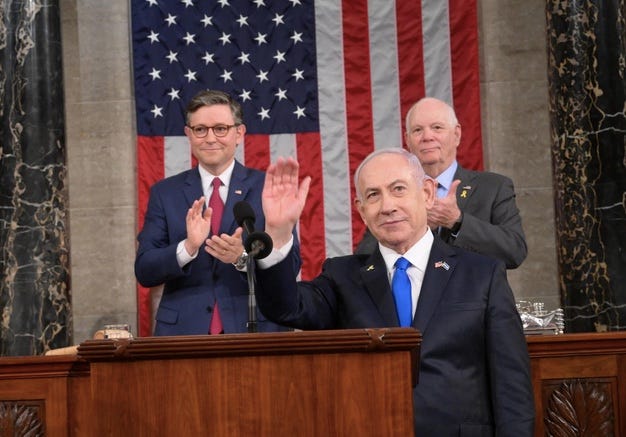
Prime Minister Netanyahu covered a lot of ground in his speech to Congress today. But the most important message he carried may be one that wasn’t about Israel, but about America.
In the run-up to Prime Minister Netanyahu’s speech to Congress today, Senator Schumer called for Netanyahu’s government to fall, and New York Times columnist Bret Stephens wrote that the prime minister shouldn’t come.
Netanyahu sure made them look silly by hitting a home run with his speech.
All the material you’d expect was there, strongly presented. “This is not a clash of civilizations. It’s a clash between barbarism and civilization,” Netanyahu said. “For the forces of civilization to triumph, America and Israel must stand together.”
When they do, “we win, they lose,” Netanyahu said, echoing Reagan’s plan for Cold War victory.
He called Hamas “monsters,” saying, “They raped women. They beheaded men. They burned babies alive.”
He highlighted the heroism of individual Israeli soldiers, including a soldier with no car who, on October 7, ran eight miles to fight on the front lines; a Bedouin soldier, and a tank corps officer who was wounded and lost his right arm and vision in his left eye, and is returning to duty as a tank company commander. “These are the soldiers of Israel — undaunted, unbowed, unafraid,” he said. He said the Israeli soldiers shouldn’t be condemned, but should be commended.
He also introduced Yechiel Leiter, whose son Moshe was killed in the war. “The sacrifice of your loved ones will not be in vain,” Netanyahu told Leiter and the other family members of fallen soldiers.
He lambasted the anti-Israel protesters: “They stand with Hamas. They stand with rapists and murderers. They should be ashamed of themselves.” He noted that Iran is promoting and funding anti-Israel protesters in America.
To the protesters, he said, “you have become Iran’s useful idiots.” He likened the slogan “Gays for Gaza” to “chickens for KFC.”
“It’s not only the campus protesters who get it wrong, it’s also the people who run the campuses,” Netanyahu said.
Netanyahu said “Iran sees America as its greatest enemy.”
“Israel is first. America is next,” Netanyahu said. “We’re not only protecting ourselves, we’re protecting you.”
The key point, he said, is, “Our enemies are your enemies, our fight is your fight, and our victory is your victory.”
He called Jerusalem “our eternal capital, never to be divided again.”
He thanked Biden for flying to Israel to visit after October 7 and for sending two U.S. air carriers. He thanked Trump for the Abraham Accords.
The first of Netanyahu’s two policy asks was “fast-tracking US military aid.” Echoing Churchill, he said, “give us the tools faster and we’ll finish the job faster.” (Netanyahu didn’t mention it, but there appears to be something of a competition between Ukraine and Israel for priority in U.S. weapons shipments.)
The second was a “new alliance against Iran,” which he proposed to call “The Abraham Alliance.”
He called, as he has in the past, for a “demilitarized and deradicalized Gaza.”
My favorite line of the whole thing wasn’t about Israel or Iran or Gaza or the war. It was about America. “I’m hopeful about America, because I am hopeful about Americans,” Netanyahu said. Coming after a Republican convention that, while well-executed, emphasized America’s problems in making the case for firing the Democrats, and coming as Biden himself, old and frail, warns that America is on the edge of plunging into tyranny, the Israeli’s optimism was welcome and pitch-perfect. It has often, recently, seemed absent from high-level American politics. Netanyahu and his minister of strategic affairs, Ron Dermer, are the rare foreigners savvy enough about America to understand what we need to hear.
The Congress, greeting him warmly and in a bipartisan manner, interrupting repeatedly with standing ovations, despite advance warnings about protests and absences, made Netanyahu seem correct in placing hope in America.
“Hope” has had its moments in American politics—Bill Clinton was the man from Hope, Arkansas, and Steve Forbes had a group called Americans for Hope, Growth, and Opportunity—but it has faded as a theme as Republicans push “great” and Democrats emphasize “democracy.” If Netanyahu can help restore the idea to the American conversation it’ll be a contribution that may yet eventually be as significant as any battlefield victory against an Iranian proxy.
You could say that Netanyahu and Dermer managed to pull it off because, having both spent lots of time in America, both as Israeli diplomats and as youngsters, they understand America. But in the end the idea of hope emerges not only from a deep understanding of America but from, also, the Israeli character. It is another shared value of Israel and America. The Israeli national anthem, after all, is Hatikvah—the hope.
Harris runs against Wall Street: At the Republican convention, Senator J.D. Vance, the vice presidential nominee, pronounced, “We’re done, ladies and gentlemen, catering to Wall Street. We’ll commit to the working man.” He said that in the financial crisis, ““Wall Street barons crashed the economy.” That came after another night’s prime-time Republican convention speech by the president of the International Brotherhood of Teamsters, Sean O’Brien, who denounced “corporate vultures” and “corporate elites” and “their pillaging of working people’s pocketbooks.”
Vice President Harris seems determined not to let the Republicans outdo her when it comes to Wall-Street bashing. In her first big political event since Biden dropped out of the race, at West Allis High School in West Allis, Wisconsin, Harris said, “As attorney general of California, I took on the big Wall Street banks and held them accountable for fraud.”
“Donald Trump is relying on support from billionaires and big corporations,” Harris said. “He intends to give tax breaks to billionaires and big corporations and make working families foot the bill.”
It’s a strange and dangerous situation when both major political parties—the Republicans and the Democrats—are running against Wall Street on behalf of the working man.
People may shrug it off as mere rhetoric; Trump was president for a term already, and Harris has been vice president, and Wall Street and “corporate elites” have done ok. That’s one possibility: that neither Vance nor Harris sincerely means what they are saying, and they are just cynically pandering to get votes from people who dislike “Wall Street.” That tactic has a cost, too, of breeding public distrust of politicians.
Another possibility is that they do mean it, and that they’d try to pursue policies that’d hurt Wall Street.
Strikingly absent are prominent voices, either in politics or in the business world, warning that these attacks on Wall Street mislead the public by ignoring the real contributions of the financial industry to the prosperity and freedom of America. It’s not zero-sum between “Wall Street” and “the working man.” Wall Street helps to finance and to insure risks for lots of companies and projects that employ lots of “working families.” And plenty of bankers have families and work pretty hard themselves.
So what’s the “Wall Street” language about? Antisemitism directed at Jewish bankers? Envy directed at high-income earners? The “long shadow of usury,” as Jerry Muller puts it? It’s almost enough to make one yearn for a No Labels or other third party presidential candidate who could defend Wall Street against the Democrats and Republicans. That candidate wouldn’t claim that the banks or other Wall Street firms are perfect. Yet at best, the financial industry embodies the upward mobility, hard work, innovation, and meritocracy that make America the land of opportunity. In general, it does a better job of allocating capital and managing risk than government does. And previous cases where bankers or rich people were demonized—the French Revolution, the Russian Revolution—the results were bloodshed and widespread misery.
Thank You: At The Editors, we share Netanyahu’s hopefulness about America. We’re also hoping to accumulate more paying readers. If you can afford the eight dollars a month, please take care of it today.
And if you know someone else who might appreciate receiving this newsletter, please let them know about it and encourage them to sign up.
How about billionaires in sports and entertainment stop sucking subsidies from the public teat? How about less rent-seeking, more freedom to fail? Make Capitalism Great Again.