

Justice Department Pushes Against Harvard Settlement
Criminal inquiry into student-group October 7 letter is an issue

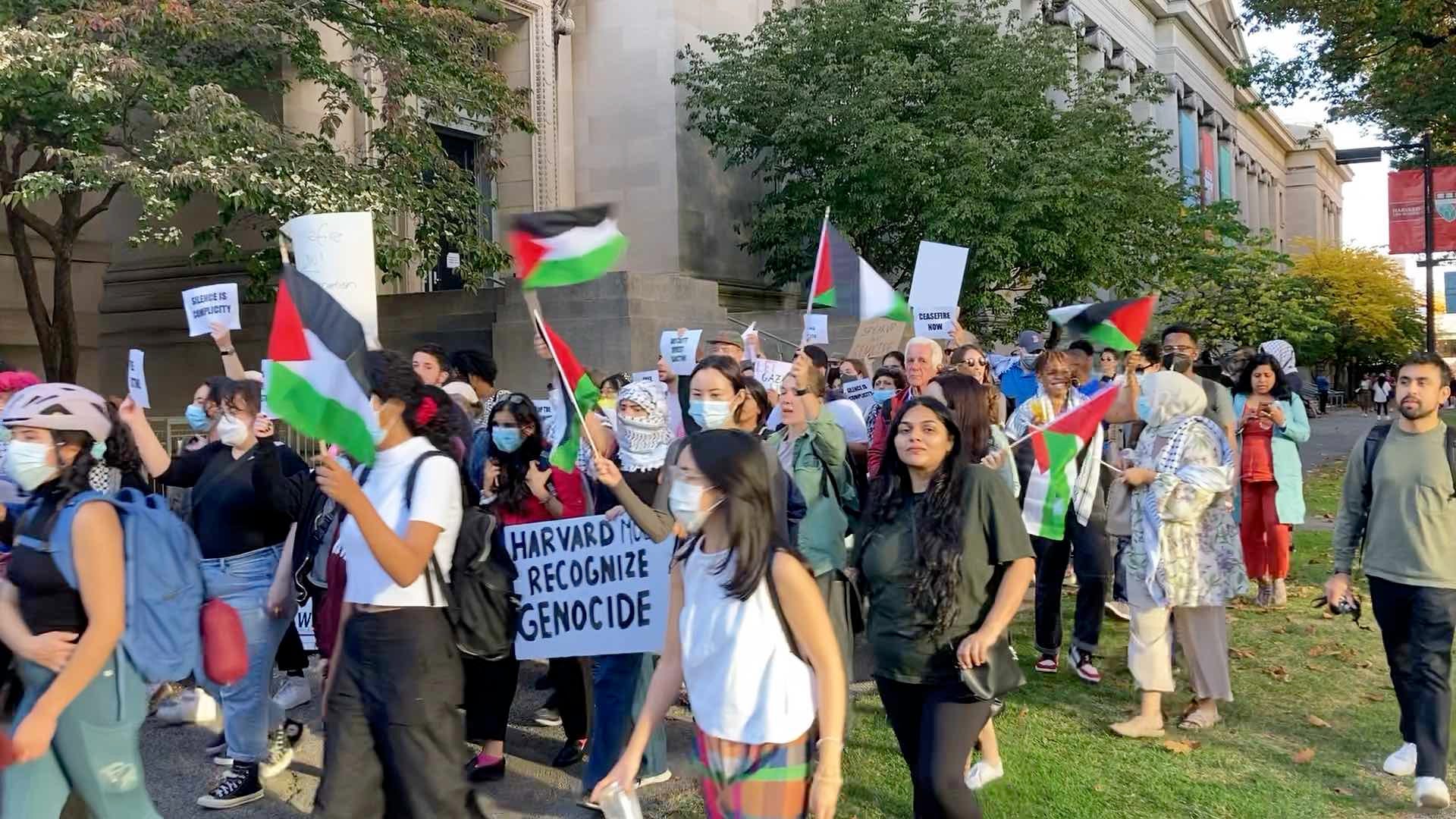
Justice Department official Leo Terrell, who chairs a multi-agency federal Task Force to Combat Antisemitism, is pushing President Trump for tougher terms in a draft settlement with Harvard University, Trump said.
One complicating factor is a federal criminal investigation into the October 7, 2023, letter signed by 34 Harvard student organizations. “We, the undersigned student organizations, hold the Israeli regime entirely responsible for all unfolding violence,” the letter said. “The coming days will require a firm stand against colonial retaliation.” Federal prosecutors have begun in recent months examining how the letter was generated so rapidly, the day of the Hamas-led terrorist attack against Israel. They are looking at possible ties between the student-group leaders and organizations with what a U.S senator and Harvard alumnus calls “ties to terrorism.”
Trump’s comments this week at an event of the White House Religious Liberty Commission have attracted little public notice, but offered a window into the administration’s internal dynamics related to a potential settlement agreement with Harvard. Terrell was at the White House event, as was Attorney General Pam Bondi, who oversees federal prosecutors and the FBI.
“I'm also taking action against antisemitic and anti-Christian bias in our institutions,” Trump said. “Leo is involved and Pam Bondi is involved. We are getting hundreds of millions of dollars in settlements, Pam, and Leo called me up, ‘sir, you can do better than that.’ I said, ‘What am I gonna do?’ I'm going to get one the way he really likes it. Everyone else says, ‘that’s amazing.’ Except for Leo. He says, ‘sir, you could've gotten more.’”
“We’re involved very much in Harvard, that’s one that people seem to be reading about more than others,” Trump said, calling Judge Allison Burroughs, “an absolute radical left judge, disgraceful, should not even be there.”
Burroughs issued a recent court ruling ordering the restoration of some federal research funding to Harvard while also castigating the university. “It is clear, even based solely on Harvard’s own admissions, that Harvard has been plagued by antisemitism in recent years and could (and should) have done a better job of dealing with the issue,” Burroughs said in a ruling that was widely described as a win for Harvard. “Harvard was wrong to tolerate hateful behavior for as long as it did.” Harvard President Garber’s statement reacting to the ruling did not acknowledge those passages or inform the community about them.
The recently opened criminal inquiry could unearth new information about whether Harvard’s anti-Israel activists acted independently or whether and how they coordinated with national or international networks. Obtaining the information could help to shut down the networks. People familiar with the investigation do not want it to end abruptly or inconclusively as part of any settlement between Harvard and the Trump administration. There is even some concern that a premature or overly generous settlement could block legal accountability for the individuals involved with the October 7 letter.
No criminal charges have been announced relating to the October 7 letter. It’s possible none will emerge. It’s also possible that if charges are brought, those facing them will prevail against them in court. Anti-Israel activists have denied wrongdoing and complained that the Trump administration is going overboard, heavyhandedly punishing political speech with law-enforcement overreach in violation of the First Amendment. I typically hesitate to report on the mere existence of such investigations, because the outcome is so uncertain and because the potential targets haven’t yet had the due process opportunity to confront their accuser or the possible charges, but I’m making an exception here because of the interaction with a potential settlement, which is a matter of intense public interest.
Senator Cotton, Republican of Arkansas and a Harvard graduate who is chairman of the Senate Intelligence Committee, issued two recent letters calling for investigations into the Palestinian Youth Movement. The group described itself on its website as “a transnational, independent, grassroots movement of young Palestinians in Palestine and in exile worldwide as a result of the ongoing Zionist colonization and occupation of our homeland.”
An August 22 letter from Cotton to Treasury Secretary Bessent, who is the acting IRS Commissioner, said, “The PYM is a youth activist organization known for its virulently antisemitic stances, public statements in support of terrorist groups, and activities and support for anti-Israel protests in America….I believe PYM’s activities, particularly its support for terrorist organizations such as Hamas, should prevent it from receiving tax exempt donations.” Cotton’s press release was headlined, “Cotton to IRS: Investigate Palestinian Youth Movement’s Funding and Ties to Terrorism.”
A September 3 letter from Cotton to FBI director Kash Patel said “PYM is populated with bad actors.” The letter said, “I write to bring to your attention the dangerous—and almost certainly illegal—activities of a member of the Palestinian Youth Movement (PYM) and ask that you conduct a full investigation into this threat to U.S. national security. PYM leader Aisha Nizar spoke at the recent People’s Conference for Palestine in Michigan where she openly called on supporters to disrupt the U.S. F-35 supply chain. This was part of her larger call to damage U.S. military support to Israel in their lawful war against Hamas.”
At least one Harvard student activist in a group that signed the October 7 letter is also active with PYM.
The Trump administration’s internal dynamics are not the only factor delaying a settlement between the administration and Harvard. There are also internal dynamics at Harvard, where some faculty and alumni activists have been agitating against a settlement. I’d like to see a settlement if Harvard can get terms similar to Columbia’s that restore the research funding while preserving the university’s academic freedom. But it would also be nice for the complete story of that October 7 letter and how it emerged to come to light. The Justice Department has capabilities that can help with that—provided that they aren’t called off as part of a settlement.
Thank you: If you know someone who would enjoy or benefit from reading The Editors, please help us grow, and help your friends, family members, and associates understand the world around them, by forwarding this email along with a suggestion that they subscribe. Or send a gift subscription. If it doesn’t work on mobile, try desktop. Or vice versa. Or ask a tech-savvy youngster to help. Thank you!
I am so glad you are keeping this issue alive. Very important investigation.
This is the first I have heard of anyone looking into this. I am thrilled to see it being taken seriously.
The first thing that occurred to me the day this letter was published was to wonder how 34 student groups could hammer out a statement overnight and get it published even as the horrors of October 7 were still underway. That Harvard itself failed to show any interest in this question was, from the start, a clear indication of its thoroughly dishonest complicity with the Jew hatred the letter itself reveals. This possible complicity with terrorism is VERY far beyond being a simple free speech issue. I seriously hope the Trump administration does not ease up on Harvard. Please.