

Harvard Law Professor in Graduation Speech Decries “Atrocities” in “Palestine”
Plus, Iran truckers strike stirs hope for freedom; Remembering Stanley Fischer

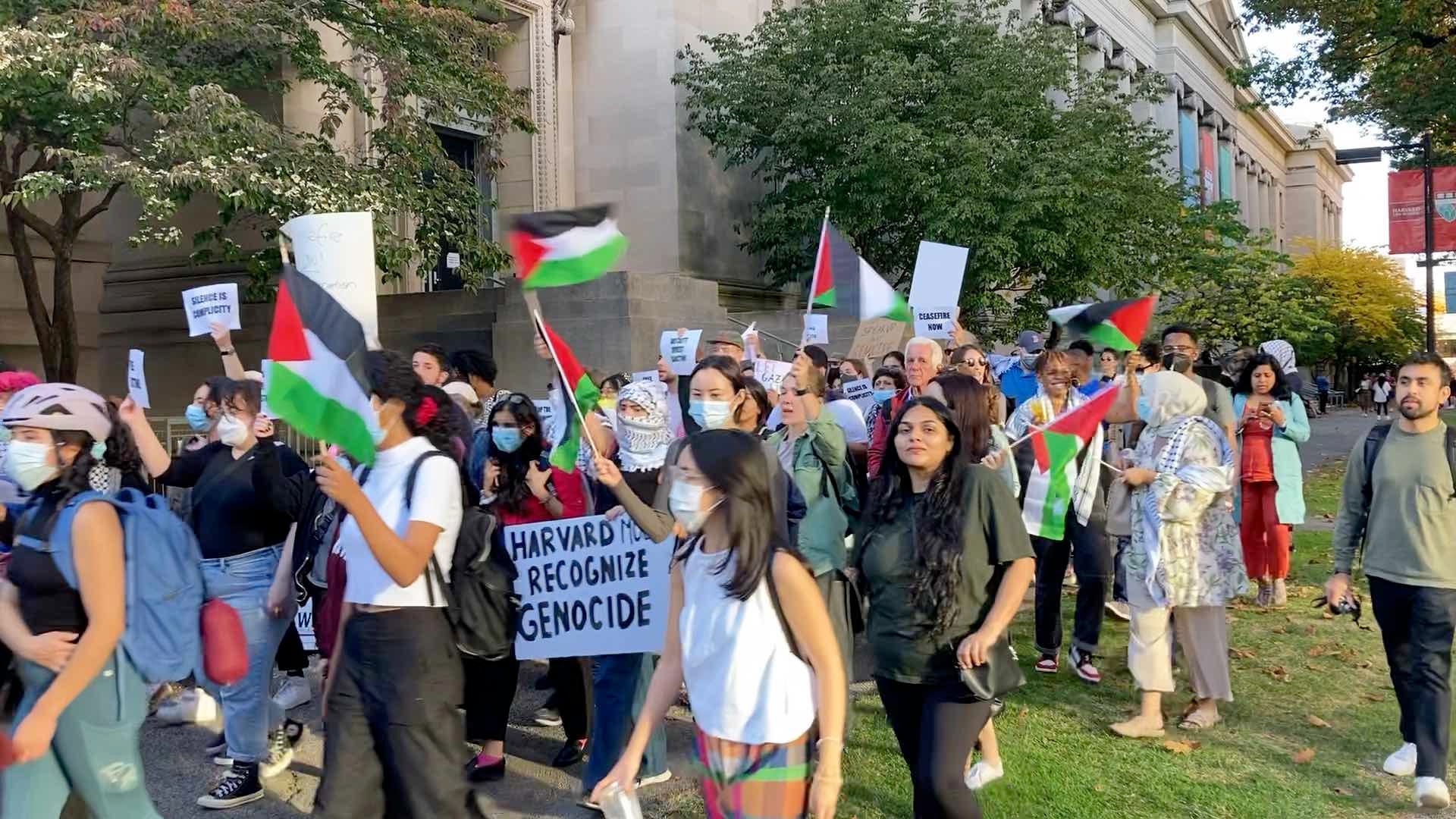
Harvard’s recent graduation ceremonies included an honorary degree awarded to a boycott-Israel advocate. They included a Harvard Divinity School student speaker declaring “I center Palestine today,” talking about “77 years of genocide,” and cheering on the “unwavering courage and profound wisdom” of a Harvard divinity student who pleaded not guilty and was ordered by a court to do community service and an anger management class after being criminally charged with assaulting a Jewish Harvard business school student. And the graduation ceremonies also included a Harvard law professor who used his speech to denounce “injustice” in “Palestine” and praise what he called the “courage” of anti-Israel student protesters.
“There are a great many of your professors here, people who have spent their lives dedicated to studying the rule of law, who worry that our country is teetering on the edge of authoritarianism. There are some of us, like me, who think we may already be there,” the professor, Andrew Manual Crespo, said in a speech that Harvard Law School promoted and posted to its official YouTube channel.
“Two months ago and two miles from here, Rumeysa Öztürk was snatched off the street by masked federal agents. They stole her away through the night and detained her in a federal prison for six weeks all without ever filing any criminal charges against her solely because she had written an oped in her university’s student newspaper. She is one of multiple scholars targeted in this way for their constitutionally protected speech, including Mahmoud Khalil, the first to be arrested, who remains detained even now, and who the federal government has fought to prevent from so much as touching his newborn baby boy. This is what authoritarianism looks like,” said Crespo, who is the Morris Wasserstein Public Interest Professor of Law at Harvard and who teaches a course called “Anti-carceral Organizing and Lawyering.”
“But there’s more. In your last semester you have seen our president try to bankrupt law firms that dare to enforce people’s rights. You have seen unprecedented attacks on the Department of Justice that have led to well over 100 lawyers including many alumni of this school to resign under protest and under threat. You have seen our president and vice president openly suggest that they would not follow court orders and have seen multiple indications that the federal government will in fact defy the courts. This too is what authoritarianism looks like,” said Crespo, who is a board member of the Harvard Law Review.
The Law Review awarded a $65,000 fellowship to Ibrahim Bharmal, who pleaded not guilty to a misdemeanor charge of assault and battery against a Jewish student during an anti-Israel campus protest. The Law Review is also planning to publish an article, “Antisemitism, Anti-Zionism, and Title VI: A Guide for the Perplexed,” arguing that the Civil Rights Act of 1964 should not be interpreted to protect Jewish students on college campuses. “Even as universities highlight the bad faith and procedural deficiencies of the Trump Administration’s enforcement efforts, therefore, they should also avoid acquiescing to the premise that they have failed to meet their legal obligations,” the article says.
Crespo’s Law School Class Day speech went on: “And then of course you felt what happened right here at home. In an endless barrage, our government has tried to crush Harvard University, the very symbol of higher education in the world and more simply than that our home. Our scientists and international students have been taken hostage, our research bankrupted, our community terrorized—all in an effort to try to change the way that we teach, the questions we ask and the answers we offer. From climate change to vaccines to the study of race and inequality in our country’s past and present, they want us to shut up. Or worse, they want us to say only what they want to hear. This too is what authoritarianism looks like.”
Crespo’s Law School Class Day speech went on: “In the face of it, fear is rational. But courage is essential. And to your great credit, you the class of 2025 have taught us time and again what true courage looks like. In the face of doxxing trucks and Twitter trolls, arrests and ad board referrals, lies about who we are and what we do, you have often done what was needed and right instead of what was safe and easy. When you have seen injustice at home, whether in the form of immigration raids, police brutality, domestic violence, forced evictions, or discrimination on the basis of color or creed, you have used your voice and your talents to demand fairness. When you have seen injustice abroad, including atrocities, unending civilian deaths, and imminent famine in Palestine, you have spoken out with courage. [applause].”
What “atrocities” Crespo meant he left unclear. He probably wasn’t referring to the detention of Israeli hostages in Gaza, or to Hamas’s execution of anti-Hamas protesters in Gaza. As for the “imminent famine,” the injustices there are that Hamas has warehouses full of looted food that it is not sharing, and that also Israel’s enemies have been complaining of an “imminent” famine for months that has not materialized. As for the “unending civilian deaths,” they have ended periodically when Hamas agrees to a ceasefire that involves releasing the Israeli hostages it has kidnapped and is holding, and the blame for them belongs to Hamas, which cynically uses civilians as human shields. It’d be courageous for Harvard Law students and professors to point that out but instead the law students have done things like pass a March 2025 resolution in favor of Harvard divesting from Israel.
Crespo went on: “If I am being honest, we, your university, have not always learned well the lessons you were trying to teach. Harvard deserves praise for taking a stand to defend its academic independence. It is just as important for Harvard to use that independence to protect the academic freedoms, including the rights to study, publish, teach, and yes protest of everyone on our campus without exception, especially when our messages are politically inconvenient. In this respect, whether in denying degrees to peaceful protesters or suspending hundreds of students and some teachers from our libraries, for firing the faculty directors of our Center for Middle Eastern Studies in what the New York Times called ‘an offering to the Trump administration,’ I fear sometimes our university has too often exhibited acquiescence when courage was called for.”
Crespo’s speech was for accepting the “Sacks-Freund Award for Teaching Excellence,” which, according to the law school, “recognizes a faculty member each year for teaching ability, attentiveness to student concerns, and general contributions to student life at the law school.”
The Crespo speech was dressed up in the trappings of reason—an acknowledgment that graduation is a day of family celebration and also a call for people to talk to each other—but the core of it was, like the honorary degree to the boycott-Israel advocate and the student speech at the divinity school, verification of a dimension of the Trump administration’s criticism of Harvard, which is that the school has strayed from scholarship to instead focus on anti-Israel political activism. Instead of decisively reining in the political activism in favor of a focus on scholarship, the Harvard administration has made belated and intermittent gestures in the direction of reining in the political activism, dismaying the activists without satisfying the critics. There appears to be no one in a leadership position at Harvard with the “courage” to explain to Professor Crespo that a graduation speech is not an appropriate time or place for a faculty member to launch an anti-Israel protest.
Iran Truckers: One righteous cause you haven’t heard a lot about at American college graduations is that of the striking Iranian truck drivers, whose work stoppage has spread to 130 cities—or as many as 160 cities, according to the National Union for Democracy in Iran. The U.S. press has been breathlessly following every incremental development in the U.S.-Iran nuclear negotiations, but a bigger story than the nuclear weapons is the fragile and brutal regime in Tehran, which has lost the support of its people and sees independent labor unions as a threat.
With some nourishment from American unions and moral encouragement from the American government, the strike could spread, like Solidarity labor activism in Poland did, to bring about the fall of the Islamic Republic. That would be a huge win for American interests and for freedom. Reza Pahlavi posted to social media, “Truck drivers and workers across Iran are on strike and are putting their lives on the line to fight for their rights and for a better future for their families. Now, they are being jailed and threatened for posting photos and videos of their strike. Only in a free Iran will all workers have the right to freely and openly organize. I invite you, labor unions and leaders, to stand with your fellow workers in Iran and show your solidarity.” Maria Bartiromo had Pahlavi on on Fox Business the other day to discuss this, and Radio Free Europe/Radio Liberty has a useful dispatch, but otherwise Iran’s Solidarity movement hasn’t yet attracted the solidarity it deserves from America.
Stanley Fischer: Stanley Fischer, the economist and central banker who died Saturday at 81, is being mourned worldwide. There are lots of people to credit for Israel’s economic miracle, but Prime Minister Netanyahu himself acknowledged today that, as governor of the bank of Israel, from 2005 to 2013, Fischer “contributed greatly to the Israeli economy, especially to restoring stability during the global economic crisis.”
Fischer served also from 2014 to 2017 as vice chairman of the Federal Reserve, embodying the possibility of serving both Israel and America without a conflict.
As an academic economist, Fischer was influential. A Bloomberg obituary notes, “The roster of MIT students he taught and advised included Ben S. Bernanke, who would go on to become Fed chair and called Fischer his mentor; Mario Draghi, a future European Central Bank president and prime minister of Italy; Lawrence Summers, who would serve as US Treasury secretary under Bill Clinton; Greg Mankiw, who would lead President George W. Bush’s Council of Economic Advisers; Kazuo Ueda, named Bank of Japan governor in 2023; and two IMF chief economists, Olivier Blanchard and Maurice Obstfeld.”
The Bloomberg obit notes that Fischer, in the late 1960s, “chose MIT for his doctorate work so that he could study under future Nobel laureate economists Paul Samuelson and Robert Solow.” Samuelson, as has been well documented, wound up at MIT rather than Harvard because of the antisemitism in the Harvard economics department at the time, and so it’s a concrete example of how Jew-hate at Harvard had and has a real cost to the university in terms of talent and excellence.
Fischer and his wife Rhoda were family friends of my wife, and I have a warm memory of them dancing the hora at my wedding. He was always gracious when our paths crossed in New York City. May his memory be a blessing.
Program notes: The Jewish holiday of Shavuot begins tonight and runs through Tuesday night. Our plan is to resume daily publication on Wednesday June 4.
Harvard is pathetic and irredeemable. RIP Stan Fisher, a real intellectual heavyweight from a time before academia became morally and intellectually bankrupt.
Crespo: "From climate change to vaccines to the study of race and inequality in our country’s past and present, they want us to shut up. Or worse, they want us to say only what they want to hear. This too is what authoritarianism looks like.” Authoritarianism "looks like" having a platform to exercise free speech at a prestigious university and not being hauled away afterwards and sent to a reeducation camp? "Our country is teetering on the edge of authoritarianism," he declared. "There are some of us, like me, who think we may already be there." He said all this—and no one prevented it?