


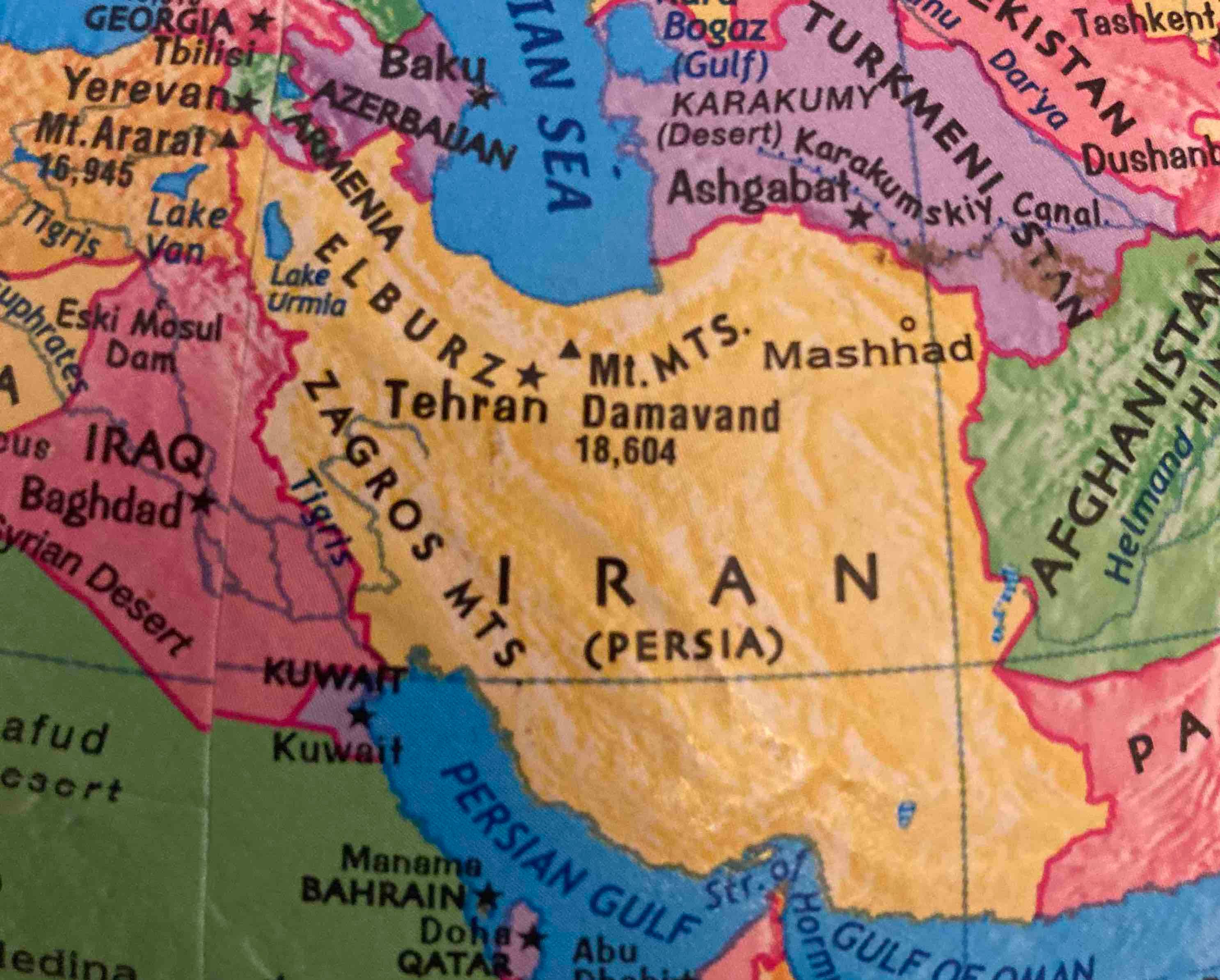
Vice President Harris did a phone call with Jewish voters on Friday, and according to a transcript issued by the White House, her remarks included the following passage arguing that she would be tougher on Iran than President Trump:
We know Hamas is not the only threat Israel faces. On October 8, Hezbollah began launching rockets at Israel, and the Houthis in Yemen began targeting Israeli cities.
And what is the common thread? Well, we all know: Iran, which has now also directly attacked Israel twice.
I am clear-eyed. Iran is a destabilizing and dangerous force.
When Donald Trump was president, he let Iran off the hook. After Iran and its proxies attacked U.S. bases and American troops, Trump did nothing. And he pulled out of the nuclear deal without any plan, leading to an unconstrained Iranian nuclear program.
On the other hand, our administration struck Iranian proxies in Iraq and Syria when they attacked American troops, and we are the first administration to ever directly defend Israel.
On April 13, I joined President Biden and our national security team for more than five hours as we and a coalition of nations that we brought together responded to Iran’s unprecedented attack. And then, of course, last week, on October 1st, I was in the Situation Room for more than three hours coordinating in real time with our military leadership as our forces intercept milsi- — missiles over the skies of Israel.
Make no mistake, as president, I will never hesitate to take whatever action is necessary to defend American forces and interests from Iran and Iran-backed terrorists, and I will never allow Iran to acquire a nuclear weapon.
Diplomacy is my preferred path to that end, but all options are on the table.
Harris’s comparison is misleading.
It’s not accurate that Trump “did nothing” or “let Iran off the hook.” In January 2020, Trump had the U.S. military kill Qasem Soleimani, the head of the Islamic Revolutionary Guard Corps-Quds Force. A Pentagon statement at the time explained, “General Soleimani and his Quds Force were responsible for the deaths of hundreds of American and coalition service members and the wounding of thousands more. He had orchestrated attacks on coalition bases in Iraq over the last several months – including the attack on December 27th – culminating in the death and wounding of additional American and Iraqi personnel. General Soleimani also approved the attacks on the U.S. Embassy in Baghdad that took place this week.”
The Biden-Harris administration’s own Justice Department in September 2024 announced the indictment of Asif Merchant, who was reportedly plotting to kill Trump. “The Justice Department will not tolerate Iran’s efforts to target our country’s public officials and endanger our national security,” Attorney General Merrick B. Garland said in the press release. “As these terrorism and murder for hire charges against Asif Merchant demonstrate, we will continue to hold accountable those who would seek to carry out Iran’s lethal plotting against Americans.”
If Trump is such a relative patsy for the Iranians, why would the Iranians be trying to assassinate him? I guess they could be misjudging their own interests, which is certainly possible.
Iran also reportedly, according to the Biden-Harris administration, tried to assassinate Trump’s former national security adviser, John Bolton, and Trump’s former secretary of State, Mike Pompeo. Politico recently reported that several other Trump administration national security officials—national security adviser Robert O’Brien; Defense Secretary Mark Esper; “Mark Milley, Chair of the Joint Chiefs of Staff; Paul Nakasone, head of NSA and U.S. Cyber Command; Kenneth McKenzie, head of U.S. Central Command; and Brian Hook, the State Department’s Special Representative for Iran”—also are being threatened by Iran. If Trump really “did nothing” and “let Iran off the hook,” why have all these Trump-era people been targeted by Iran?
Perhaps it is a positive development that the two presidential candidates are competing on who will be tougher on Iran.
Trump has consistently assailed the Biden-Harris team for weakening sanctions on Iran, enriching a regime that Trump says had he had left totally broke.
Whatever Harris’s and her team’s flaws, her remarks signal that she has an accurate sense of where the American people, and the American Jewish community, are on this issue. The public desire is for a hard line against Iran, not for any sort of appeasement.
That reality is helpful for Prime Minister Netanyahu, giving him a freer rein than he might otherwise have to take action against the Iranian regime.
The founder and chairman of Israel’s Defense and Security Forum, Brigadier General (Reserve) Amir Avivi, signaled in his October 10 briefing that such action is on the way. “I’m saying crystal clear: war with Iran is imminent,” Avivi said. He said Israel could either act alone or in coalition with other powers, and is preparing for both scenarios against Iran. “Maybe we’ll see some leaders disappearing,” Avivi said. “They made a huge, huge mistake dealing with us, and they’ll learn it the hard way like Hezbollah did.”
Harvard’s China cheerleader: Back in April, we flagged (“Harvard’s China Cheerleader”) what we described as “boosterish propaganda about the Chinese Communist economy” posted by the Douglas Dillon professor of government at the Harvard Kennedy School, Graham Allison. “I take Chinese Communist economic statistics with same boulder of salt I’d take statistics issued by any other Communist-controlled government. That is to say, they are unreliable,” I wrote then.
Now Allison, who has been a Harvard professor since 1968 with a brief departure to serve in the Clinton administration’s defense department, is back at it. “In 2024, the vacancy rate for life science properties in Boston was 27.7%—in Shanghai it was 5%,” Allison claims in a post on x. “This is consistent with the point made in an earlier tweet: Who has a real estate problem with offices in major cities? When one compares the two capitals, Washington has a higher office vacancy rate than Beijing: 22% in Washington vs. 18% in Beijing.”
It’s untrue that “the vacancy rate for life science properties in Boston was 27.7%.” An October 8, 2024 post from CBRE reported the vacancy rate at 19.6 percent. Some of this is newly built space that will get leased up eventually. Meanwhile, CBRE on July 17, 2024 reported a Shanghai office vacancy rate of 21.1 percent. Allison doesn’t cite his sources. That is irresponsible behavior for a Harvard professor, setting a bad example for students and raising the question of where he is getting his information.
If Allison want to set up a research project at Harvard or elsewhere providing reliable, transparent, and comparable economic statistics on the U.S. and Communist China, he should go ahead and do it, but simply tweeting out unsourced and cherry-picked data points designed to make China look relatively successful raises questions about what his agenda is. It reinforces the perception of Harvard as an institution coasting on its past reputation that has declined toward mediocrity in part because of unwillingness to rein in risky behavior by senior faculty.
Anyway, vacancy rates are only one measure, a snapshot, of the health of a real-estate market or a life-science research ecosystem. If you were investing in real estate or a startup drug company, would you rather be in China where the Communist Party still centrally plans a lot of economic activity, or in the U.S., where there is more rule of law, political freedom, and free enterprise, and less central planning?
Thank you: Please help us grow by sharing this newsletter with a friend, family member, or colleague who might appreciate it and be inclined to sign up.
I believe that Allison for most of his career was a professor at Wellesley College with a cross appointment at the Kennedy School. Despite what it says on his page on the HKS website, I don't believe he's ever been a professor in the Government department, which has much higher standards than the K school.