

Don’t Just ’Deter' Iran. Help Free It.
Plus, a Harvard update; the Wall Street Journal’s news tilt

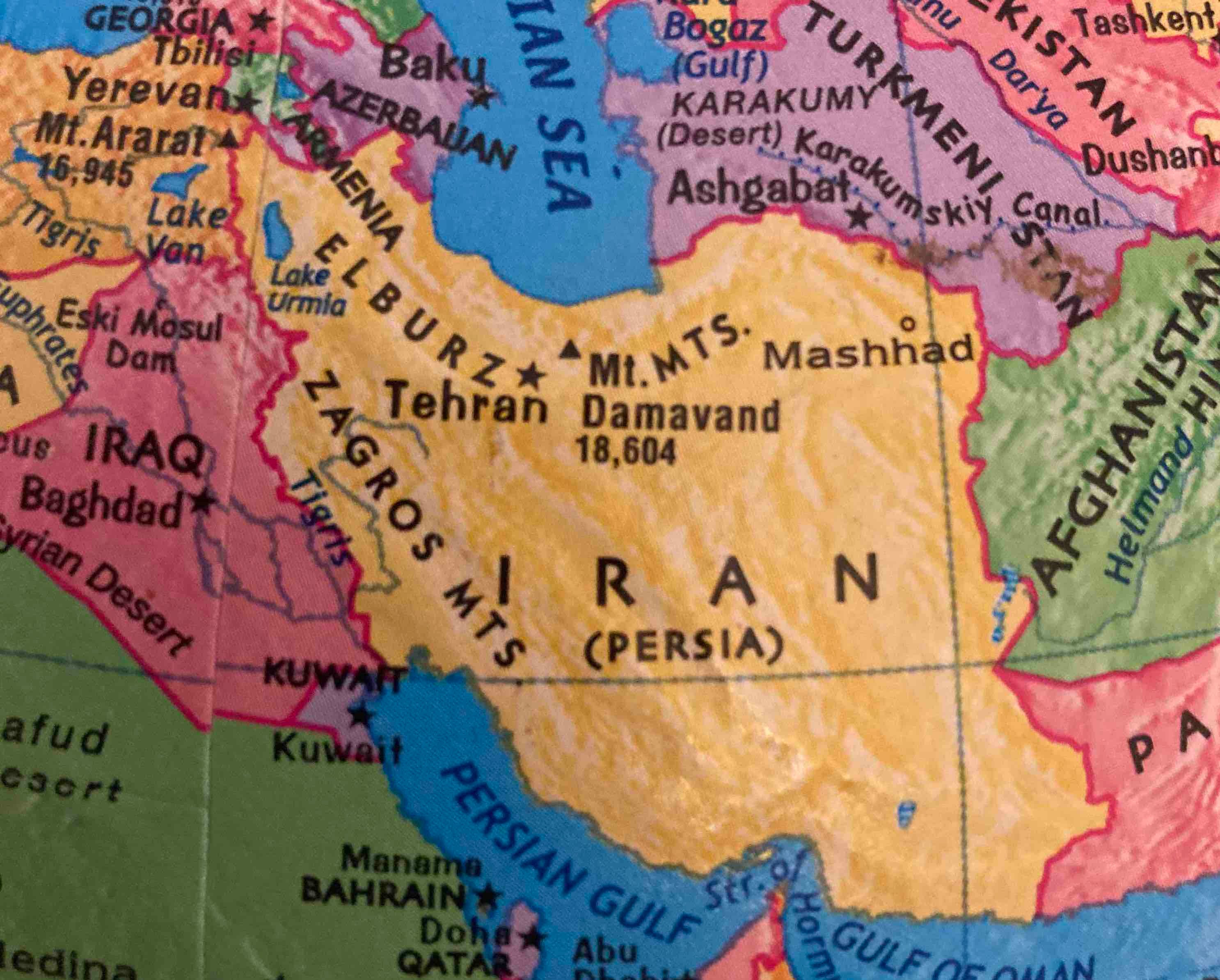
The flag-draped caskets of three U.S. soldiers killed by an Iran-backed militia at Tower 22 in Jordan had barely made their way back to America before a bipartisan consensus began to emerge about the need to “restore deterrence” against Iran.
The calls to sink Iranian ships and kill its military leaders are well intentioned. They might even work temporarily. “Deterrence” is a step up from appeasement, but even at best, it will only provide the delusion of security so long as the inherently hostile Iranian regime remains in power in Tehran.
Fortunately, there’s a better alternative policy route that’s less costly, that’s more appropriate to this particular enemy, and that has the potential to improve America’s geopolitical position. Rather than bombing Iran, why not instead help the Iranian people liberate themselves from the expansionist dictatorship that now oppresses them?
The moment is ripe. Even the New York Times reports, on March 15, about crowds chanting, “Freedom, freedom, freedom,” “Death to the dictator” and “Get lost, clerics.”
“We should do something now. We should put more pressure on Iran,” Brigadier General (Res.) Yossi Kuperwasser, director of research for Israel’s Defense and Security Forum, said in a recent briefing. “More support for the Iranian opposition is needed, to make sure that they can trust the West in their effort to unsettle the regime, this terrible regime in Iran.”
One Iranian opposition figure, Vahid Beheshti, has been circulating between London, Jerusalem, and New York. He spoke to the Israeli Parliament about the Iranians “thirsty for freedom and democracy.”
Another prominent Israeli, Natan Sharansky, at a March 4 event of American Purpose, said that the desire for freedom of people in Iran, Russia, and China is the most powerful weapon the West has.
The October 7, 2023, terrorist attack on Israel by Iran-funded-and-trained Hamas is a caution about the limits of “deterrence” when it comes to fanatics. Israel had responded to Hamas attacks before with Operation Cast Lead in December 2008 and January 2009, with Operation Pillar of Defense in November 2012, with Operation Protective Edge In July and August 2014, with Operation Guardian of the Walls in May 2021. Each time, Israel destroyed terrorist targets and restored “deterrence” enough for a period of calm. Yet so long as Hamas controlled Gaza—and so long as Iran kept funding and training Hamas—Israel was not genuinely secure.
Israelis talked about those Gaza tactics as “mowing the lawn.” In retrospect, a better gardening metaphor might be dandelions. To get rid of them, merely picking the yellow flowers is insufficient. A lasting fix requires digging up the root.
The historian Bernard Lewis used to warn that for Iran’s leaders, the Cold War nuclear strategy concept of “mutual assured destruction” was not a deterrent but an “inducement.” One can parse the nuances between Al Qaeda, ISIS, and Iran, but this is an enemy whose signature tactics, broadly defined, include suicide bombings and flying airplanes into office buildings. “Deterrence” isn’t a concept that applies.
What might work in Iran is not a Bay of Pigs-style covert action or an Iraq War-style invasion but something closer to the Velvet Revolution that ended Communist rule in Czechoslovakia in 1989. America had an opportunity to help Iran’s Green Revolution in 2009 and 2010 but missed the chance out of a misguided fear by the Obama administration that American meddling would backfire.
Concern about further stoking anti-Americanism is one reason people give for opposing a rollback of Iran and preferring containment instead. Yet the approach of bombing Iran while cynically leaving a corrupt and cruel regime in power has its own risks. In Poland and what is now the Czech Republic, American help during the Cold War against communism produced gratitude and friendship after the Iron Wall fell, warm feelings that remain to this day.
People also worry that what comes after the current leadership in Iran might be even worse—chaos, or an Islamic State takeover. Could be. But what we have now is no picnic: plotting to assassinate John Bolton and Michael Pompeo, launching a cyberattack against a New York dam, trying to interfere in the 2020 presidential election. The Iran-backed October 7 attack killed more than 30 Americans. Another two Navy SEALS died in January while seizing Iranian weapons that the U.S. government says were being used “to resupply Houthi forces in Yemen as part of the Houthis’ ongoing campaign of attacks against international merchant shipping.”
All that has happened in the years since 2012, when Michael Ledeen wrote in Foreign Affairs, “the time has come for the United States and other Western nations to actively support Iran's democratic dissidents.” Imagine all the trouble that might have been avoided had Ledeen’s advice been followed then.
Rather than perseverating about what might go wrong, consider what might go right. A newly free, pro-American Iran, instead of helping Russia and Communist China, might instead serve as a base to inspire those countries, eventually, too, to advance toward political freedom. Iran’s oil and gas supplies might help bring down energy prices and combat inflation. The sanctions on Iran could go away, opening up new markets for American goods and services.
Iranian support for terrorism, oppression of domestic opposition, and nuclear weapons programs would be over and done with. America could reopen its embassy in Tehran, and Tehran could reopen its in Washington. The New York Times might even be able to resume its journalist-led luxury expeditions to Iranian tourist destinations, this time without any embarrassment or doubts about whether gay or Jewish travelers, or women not dressed according to Iranian modesty standards, might participate.
People think it’s crazy to talk this way. But they called Reagan and his aides crazy, too, when he talked about defeating the Soviet Union rather than merely deterring it.
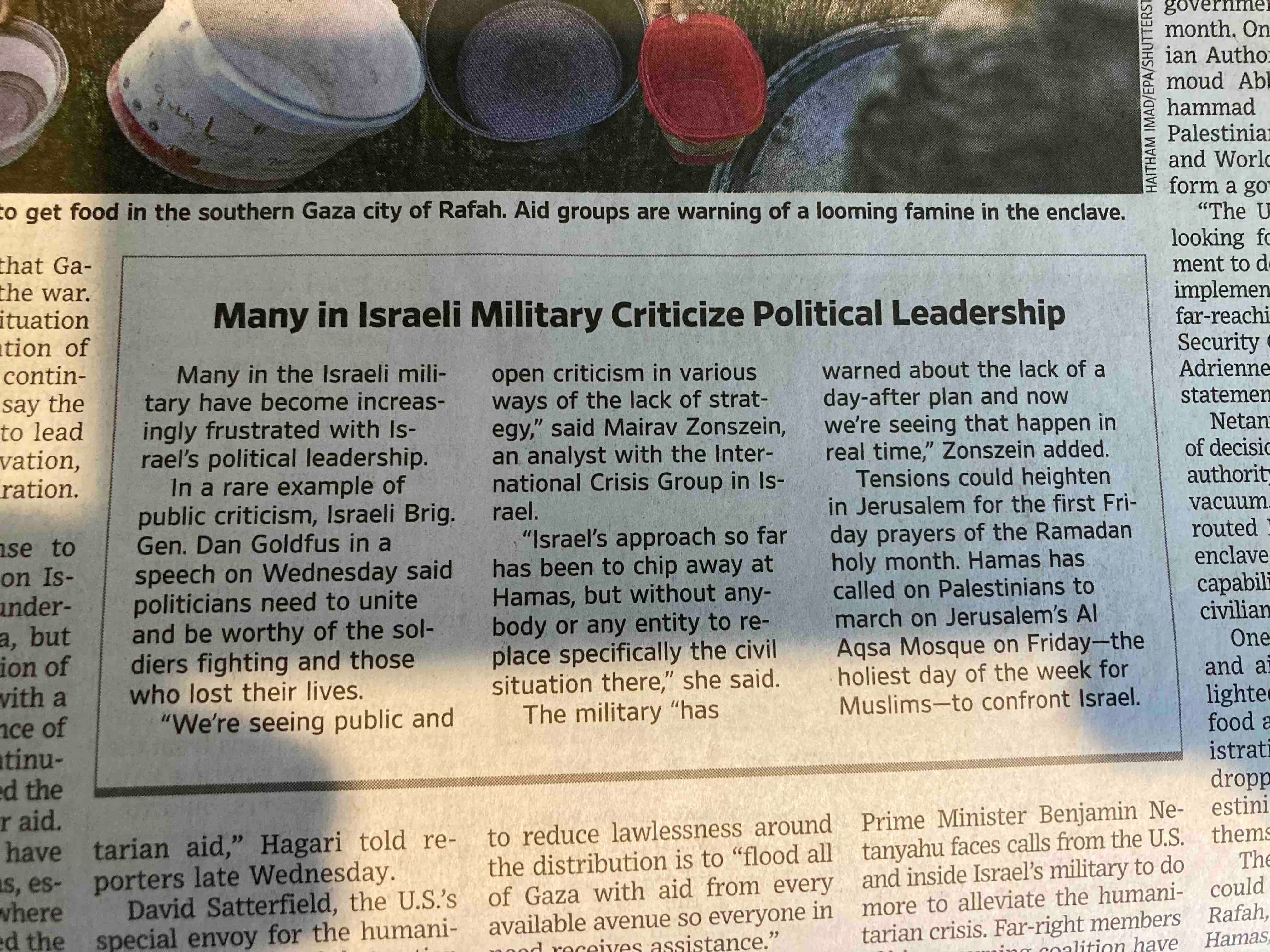
Wall Street Journal and Zonstein: The Wall Street Journal gets a lot of slack because its opinion pages and staff editorials have been so strongly supportive of Israel. But its news pages have been disappointing on the issue, especially recently. The latest example is on page A7 of today’s paper. A six-paragraph article headlined “Many in Israeli Military Criticize Political Leadership” includes quotations from only a single named source, “Mairav Zonszein, an analyst with the International Crisis Group in Israel.”
The Journal doesn’t tell readers that Zonszein is a longtime supporter of the movement to Boycott, Divest, and Sanction Israel, or that the International Crisis Group is funded, according to NGL monitor, by anti-Israel donors, including foreign governments and the United Nations
.
It’d be like writing an article about the U.S. military with the only quoted person being someone from the Green Party or the Institute for Policy Studies. The person is so far out of the mainstream that they aren’t likely to be a reliable or representative guide to what is going on.
“Where were the editors?” as we like to ask here at The Editors.
At the Journal, I can’t quite tell what’s driving it; the Zonszein story in print has no byline, but online it’s part of a piece by Rory Jones and Marcus Walker, who both seem to be products of British universities, as is the paper’s newish editor, Emma Tucker. Perhaps the paper is reflecting a more European and less American view of the Arab-Israeli conflict, and thus one more hostile to Israel.
Harvard updates: With minimal public notice, discussion, or press attention, the board of the Massachusetts Development Finance Agency approved $2 billion in tax-exempt financing for Harvard, according to a paywalled story in Bloomberg Law that is the only media coverage of the Thursday March 14 event I could find. The bond offering was the subject of a hearing on March 12 that I spoke at and wrote about here.
Meanwhile, there are several new developments in one of the federal civil lawsuits Harvard is facing over the outbreak of antisemitism on its campus, Kestenbaum v. President and Fellows of Harvard College.
New court filings indicate that Harvard is sticking with the law firm, WilmerHale, that expensively failed to win the case about discrimination against Asian-Americans in admissions, and that also helped to prepare Claudine Gay for her disastrous hearing before the House Committee on Education and the Workforce. The docket lists five lawyers for Harvard from WilmerHale, including Seth Waxman and Felicia Ellsworth, who both represented Harvard in the Asian-American discrimination case. It also lists four lawyers for Harvard from King and Spalding, a firm that Harvard reportedly recently brought on to help deal with the House investigation. A partner at WilmerHale, William Lee, was “senior fellow,” or chairman, of the Harvard Corporation, or governing board, while also representing Harvard in the Asian-American admissions case.
Harvard’s lawyers and the lawyers at Kasowitz, Benson for the Jewish students who are suing filed a joint motion proposing a schedule for filing an amended complaint and an “anticipated motion to dismiss.” That’s the first formal indication that Harvard plans to contest the case rather than apologize and acknowledge the antisemitic discrimination. The lawyers proposed a schedule with four briefs to be filed between April 19 and June 14, 2024. The newly assigned judge in the case, Richard Stearns, a Clinton appointee, promptly rejected the pace proposed by the lawyers as too leisurely. “While the court is willing to set a schedule for the filing of an Amended Complaint and defendant's response, not at the pace suggested by the parties. Plaintiffs must file their Amended Complaint no later than Friday, March 29, 2024. Defendant's response is due by April 12, 2024. Any opposition to a motion to dismiss must be filed by April 26, 2024. The court will entertain the filing of a Reply on a showing that the Opposition raised issues that defendant was unable to anticipate,” Judge Stearns said in a March 15 order.
Recent work: “What the New York Times Let Out of Its ‘Starving Gaza Children’ Story” is the headline over my latest column for the Algemeiner.
Thank you!: Thanks for being a reader, member, or subscriber. If you’re enjoying The Editors, please help us grow by forwarding this email to a friend and encouraging them to sign up.