


Now they tell us.
The Congressional Budget Office, whose gloomy view of the long-term federal budget picture skewed public debate over the One Big Beautiful Bill, issued a trillion-dollar revision. It did so on a Friday afternoon (okay, 11:45 on Friday morning) in the summer during Congress’s August recess, on a day when economic news was dominated by Federal Reserve Chairman Jerome Powell’s Jackson Hole self-satisfied tribute to his own supposed “success in bringing down inflation without a sharp increase in unemployment.”
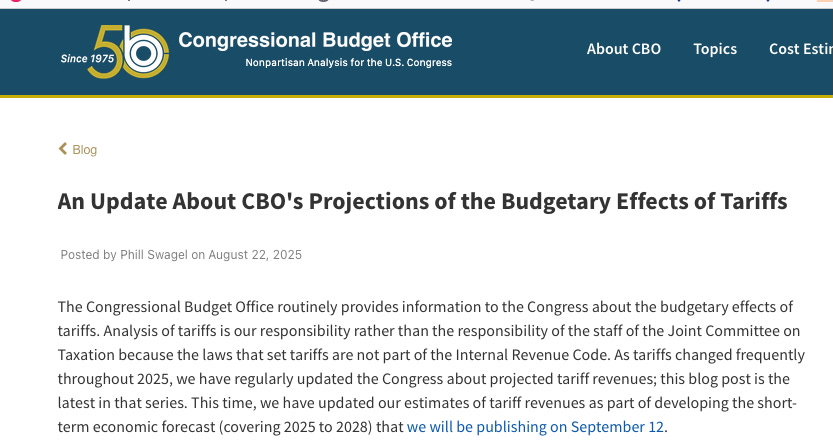
Back on June 4, when Congress was debating the One Big Beautiful Bill amid hotly contested estimates of its fiscal impact (see, “How ‘Big’ Is the One Big Beautiful Bill?” May 30, 2025), the CBO estimated the effect of the tariffs at a “$2.5 trillion decrease in primary deficits and $0.5 trillion reduction in interest outlays.” Now that it’s mid-August, about 10 weeks later, CBO has a revised estimate: “We project that increases in tariffs implemented during the period from January 6, 2025, to August 19 will decrease primary deficits (which exclude net outlays for interest) by $3.3 trillion if the higher tariffs persist for the 2025‒2035 period. By reducing the need for federal borrowing, those tariff collections will also reduce federal outlays for interest by an additional $0.7 trillion. As a result, the changes in tariffs will reduce total deficits by $4.0 trillion altogether.”
That’s a trillion dollar swing—to $4 trillion from $3 trillion—from June 4 to August 22.
Granted, these are ten year estimates. And granted, as the CBO’s latest announcement, “An Update About CBO's Projections of the Budgetary Effects of Tariffs,” acknowledges, “The estimates are subject to significant uncertainty, largely owing to questions about timing, possible exceptions, and a lack of precedents.” And granted, too, the estimates “do not account for effects on the size of the economy.”
But there was so much debt and deficit panic around the One Big Beautiful Bill. Just a selection of headlines from the New York Times alone will remind people of the tenor of it: A June 27, 2025 editorial headlined, “The National Debt Is Already Causing Bigger Problems Than People Realize,” a May 21, 2025 news article, “Why Washington’s Huge Tax Bill Is Worrying Bond Investors,” a July 2, 2025 front-page “news analysis” headlined, “Costly Bill Puts U.S. on Perilous Path,” a June 6, 2025 news analysis headlined “Deficit Politics Returns in Debate Over Trump Tax Cuts.” You could dip into Bloomberg or the Wall Street Journal news section for similar hyperventilation.
The entire One Big Beautiful Bill had a ten-year effect of somewhere between adding $5 trillion to the debt or reducing the debt by $2 trillion. In that context, $3 trillion or $4 trillion in tariff revenue and attendant borrowing cost reductions—or even the $1 trillion difference between $3 trillion and $4 trillion—is material. Not to mention that interest rates, and expectations about interest rates, themselves affect the federal government’s borrowing costs, at what President Trump likes to say is $360 billion for each interest rate point.
My point here isn’t to minimize concerns about the deficit or the debt. Those concerns are real, and the longer the delay in getting the U.S. on more of a sustainable trajectory, the more difficult it will be to address them.
And my point here isn’t even really to defend the tariff policy; I have reservations about how, and even whether, Congress has delegated its taxing power to the executive branch. And I’d prefer to deal with unfree countries by supporting efforts to promote freedom and democracy and rule of law there, not solely by raising taxes on their exports to America.
But we are in an era when popular trust in elite technocratic institutions is declining. That includes the academic economists—Congressional Budget Office director Phillip Swagel is a Harvard economics Ph.D. who had worked at the Federal Reserve—and the news organizations that rely on them without a lot of skepticism. These estimates—$3 trillion, $4 trillion—are spoken about with a level of precision that is not justified by the track record. The CBO can barely forecast current year revenues accurately, let alone ten years’ worth.
So take the prediction of $4 trillion in tariff revenues with some skepticism. If it gets much press attention anywhere other than here, it’ll probably be because someone finds a way to spin it as negative—Trump’s $4 trillion inflationary tax increase on American consumers—rather than as positive, a $4 trillion improvement over the budget baseline from early June.
Thank you: Here at The Editors, we estimate our revenue in orders of magnitude that are lower than trillions of dollars. But we are growing, thanks to readers like you who appreciate the information and point of view. We rely on that revenue to help pay the bills, and to ensure our editorial independence. If you know someone who would enjoy or benefit from reading The Editors, please help us grow, and help your friends, family members, and associates understand the world around them, by forwarding this email along with a suggestion that they subscribe. Or send a gift subscription. Thank you!
I hope you will support democracy, freedom, and the rule of law in this country as well as unfree countries.
LBJ once quipped that if he walked across the Potomac River, the newspaper headlines would be "President can't swim".
President Trump is getting the same treatment.