

Columbia Professor Claims “Mossad Agents” Instigate Iran Protests
Aim is “to distract attention from the ongoing genocide of Palestinians in Gaza,” Dabashi says

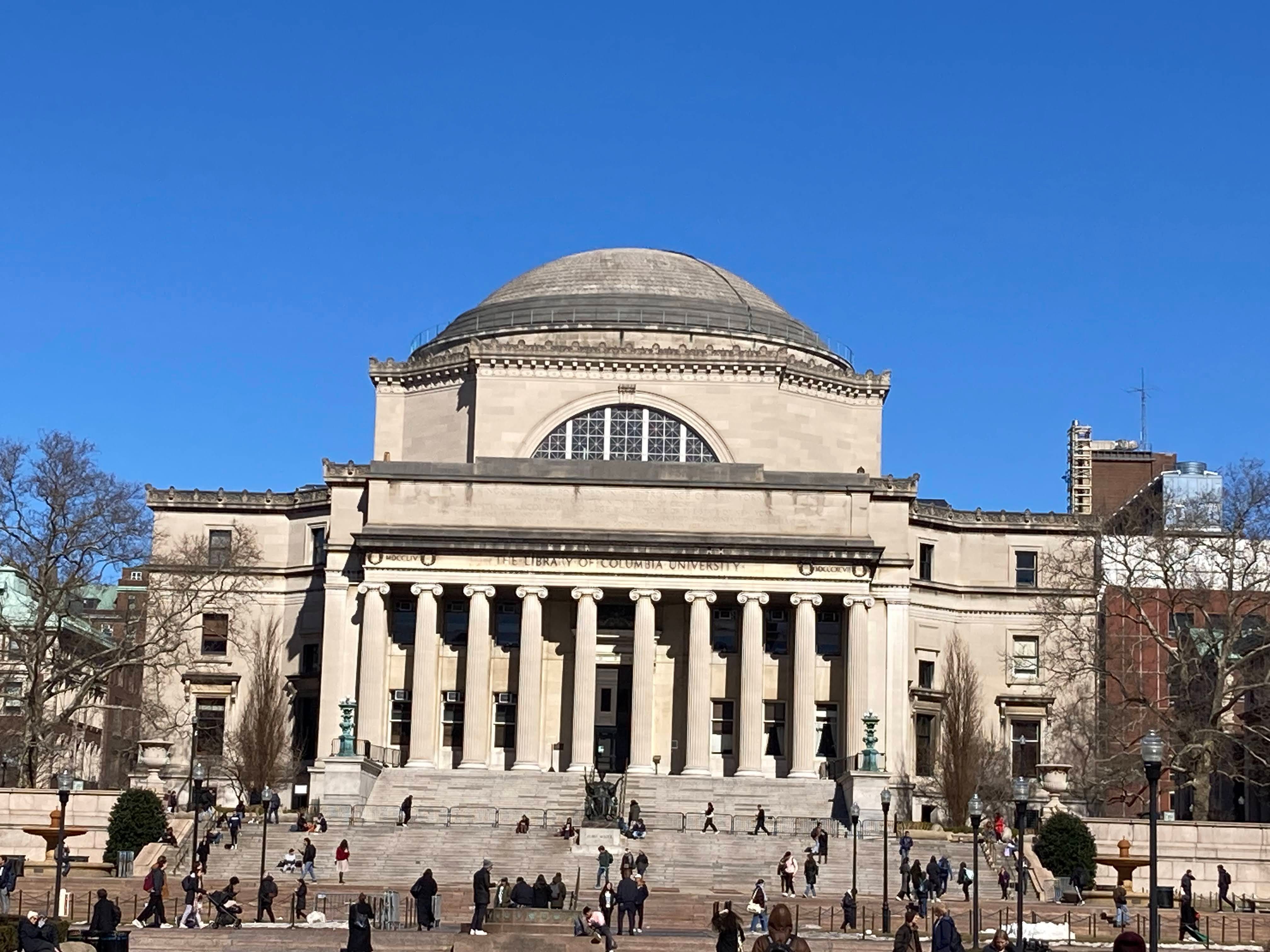
A professor who is director of undergraduate studies at Columbia’s Department of Middle Eastern, South Asian, and African Studies says the Iran protests are an Israeli plot to distract from what he calls the “genocide” in Gaza.
Hamid Dabashi, who is Hagop Kevorkian Professor of Iranian Studies and Comparative Literature at Columbia University and who since 2020 has been director of undergraduate studies in Columbia’s Middle East Studies Department, is also a past chair of the department and past director of graduate studies.
Dabashi has a long history of anti-Israel activism. In a September 11, 2008, article for the New York Sun, Bari Weiss listed Dabashi among five professors in the department who signed a 2004 letter supporting an academic boycott against Israel. In an October 15, 2007 article for the New York Sun, Annie Karni reported that Dabashi had written an article for a government owned Egyptian newspaper, Al-Ahram, faulting the then-president of Columbia, Lee Bollinger, for offering a critical introduction to a speaking appearance by the then-president of Iran, Mahmoud Ahmadinejad. Dabashi said Bollinger’s introduction included, “the most ridiculous clichés of the neocon propaganda machinery, wrapped in the missionary position of a white racist supremacist carrying the heavy burden of civilizing the world.” In a November 22, 2004 article for the New York Sun, Jacob Gershman reported on another Dabashi Al-Ahram article in which Dabashi wrote, “What they call ‘Israel’ is no mere military state. A subsumed militarism, a systemic mendacity with an ingrained violence constitutional to the very fusion of its fabric, has penetrated the deepest corners of what these people have to call their ‘soul.’” When an Israeli graduate student complained, Dabashi asked that Columbia officials notify security: “Given the military record of this person, I also feel physically threatened,” Dabashi wrote at the time.
That two decades later Dabashi is making new headlines with new outrageously provocative and unsubstantiated claims against Israel is a sign of how resistant to change Columbia is, notwithstanding years of donor and alumni pressure, congressional and executive branch investigations, and a July 2025, $221 million settlement with the U.S. Government.
A December 2025 report from the Columbia University Task Force on Antisemitism—cochaired by Ester Fuchs, Nicholas Lemann, and David Schizer— found, “We heard from many students that an academic perspective that treats Zionism as legitimate is underrepresented in Columbia’s course offerings, compared to a perspective that treats it as illegitimate. The University should work quickly to add more intellectual diversity to these offerings. Columbia would benefit from full-time tenure line faculty expertise in Middle East history, politics, political economy and policy that is not explicitly anti-Zionist. We recommend the University address this imbalance through the establishment of new chairs at a senior level in Middle East history, politics, political economy and policy.” Later on, the report says that Zionism isn’t just “underrepresented,” it’s absent: “Columbia lacks full-time tenure line faculty expertise in Middle East history, politics, political economy, and policy that is not explicitly anti-Zionist. This is an important gap in the University’s academic capacity, which should be addressed through the establishment of new chairs at a senior level in Middle East history, politics, political economy and policy. Columbia is missing an opportunity for leadership here; correcting that should be an urgent priority.”
That report was met with an opinion piece in the student newspaper by Mahmoud Mamdani, a Columbia professor who is the father of Mayor Zohran Mamdani: “I think the sort of policing of the classroom began with the Middle East and antisemitism. But antisemitism has become a code word. It’s got nothing to do with antisemitism. It’s a code word, like anti-communism was a code word in the 1950s. Antisemitism is about disciplining us, getting us to do what we are expected to do.”
Dabashi’s latest comments were disseminated by Al Jazeera, which is owned and controlled by the government of Qatar. In the clip, he says, “What we are seeing today is Israel-instigated revolt, because there are Mossad agents in the streets of Tehran, hiding among Iranian demonstrators.”
“Over the last few days we have seen Israeli flags in Iran among the protesters,” Dabashi claims, asking, “What is Israeli flag doing in Iran?”
He speaks of “Illegitimate Israeli-instigated protests for their own nefarious reasons.”
“Why is Israel interested in Iran? It’s very simple, To distract attention from the ongoing genocide of Palestinians in Gaza and the continuing theft of Palestinian territories in West Bank,” the professor says.
In the clip, he acknowledges that some Iranians may be genuinely upset about currency devaluation, but doesn’t acknowledge the many other reasons they would be fed up with the theocracy, such as its oppressive brutality and foreign military adventurism.
The Columbia professor’s comments were too much for a former paid consultant to the Iranian U.N. mission to the U.N., Kaveh Afrasiabi. Afrasiabi posted to Facebook, “I call on Columbia University to expel Hamid Dabashi for his reactionary stance against the brave Iranian people fighting for freedom.” Afrasiabi added, “What Dabashi and others miss is that no matter how hard outside forces try to infiltrate or influence the popular uprising, the movement remains authentic, home grown and legitimate. Bankrupt pseudo intellectuals like Amirahmadi, a khamenei worshipper, Boroujerdi and Dabashi are incapable of understanding the autonomy of this uprising all around Iran.”
Ironically, one thing the Iranian people are angry about is that their government has squandered so much money on supporting anti-Israel terrorism by Hamas and Hezbollah instead of using it to improve the lives of ordinary Iranians. Iran has also fueled anti-Israel protests of the sort that occupied and disrupted the Columbia campus. In July 2024 the director of national intelligence, Avril Haines, said the U.S. intelligence community has “observed actors tied to Iran’s government posing as activists online, seeking to encourage protests, and even providing financial support to protesters.”
“In recent weeks, Iranian government actors have sought to opportunistically take advantage of ongoing protests regarding the war in Gaza,” Haines said. “Americans who are being targeted by this Iranian campaign may not be aware that they are interacting with or receiving support from a foreign government.”
Thank you: The Editors is a reader-supported publication that relies on paying customers to sustain its editorial independence. Unlike Al Jazeera or Al Ahram, we are not government controlled. If you know someone who would enjoy or benefit from reading The Editors, please help us grow, and help your friends, family members, and associates understand the world around them, by forwarding this email along with a suggestion that they subscribe today. Or send a gift subscription. If it doesn’t work on mobile, try desktop. Or vice versa. Or ask a tech-savvy youngster to help. Thank you to those of who who have done this recently and thanks in advance to the rest of you.
The reason that Columbia U is a hotbed of anti-Zionism and antisemitism (assuming that's not redundant) is because Columbia nurtured that development by hiring and promoting numerous faculty who were just that. Dabashi's career is just one example
What does Dabashi think about an Iranian pasting a new layer on a street sign to rename the street after Donald Trump? Would Dabashi conclude, without evidence, that this person was paid by the USA? How about the possibility that this person was looking to Trump for help, as Israelis did to promote release of hostages?
The demonstrators are shouting slogans about not wanting their resources spent on fighting Israel. Displaying an Israeli flag is a good way to flip the narrative on the regime. It is not necessary to conclude, without evidence, that Israel provided the flags.