

Billionaire-Bashing Becomes a Business
Plus, Bloomberg reporter fawns over Qatar executive; Netanyahu on the public diplomacy damage; Harvard cuts

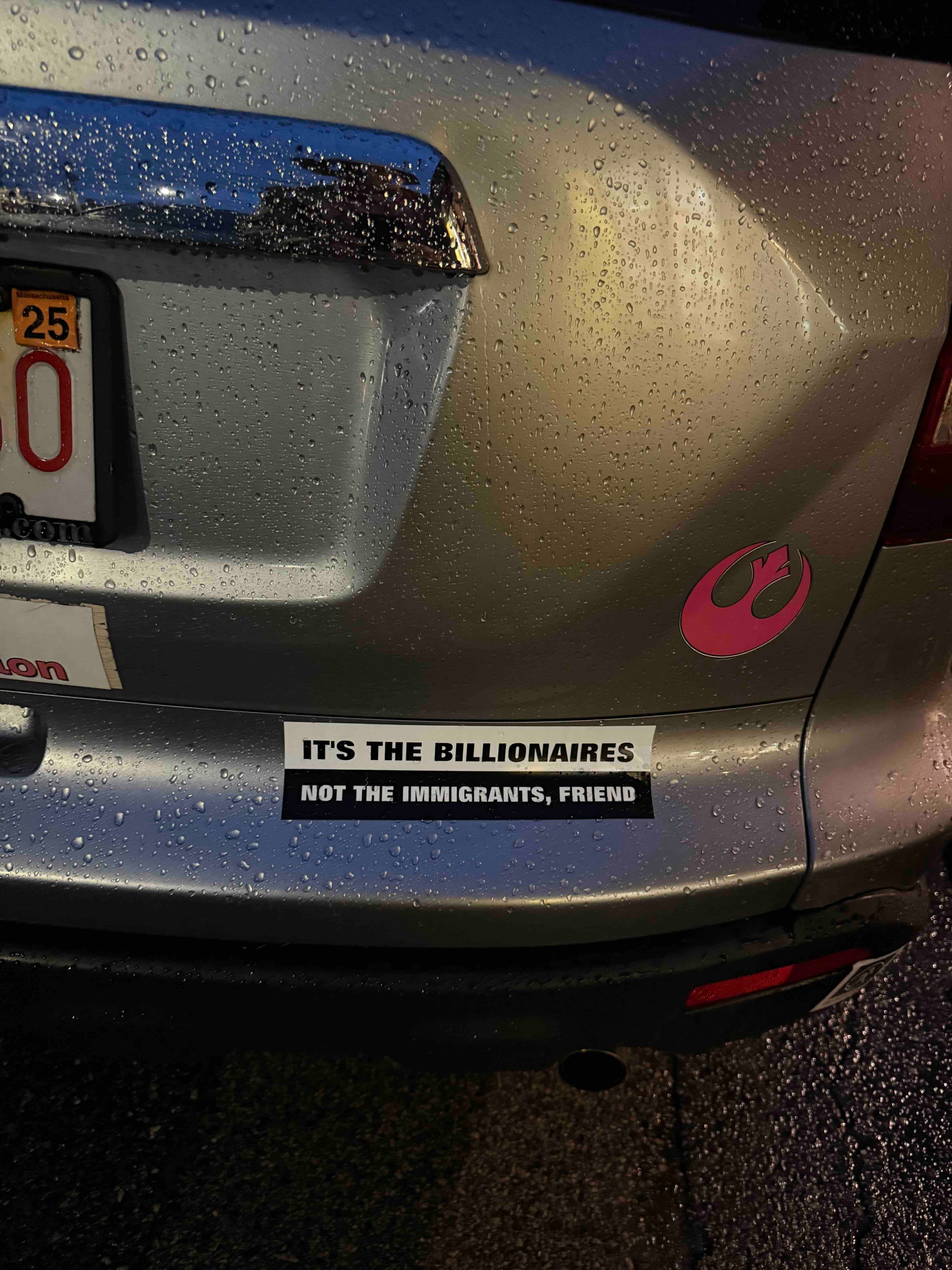
As the national Democratic Party and the Democratic candidate for mayor of New York, Zohran Mamdani, ramp up the anti-billionaire rhetoric, some businesses are seeking to cash in on the trend.
At Walmart.com, a “billionaires shouldn’t exist” t-shirt is sold out in all 7 sizes, from small to 4xl.
Amazon is selling “billionaires should not exist” shirts, tote bags, and sweatshirts. It’s also selling “eliminate billionaires” throw pillows, iphone cases, and insulated drink tumblers—all with a logo that includes a French Revolution-style guillotine. Amazon Music also sells six different songs with a “guillotine billionaires” theme, including one that carries a warning about “explicit” lyrics (“shoulda known greed was the creed of the beheaded…guillotine billionaires everybody everywhere, burn their money, we don’t care.”).
Etsy has shirts, yard signs, bumper stickers and car magnets with the slogans “the only minority destroying the country are the billionaires” and “deport billionaires.” One shirt design features a guillotine and the phrase “billionaires should not exist.”
The creator explains she was motivated by “wanting to create some clothing for myself that expresses my beliefs that the capitalist system is deeply failing humanity. In my everyday life I am a therapist and profit I make here goes towards providing fee-free mental health & wellbeing services to low-income communities.”
The Democratic National Committee’s main X account earlier this year posted video of a Democratic state representative from Texas, James Talarico, saying, “The only minority destroying America is the billionaires.”
The DNC also posted video of last night’s event in Brooklyn with Senator Sanders of Vermont and Zohran Mamdani in which Mamdani talked about “the interconnectedness of an attack on working people all to enrich those same billionaire donors that gave us Donald Trump’s second term.” And, as I’ve reported, even the Republican candidate for mayor of New York, Curtis Sliwa, is running against billionaires (see “In N.Y. Mayoral Race, Even Republican Runs Against Billionaires,” August 15, 2025.)
What to make of this, beyond chuckling at the irony of the owners of Amazon and Walmart making money from this phenomenon (or chuckling at the irony of the billionaire-bashers selling on those platforms rather than waiting for Mayor Mamdani to open city-owned t-shirt stores as he promises to do with supermarkets)?
Reassuring is that it appears to be a minority view. A billionaire politician, Donald Trump, won election as president. It seems more mainstream in America, even in 2025, to dream of becoming a billionaire than to fantasize about cutting off the head of one.
But for those generally opposed to demonizing or scapegoating minorities, especially with images or rhetoric that targets them for violence, the idea that there should be an exception to that principle when it comes to blaming billionaires for all of America’s problems seems strange. I encountered a billionaire-bashing bumper-sticker this past week on a parked car in Newton, Massachusetts. That it’s become socially acceptable in places like that to drive around with a sticker like that on your car is concerning. A society that gangs up violently against a prosperous minority is nothing to aspire to. Most billionaires got that way by innovating and creating value for customers through voluntary, mutually beneficial transactions. Punishing that, or creating a country where it can’t happen, would hurt not only billionaires but a lot of other people, too—customers, suppliers, employees, shareholders. It’d be the equivalent of a revolutionary accidentally amputating one of her own limbs in the guillotine—self-defeating.
Bloomberg reporter fawns over Qatar executive: Bloomberg’s Avril Hong has an interview with the chief commercial officer at state-owned Qatar Airways, Thierry Antinori, on the sidelines of the Goldman Sachs Asia Leaders Conference in Hong Kong. “It’s a strong brand, undeniably,” Hong fawned about Qatar Airways.
Thanks to the Washington Free Beacon and the House Committee on Education and Workforce, we now know that Northwestern University’s agreement with the Qatar Foundation included a clause requiring that Northwestern “employees, students, faculty, families, contractors, and agents should be subject to the applicable laws and regulations of the state of Qatar, and shall respect the cultural, religious, and social customs of the state of Qatar.” Qatar criminalizes criticism of the government.
It’s an interesting question whether Bloomberg’s agreement with Qatar for the Qatar Economic Forum includes a no criticism-clause similar to Northwestern’s. A reporter not bound by such a clause might be bolder in asking questions such as why is Qatar a “dialogue partner” of the Shanghai Cooperation Organization of American enemies like Iran, Russia, and China? Or, how can Qatar Airways passengers have any confidence that the person in the seat next to them isn’t going to be a Hamas terrorist, since Qatar is hosting the leaders of Hamas? Or, how does broadcasting terrorist-inspiring propaganda on Qatar-owned-and-controlled Al Jazeera fit with the corporate strategy of Qatar Airways?
Michael Bloomberg is an Eagle Scout and has been a remarkable business success. His mayoralty of New York looks even better in retrospect given what has come since and with Mamdani looming. Qatar needs Bloomberg’s reputation more than Bloomberg needs anything from Qatar. It damages Bloomberg’s brand to have reporters out there fawning over executives of Qatar’s state-owned airlines, just as badly as it damages Northwestern’s brand to have gotten into the agreement it did with Qatar.
Netanyahu on the “public diplomacy damage”: Prime Minister Netanyahu, in remarks today at the beginning of a cabinet meeting, addressed international criticism of Israel:
I am aware of the price that we are paying in the diplomatic and public diplomacy fields for the State of Israel and the best way to get out of this, of course, is to establish completely new mechanisms as we mentioned, and – of course – to end the war as fast as possible with the victory that we have defined: Eliminating Hamas, the return of all the hostages and ensuring that Gaza never again threatens Israel.
But regarding the public diplomacy damage, I would like to say one thing: If I need to choose between victory over our enemies and malicious propaganda against us, I choose victory over our enemies, as opposed to the opposite. I do not want stories that we have been beaten by our enemies and for us to be eulogized well in the global media. I choose victory.
Harvard cuts: The Crimson reports that Harvard’s introductory Computer Science 50 class is reducing its use of “course assistants,” undergraduate students who are paid (at $21 or $23 an hour) to help other students learn. “Harvard’s flagship CS 50 course also reduced its undergraduate teaching staff from 37 in 2024 to 25 this fall. According to [Gordon McKay Professor of the Practice of Computer Science David] Malan, the drop was partially caused by budget shortfalls, in addition to enrollment projections and a new CS 50 AI tool reducing students’ reliance on course support staff.” By “undergraduate teaching staff,” at least as I understand it from the context, the Crimson doesn’t mean grownups who are teaching undergraduates, it means undergraduates who are paid to teach their peers. (This is something that almost never happened at Harvard when I was a student there decades ago, but it appears to be common now. In large lecture courses we did have section leaders who led discussion sections and graded papers or quizzes, but they were graduate students, not other undergraduates.)
Malan has a bunch of slides up contending that the AI tool can “provide students with office hours 24/7” and “approximate a 1:1 student to teacher ratio.” Also, the AI assistant is less arrogant and condescending than the Harvard undergraduate course-assistant humans. Malan quotes a student comment: “love how AI bots will answer questions without ego and without judgment, generally entertaining even the stupidest of questions without treating them like they're stupid. It has an, as one could expect, inhuman level of patience.”
If the for-profit part of the economy is rolling out artificial intelligence to improve service and cut costs, why shouldn’t higher education do the same? There are probably downsides to AI assistants, but there are downsides to the human assistants, too. People may have differing views on whether the Trump pressure on high-end higher education is helpful or unhelpful. But if the budget pressure accelerates some technological innovation that makes the teaching less costly and, in some ways, better, that might not be the worst thing.
Thank you! The Editors is a reader-supported publication. Unlike Bloomberg and and Northwestern University, we don’t have any deals with the government of Qatar. We rely instead on readers like you. If you appreciate the information and analysis and are learning things here that you are not getting elsewhere, please become a paid subscriber today. Paid subscribers have full access to all the content and are helping to sustain our growth and editorial independence. Thanks to those who have already pitched in, at a price of as little as $1.54 a week. If you have trouble making it work on a phone, try a desktop, or if you have trouble on a desktop, try a phone. Or ask some tech-savvy youngster to give you a hand.
And if you know someone who would enjoy or benefit from reading The Editors, please help us grow, and help your friends, family members, and associates understand the world around them, by forwarding this email along with a suggestion that they subscribe. Or send a gift subscription. If it doesn’t work on mobile, try desktop. Or vice versa. Or ask a tech-savvy youngster to help. Thank you!
The face of greed and exploitation used to be a millionaire. But since Bernie, Michael Moore, and Ilhan Omar exceed that threshold, they had to substitute a "b" for "m." However, those condemned to the guillotine aren't named Soros, Pritzker, Gates, Steyer, or Hoffman.
As a junior, I was a teaching fellow for introductory biology labs at Harvard. I didn't feel underqualified.
That said, some section meetings run by graduate students were among my best undergraduate experiences.
In the introductory neurobiology course, our section meetings started going longer than the scheduled hour, and students started switching to other sections. Soon we were down to 2 undergraduates and meeting for 3 hours. All 3 of us, the 2 undergraduates and the graduate student, ended up on the faculty of Harvard Medical School, with one in neurobiology and one in neurology.
For organic chemistry there was a supplemental section for people who wanted to learn the minicomputer-based software being developed in the department to advise on synthesis of complicated organic molecules. I didn't have time to take a second section, but I went to the orientation meeting to get a flavor of the software project. I decided I couldn't miss this, and what I learned from that supplemental section on how the software approached chemical synthesis made it such that the hard problems on the final exam were easy to solve. That experience is the inspiration for our "Elements of Diagnosis" instructional material using our medical diagnostic software: https://simulconsult.com/elements/
Students should go to section meetings. Bill Gates often skipped classes, but his teaching fellow for that neurobiology course told me that Gates showed up for the sections. (That teaching fellow also became a HMS faculty member in neurology).