



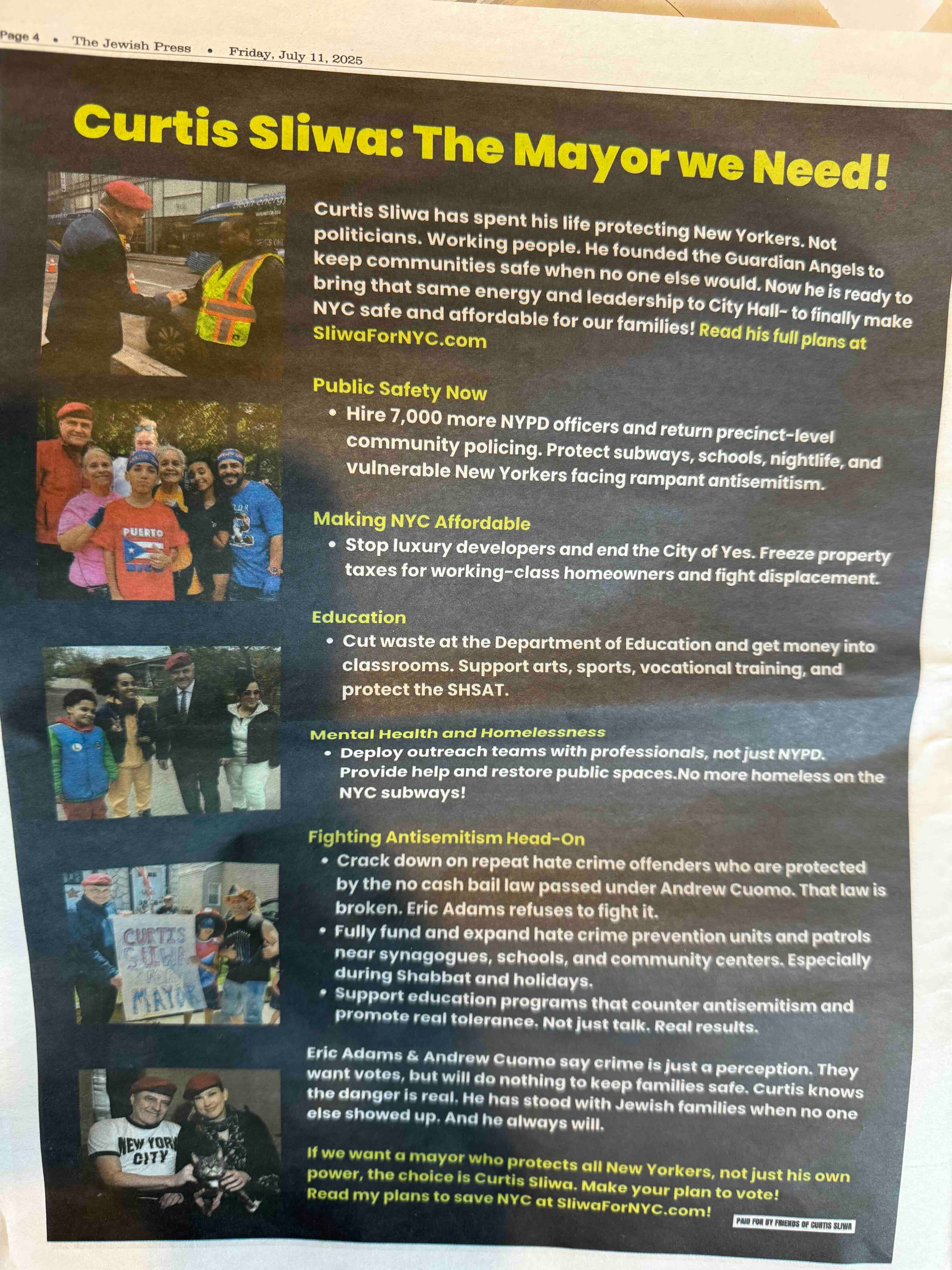
The Republican candidate for mayor of New York, Curtis Sliwa—one of three people on the planet, along with Mayor Eric Adams and Andrew Cuomo, who could prevent the Israel-hating socialist Zohran Mamdani from taking over the city—is campaigning Wednesday afternoon in the Times Square subway station.
It’s a block from New York Times headquarters and in the middle of what used to be the media capital of the world, and the event is on Sliwa’s public schedule. Yet there are no other reporters there—not from New York’s all-news cable television outlets, not from any of the nonprofit local newsrooms, not from the remaining print or online dailies, not from the local public radio affiliates. Just me, a former New Yorker visiting from Boston, on a subway platform on an 89-degree day with the hot-air output from the subway car air-conditioners making it even hotter.
And no other reporters show up. So for an hour, in-between passing subway riders and prospective voters who paused for a selfie with the candidate in his Guardian Angel red beret or wished him well, I have what amounts to an exclusive interview with Sliwa.
The day before I’d had a visit to the headquarters of the Success Academy charter school network, so my first question to Sliwa was about K-12 education policy. What threat would a Mayor Mamdani pose to charter school growth? Sliwa reminds me that the United Federation of Teachers, the powerful teachers union that has been largely hostile to charters, recently endorsed Mamdani. Sliwa says as mayor, he’d try to keep all kinds of schools—traditional public, charter, parochial, and private schools—viable.
How’d he deal with the “affordability” issue that Mamadani was emphasizing with apparent success? He replies by talking mainly about housing, saying that he’d add supply by making available 6,000 apartments in public housing projects that he said are now vacant owing to corruption and incompetence in managing the waitlist for public housing. He also said he’d meet with landlords to try to open up rent-stabilized apartments that the landlords are now keeping vacant instead of renting. After Covid-era changes making evictions more difficult, he said landlords tired of deadbeats and squatters now figure, “I’d rather take a loss than deal with a nightmare tenant.”
What he opposes, he says, is “build, build, build…the only one that benefits is the developers.” I ask what’s wrong with developers making money, isn’t that what America is all about?
“It destroys neighborhoods,” he says, mentioning that his father was a merchant seaman. “I represent the blue-collar working class.”
Having also attended earlier this week at a launch event for my former Forward colleague Jonathan Mahler’s “The Gods of New York,” I asked Sliwa whether there are enough of those “blue-collar working class” people in the city to elect a mayor.
He insists there are: carpenters, electricians, plumbers, civil servants. “I’m the outer-borough mayor, first and foremost,” he says. He’s the only major mayoral candidate who opposed congestion pricing, a kind of tax on visiting Midtown and Lower Manhattan from elsewhere: “you get clipped for $9 coming in.”
I’d noticed him talking in recent television appearances about how the war in Gaza was helping Mamdani. I probably first met Sliwa years ago at a dinner of the Zionist Organization of America, so that take on it surprised me a bit. As we moved from the shuttle platform toward an uptown 2 train, I ask how he’d like to see the war end. “I’d like to see Hamas destroyed,” he said. But he added that the video footage from Gaza is “not good for those who support Israel.”
Immigration? Sliwa says he believes in deporting criminals but opposes numerical goals that he says goad immigration enforcement to excessive levels. “Quotas are never good,” he says.
As the uptown 2 train approaches 96th street, I ask my standard end-of-interview question, which is whether there’s anything I haven’t asked about that he wants to mention. Yes, he says, there is.
“This is not gonna be an election determined by billionaires,” he says. “This will be an election that will be determined by the people voting, not by billionaires playing chess.”
The billionaires, he says, will “be okay”—they can move elsewhere, or avoid dangerous areas of a declining city. Less wealthy people, he says, “don’t have options.”
“I’ve never been one for the billionaires,” he says.
Some Republicans want Mamdani to win because they see running against him nationally as a ticket to a maintaining a House majority. Sliwa, though, says he’ll try to take the high road in his campaign. He says negative campaigning tends to turn off voters, especially women, who have a high propensity to vote. He is also wooing them with an animal-rights dimension to his campaign.
“I’ll talk issues. I think it resonates with the voters,” Sliwa says.
As we stand on the platform and ride the subway, we are constantly interrupted by a stream of people—finance bros, uniformed city workers in dreadlocks, elderly immigrants from Eastern Europe, young parents upset about open drug use in Bronx parks—who recognize Sliwa and stop to encourage him. He hands them business cards with a QR code and the web address of his campaign website page about making the subways safer.
There are two required mayoral debates for the candidates participating in the city’s public campaign finance matching program. Sliwa drew 28 percent of the votes, or some 312,385 votes, against Adams in the 2021 general election. He spins a scenario where he builds on that, the other candidates all stay in and split up the remainder of the vote, and he emerges as the winner.
The next morning I caught the well-tailored Mayor Adams at a highly scripted Manhattan Institute event. “While we have made progress, public drug use is still a problem,” Adams said, asking the legislature to pass a “compassionate intervention act” that would allow doctors or nurses to seek a court order that would involuntarily commit addicts to treatment programs. He called for building a “culture of compassion instead of a place where anything goes.” While Sliwa had been talking to anyone on the subway, and traveling without a security detail and without even any campaign volunteers or aides, Adams had a teleprompter and an entourage and took questions only from Manhattan Institute president Reihan Salam, not the audience.
Sliwa, who has a radio show, could do well in a debate.
This is not an endorsement or a prediction. But for those who aren’t quite ready to concede New York City to the Israel-hating socialist, some time with Sliwa on the subway might be time well spent—not only for a view of where New York City is headed going into the 2025 mayoral election, but for a sense of the American mood at this moment.
David Brooks on Democrats as “party of the status quo”: David Brooks writes in the New York Times:
In sector after sector, Democrats are in danger of becoming the party of the status quo. Here’s how it’s happening: Trump goes after some institution, like D.E.I., the federal bureaucracy or universities. The resistance folks rise up to defend those institutions without acknowledging that there’s usually a kernel of truth behind Trump’s critiques; they don’t want to give him that win, so they end up defending the institutions up and down the line. Trump ends up looking like the change agent and the resistance looks like the defenders of the past.
The Federal Reserve is a case in point. My former New York Sun colleague Joseph Sternberg has two excellent sentences on this point in today’s Wall Street Journal:
No democratic political system can tolerate an unaccountable institution that exercises such awesome economic power and also makes so many mistakes. Witness mounting bipartisan frustration with the Fed in Congress.
Know someone who would enjoy or benefit from reading The Editors? Please help us grow by forwarding this email along with a suggestion that they subscribe. Or send a gift subscription.
Zohran Mamdani has a sure-fire way of reducing housing costs: killing jobs so people move away.
Before the election, voters imagine that only other people will lose their jobs. But sooner or later Mamdani will run out of other people's jobs to kill.