


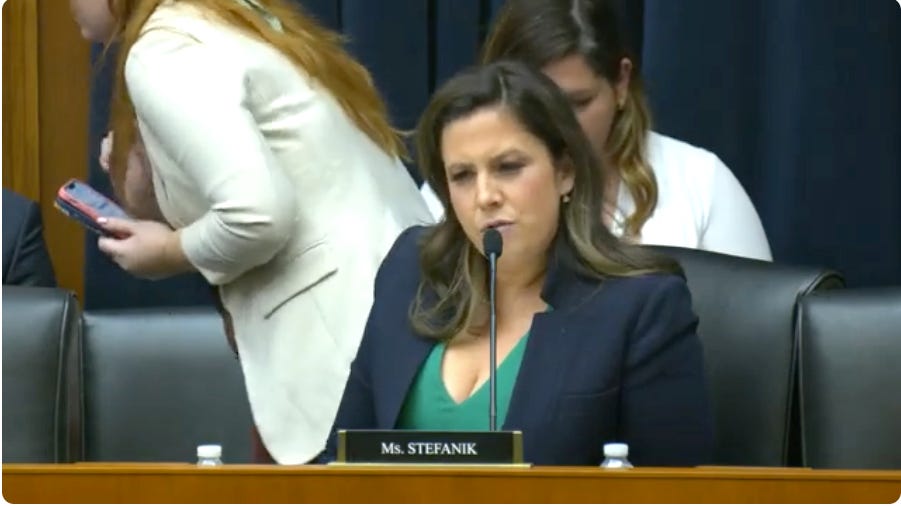
Rep. Elise Stefanik this morning officially kicked off her campaign for governor of New York.
Her launch video focuses on crime and affordability. With images of New York City Mayor-elect Zohran Mamdani, it also scores the incumbent governor, Democrat Kathy Hochul, for having “cozied up to a defund-the-police, tax-hiking antisemitic communist.”
Her website, eliseforgovernor.com says she is running “to make New York affordable and safe” and lists among her top priorities “cut taxes,” expand school choice,” and “lower energy and utility costs by expanding energy independence.”
People haven’t really yet focused on it yet, but because of a provision in the New York state constitution, a Governor Stefanik would have the power not only to help protect the state from the worst of Mamdani’s socialist or anti-Israel policies—she could actually formally remove him as mayor.
The New York State’s Unified Court System has an “Ask a Law Librarian” page up with a question, “What law gives the governor of New York the power to remove mayors, district attorneys, and other nonjudicial public officers?”
It answers:
The governor’s power to remove a public officer is derived from the New York State Constitution, Article 13, §§ 5 and 13(a)-(b). Public Officers Law § 33 codifies this power with respect to municipal mayors and police commissioners only. The New York City Charter § 9 affirms this power with respect to the mayor of New York City.
There are few precedents for the exercise of this power. In 1900, Governor Theodore Roosevelt removed the elected district attorney of New York County, Asa Bird Gardiner, on charges of “interfering with deputies of the Attorney General in presentation of election cases to the Grand Jury and the prosecution thereof.“ In 1932, Governor Franklin D. Roosevelt held hearings to remove Mayor Jimmy Walker. People ex rel Walker v Roosevelt, 144 Misc 525 (Sup Crt, Albany County 1932) provides some background to this famous Tammany Hall case, which cites the 1896 Constitution and the 1901 New York City Charter.
The Public Officers Law states, “The chief executive officer of every city and the chief or commissioner of police, commissioner or director of public safety or other chief executive officer of the police force by whatever title he may be designated, of every city may be removed by the governor after giving to such officer a copy of the charges against him and an opportunity to be heard in his defense. The power of removal provided for in this subdivision shall be deemed to be in addition to the power of removal provided for in any other law. The provisions of this subdivision shall apply notwithstanding any inconsistent provisions of any general, special or local law, ordinance or city charter.”
A live topic in the Stefanik camp is whether to promise to remove Mamdani and, if so, how much to emphasize that plan in his campaign. Making it the centerpiece of her campaign could backfire by energizing Mamdani’s supporters or appear to try to undo the outcome of the election that just took place in New York City. However, it could also work to her advantage by energizing Mamdani’s opponents.
Early indications are that Mamdani is not backing away in the slightest from his anti-Israel agenda. Marshall Ganz, 82, a lecturer at Harvard Kennedy School, reportedly attended Mamdani’s victory party and has been reportedly “consulted by Mr. Mamdani and his aides.” Harvard earlier this year settled an antisemitism lawsuit brought by Israeli students represented by the Louis D. Brandeis Center for Human Rights Under the Law over a Ganz-taught class in which a class activity was convincing students to attend a boycott-Israel event, Ganz and the class posed in keffiyehs for a picture, and the Israeli students were told by Ganz that they could not work on a project about Israel as a Jewish democracy.
Mamdani, the Bowdoin-educated son of a tenured professor at Columbia, also gave an election-night victory speech in which he postured as a representative of the working man: “for as long as we can remember, the working people of New York have been told by the wealthy and the well-connected that power does not belong in their hands. Fingers bruised from lifting boxes on the warehouse floor, palms calloused from delivery bike handlebars, knuckles scarred with kitchen burns: These are not hands that have been allowed to hold power…Tonight, against all odds, we have grasped it. The future is in our hands.”
“You eroded the cynicism that has come to define our politics,” Mamdani said, while himself contributing to the cynicism with his own phoniness.
Even on antisemitism, which Mamdani rhetorically opposes while personally fueling, Mamdani couldn’t denounce it without immediately moving to “Islamophobia” against what he said were “the more than one million Muslims” in the city. Mamdani won with narrowly more than 1 million votes total.
The New York Times dealt with this point earlier this year in an editorial: “University leaders have often felt uncomfortable decrying antisemitism without also decrying Islamophobia. Islamophobia, to be clear, is a real problem that deserves attention on its own. Yet antisemitism seems to be a rare type of bigotry that some intellectuals are uncomfortable rebuking without caveat. …People should be able to denounce a growing form of hatred without ritually denouncing other forms.”
If Governor Stefanik means that New York City is only subjected to one year of Mamdani’s rule rather than four years, it could be really significant. Not to mention that a young Republican woman winning election in a Democrat-leaning state in a midterm election year would instantly raise Stefanik’s profile as a major national figure and presidential contender.
A lot of Republicans and free-market people have written off New York as lost, moving to Florida or other lower-tax, where-woke-goes-to-die jurisdictions. Whatever decision she makes about removing Mamdani, or communicating about it, Stefanik’s “it’s time to save New York” campaign is a hopeful sign that the Empire State could yet have another comeback ahead.
Jon Hilsenrath on change at the Federal Reserve: Barry Ritholtz has a podcast interview with a person who used to cover the Federal Reserve for the Wall Street Journal, Jon Hilsenrath. From the transcript:
the Fed is a very consensus-driven institution. When I was covering the Fed back in the financial crisis period, 2008, 2009, there was actually a lot of disagreement at the time. The disagreement was internal and mostly in the regional Fed banks. So I actually spent a lot of time talking to these regional Fed bank hawks to understand what their case was against programs like QE and interest rate cuts and things like that…Bernanke and Yellen, and then Powell spent a lot of time trying to build processes to build consensus around their decisions….
Now, though, more disagreement is returning, Hilsenrath said.
The president has a clear view of where he wants interest rates going. He wants all interest rates going down….He’s putting on people…he expects to be loyal to him. Stephen Miran is the latest. So we’re and there’s a lot at stake, and there’s turnover happening at the Fed right now. We all know there’s going to be a new chairman appointed by the President next year. There are tests of loyalty. The really big issue is if the president gets four people who are loyal or even closely loyal to his views, he has an opportunity to remake the entire system .. There are seven Board governors. With a majority of four on the Fed Board, then the Board can start firing and restructuring the regional banks that might oppose some of the policies that the president wants to pursue. So there’s a lot at stake right now. Two levels, one with the succession of Jay Powell and two with the construction of who the other governors are going to be on the Fed board and how loyal they’ll be to the president’s vision of how monetary policy should be running.
Thank you: The Editors is a reader-supported publication that relies on paying customers. If you know someone who would enjoy or benefit from reading The Editors, please help us grow, and help your friends, family members, and associates understand the world around them, by forwarding this email along with a suggestion that they subscribe today. Or send a gift subscription. If it doesn’t work on mobile, try desktop. Or vice versa. Or ask a tech-savvy youngster to help. Thank you to those of who who have done this recently and thanks in advance to the rest of you.
Ira, your comments about removing Mamdani disturb me. The voters knew what they were getting and will now get it “good and hard,” as Mencken would say. The remedy must come via the political process (unless Mayor M fails to execute the laws, e.g., by keeping the police from stopping anti-Jew violence.) We don’t need troops on our streets or removal of elected officials by fiat, on a slippery slope to authoritarianism.