


Freedom is on the march in Venezuela and Iran, but in retreat in New York City.
President Trump’s decision to use military force to capture the mustachioed, Iran-allied, Venezuelan dictator, Nicolas Maduro, is buoying hopes for a restoration there of freedom, democracy, and rule of law. It’s also raising expectations for the possibility of an end to the terror-sponsoring, human-rights abusing theocracy in Iran and of the communist dictatorship in Cuba, which is heavily reliant on support from Venezuela. Trump was pictured smiling aboard Air Force One alongside Senator Lindsey Graham, a Republican of South Carolina, and holding a “Make Iran Great Again” baseball cap.
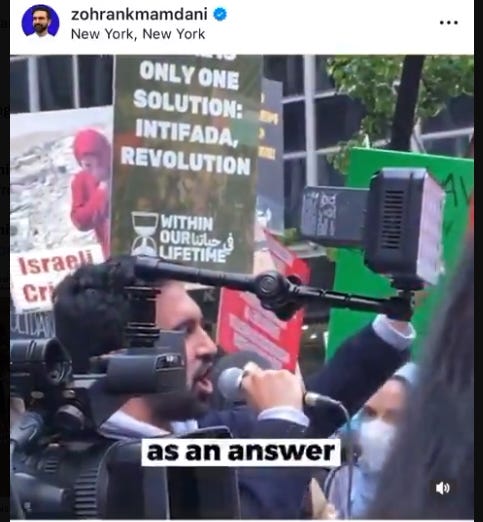
Yet even as central planners and anti-Israel political leaders come under pressure or are ousted around the world, one is taking power in New York City. The Zohran Mamdani mayoralty might perhaps have gone in a better-than-expected direction, given the positive recent meeting between Mamdani and President Trump, given Mamdani’s decision to retain Police Commissioner Jessica Tisch and her decision to continue to serve, and given Mamdani’s decision to cut loose a top aide after her antisemitic tweets surfaced. Instead, the new mayor of New York, in his first week on the job, is shaping up as even more radical than feared—a Maduro of Manhattan.
Among the events and decisions fueling concerns:
Mamdani on January 1 named Cea Weaver as director of the “Mayor’s Office to Protect Tenants.” A 2018 tweet from Weaver said, “Impoverish the white middle class. Homeownership is racist/failed public policy.” What is described as a “resurfaced video” has her saying, “I think the reality is that for centuries, we’ve really treated property as an individualized good and not a collective good. And we are gonna... and transitioning to treating it as a collective good and towards a model of shared equity will require that we think about it differently. And it will mean that families, especially white families, but some POC families who are homeowners as well, are gonna have a different relationship to property than the one that we currently have.” In a 2020 video she advised even tenants who had funds available to cease paying rent, and she talked about, “The short term transitional demands that we have to get out of this trap of private property.”
Weaver quite publicly and recently talks about her goal of having tenants basically take over buildings from landlords by forcing a sale. Here she is in a Winter 2025 interview with Dissent: “you could form a tenant union, organize for better living conditions, demand that your landlord fix things, take them to court and sue them. Then the landlord could say, ‘I’m fed up with this building that is full of organized renters,’ sell the housing to the SHDA, and you could become a tenant of the public-sector housing authority.”
Weaver is part-time faculty at NYU, which is a reminder of how many of the worst ideas have burrowed into the universities. Mamdani himself is the son of a Columbia faculty member, raising the question of whether the right nickname for him is the Maduro of Manhattan, or the Maduro of Morningside Heights.
The assistant attorney general for Civil Rights, Harmeet Dhillon, commented on Weaver’s video: “I don’t think so … we have federal housing laws that trump any collective Marxist fantasies.”
The idea of eliminating private homeownership is somewhat in keeping with Mamdani’s inaugural address, which said, “We will replace the frigidity of rugged individualism with the warmth of collectivism.”
What “warmth of collectivism” was Mamdani talking about? The Wall Street Journal editorial board recommended “One Day in the Life of Ivan Denisovich” by Alexander Solzhenitsyn, observing, “It was a very cold day in Siberia.” A good place to start. For further reading, my recommendations include Menachem Begin’s “White Nights.” Also good is Ida Nudel’s memoir, “A Hand in the Darkness,” which talks about temperatures in her Siberian prison room reaching 60 degrees below zero.
Truth is, you don’t have to be a socialist like Mamdani to believe modern America could use a modest adjustment in the direction of community, away from loneliness. David Brooks writes a version of that column frequently. Even, of all things, the new Koren Sacks Humash, according to a new review at Lehrhaus, includes the late Lord Rabbi Jonathan Sacks criticizing the “hyper-individualism of our late capitalist society” and a culture that glorifies “I” and not “we.” If Mamdani had been smart, he’d have used the line from Lord Sacks, boggling everyone’s mind. The Koren Sacks Humash is also known as the Magerman edition, after David Magerman, who made a fortune at the Renaissance Technologies hedge fund. If Mamdani had really wanted to boggle everyone’s mind, he could have attributed the line to the Magerman edition of the Koren Sacks Humash.
Yet Mamdani’s personnel choices and policies signal less the warmth of voluntary community and more the frigidity of a coerced collectivism. The word choices are not accidental. Perhaps some of it can be traced to Mamdani’s experience as a student at Bowdoin a decade ago. While Mamdani was a student there the Bowdoin Orient quoted a government professor talking about “New England rugged individualism.” The Bowdoin psychology department was also working on research along the lines of “East-west, collectivist-individualist: A cross-cultural examination of temperament in toddlers from Chile, Poland, South Korea, and the U.S.”
Despite New York Times coverage inaccurately portraying divisions and despite Mamdani’s cynical use of figures such as Bernie Sanders and Mandy Patinkin, the Jewish community in New York is remarkably united—a joint statement January 2 from the UJA-Federation of New York, American Jewish Committee, Anti-Defamation League, Orthodox Union, Agudath Israel of America, New York Board of Rabbis, and Jewish Community Relations Council of New York, faulted Mamdani’s moves to reverse two “significant protections against antisemitism.” “Singling out Israel for sanctions is not the way to make Jewish New Yorkers feel included and safe,” they said. If New York’s capital and business community and real estate community show similar unity against Mamdani, perhaps the worst damage can be averted. It’ll be a real disaster for America if its largest city becomes like revolutionary Iran or Venezuela, places where property rights were imperiled and Israel was seen as the enemy.
Thank you: The Editors is a reader-supported publication that relies on paying customers to sustain its editorial independence. If you know someone who would enjoy or benefit from reading The Editors, please help us grow, and help your friends, family members, and associates understand the world around them, by forwarding this email along with a suggestion that they subscribe today. Or send a gift subscription. If it doesn’t work on mobile, try desktop. Or vice versa. Or ask a tech-savvy youngster to help. Thank you to those of who who have done this recently and thanks in advance to the rest of you.
Evidence that DJT cares about DEMOCRACY RULE OF LAW SOVEREIGNTY ETC? As opposed to American power. He’s giving imperialism a bad name