

Why Trump’s Anti-Trans Ad Worked
Hillary Clinton spokesman Philippe Reines explains

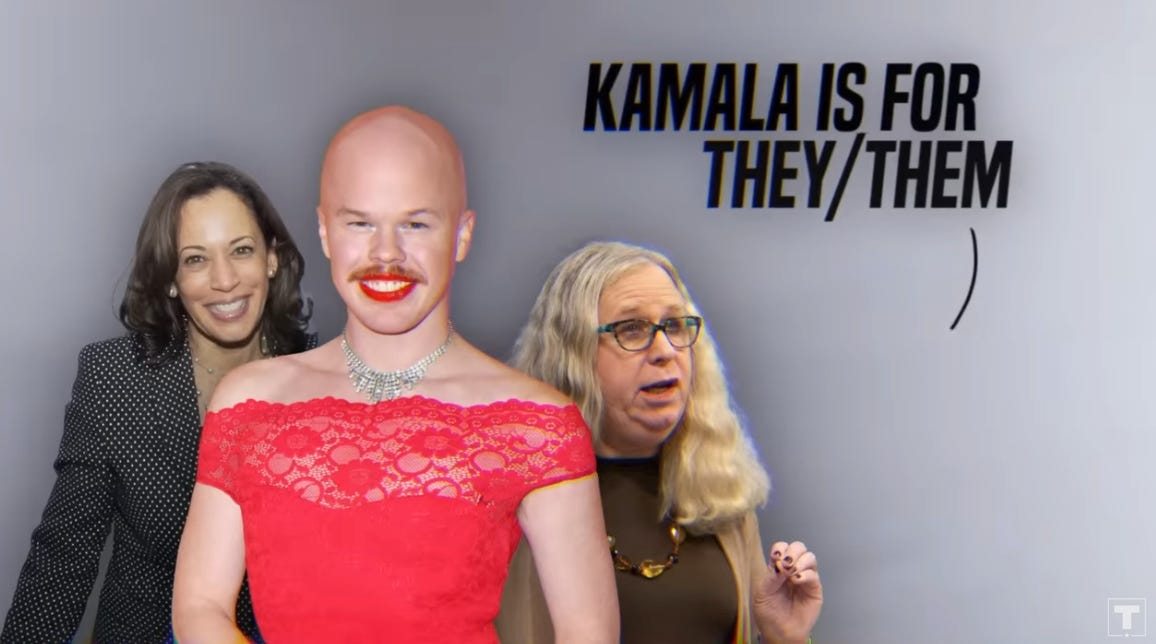
“Kamala is for they/them. President Trump is for you,” went the tagline of the Trump television commercial highlighting Kamala Harris’s response to an ACLU questionnaire in which she said she’d support taxpayer-funded sex-change operations for illegal aliens. The commercial must have aired in my house seven or eight times over the past few weeks, and we hardly ever watch television and we don’t live in a swing state.
The New York Times has some good reporting on the ad buried in the midst of an overly long campaign postmortem:
The Charlamagne ad ranked as one of the Trump team’s most effective 30-second spots, according to an analysis by Future Forward, Ms. Harris’s leading super PAC. It shifted the race 2.7 percentage points in Mr. Trump’s favor after viewers watched it.
The anti-trans ads cut to the core of the Trump argument: that Ms. Harris was “dangerously liberal” — the exact vulnerability her team was most worried about. The ads were effective with Black and Latino men, according to the Trump team, but also with moderate suburban white women who might be concerned about transgender athletes in girls’ sports.
Those were the same suburban women Ms. Harris was trying to mobilize with ads about abortion.
Democrats struggled to respond. At one point, former President Bill Clinton told an associate, “We have to answer it and say we won’t do it.” He even raised the issue in a conversation with the campaign and was told the Trump ads were not necessarily having an impact, according to two people familiar with his conversations. He never broached the topic publicly.
The Harris team debated internally how to respond. Ads the Harris team produced with a direct response to the “they/them” ads wound up faring poorly in internal tests. The ads never ran.
Maybe I wasn’t the target audience, but I found the ads targeting trans people, who have a hard time and deserve to be treated with the same human dignity as everyone else, cruel. I didn’t really get it until after the election, when I saw a former aide to Hillary Clinton, Philippe Reines, who played Trump in debate prep for Harris and for Hillary, on Kasie Hunt’s CNN show. Said Reines, as Hunt tweeted out the comments, “the woke stuff, the PC police stuff.”
“I don't like the fact that a small portion of our party is pretty much dictating where we are, that they are — pretty much we are being branded as the most extreme of us. It is not only politically problematic as we just saw, because none of this stuff helped the other day. Without a doubt, it’s a problem. But we need to take stock of why we are being held hostage to the far left. No one should be and wants to be kowtowing to the extremes of their own parties. ... The majority of Democrats don’t agree with the things that we are being tagged with. ... I think Democrats believe in common sense stuff more than you’d realize,” Reines said. “Most Democrats I know think there’s a huge problem at the border. Most Democrats I know think, frankly, that males at birth shouldn't play women sports and vice versa. Now, you can have a healthy conversation within a party. ... But at the end of the day, if you have some of these issues that are 80-20 across the country, you really got to figure out why they’re being so tagged with one."
What Reines is getting at, I think, is that the They/Them ad worked not because the American public is bigoted against trans people, but because it’s a stand-in for the broader “held hostage to the far left,” “woke,” issue. Harris, the daughter of academics from Berkeley, California, was vulnerable to that line of attack. And by answering the ACLU questionnaire the way she did, she left herself open to the attack and showed herself wanting to woo the activist left wing of her party rather than stand up against it.
Iran Tried to Kill Trump: We’ve reported here in recent weeks about Iran’s plan to kill President Trump and some of his former aides. (“If Trump is such a relative patsy for the Iranians, why would the Iranians be trying to assassinate him?” I wrote back on October 13.) The Justice Department today issued a press release disclosing additional public details about those Iranian activities.
From the release:
“There are few actors in the world that pose as grave a threat to the national security of the United States as does Iran,” said Attorney General Merrick B. Garland. “The Justice Department has charged an asset of the Iranian regime who was tasked by the regime to direct a network of criminal associates to further Iran’s assassination plots against its targets, including President-elect Donald Trump. We have also charged and arrested two individuals who we allege were recruited as part of that network to silence and kill, on U.S. soil, an American journalist who has been a prominent critic of the regime. We will not stand for the Iranian regime’s attempts to endanger the American people and America’s national security.”...
“Actors directed by the Government of Iran continue to target our citizens, including President-elect Trump, on U.S. soil and abroad. This has to stop,” said U.S. Attorney Damian Williams for the Southern District of New York.
The Biden administration seems to be taking a law-enforcement approach to the issue rather than a military act-of-war response, in keeping with the generally wan approach to Iran overall. Press releases about how they won’t stand for it are less important than actions to cause it to end.
Least Trumpy Massachusetts Towns: WBUR has a map of the presidential race results in all 352 cities and towns in Massachusetts. There is also a list that is sortable by vote percentages. The three places where Trump did the worst were Provincetown (where Trump got 7.2 percent), Amherst (where Trump got 8.5 percent) and Cambridge (where Trump got 8.6 percent).
Provincetown, at the tip of Cape Cod, is a base of Andrew Sullivan; Harris had a fundraiser there on July 20. Enough said.
The lopsided showings in Amherst (home to the University of Massachusetts, Amherst and Amherst College) and in Cambridge (home to Harvard and MIT) are indicators of how different those places are compared to the rest of the country and the rest of the state. The over-the-top reaction to the election results—unilaterally turning the morning-after-the-election jazz program on Harvard student radio station WHRB to blues because, the host announced, he despaired about the future of the country, a Harvard physics professor publicly offering up her office as a space for the “many in our community…embarrassed to face our international colleagues”—is more understandable when one realizes what a sheltered environment the residents of these places exist in. For institutions that fought to the Supreme Court about the importance of diversity to education, the monoculture is fairly evident.
I guess one could claim that the people in and around these universities are so intelligent that none of them would make the mistake of voting for Trump. Anyway, maybe the endowments of these places swelled so much from the stock market gains of the past few days that it will offset the effects of whatever endowment tax increases come from Trump and Republicans in Congress.