

Why Harris Picked Walz, and What it Means
Plus, Judge rules for Jewish students against Harvard; New York Times bares bias.

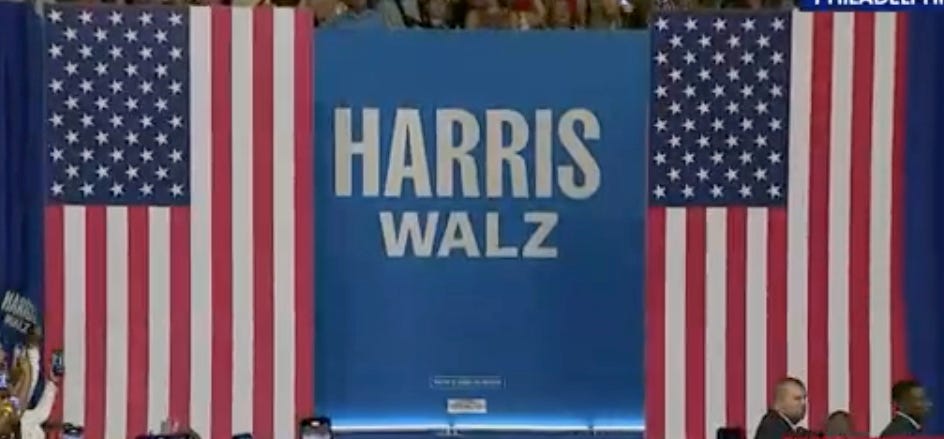
Immediate Republican reaction to Vice President Harris’s choice of Governor Walz as her running mate over Governor Shapiro centered on anti-Israel opposition to Shapiro. Senator Cotton of Arkansas put it this way: “Let’s be honest. Kamala is the most anti-Israel member of Biden’s team, always siding with Hamas and Iran’s interests. Shapiro and Walz’s views on Israel aren’t that different. But Harris catered to her pro-Hamas, antisemitic base who opposed Shapiro because he’s Jewish.”
That could have been a consideration. Yet there are other considerations that might have been even more significant.
An overlooked yet perhaps as important factor is that the teachers unions dislike Shapiro because of his support for school choice. And those same unions like Walz because he’s a former union teacher who brought universal free lunch to Minnesota schools. The president of the American Federation of Teachers, Randi Weingarten, greeted the choice with two tweets: “Inspired Choice!!! Gov Walz represents America. A social studies teacher and veteran from rural Minn” and “Congrats @Tim_Walz! As Governor his record has been exemplary including record funding for public education, protecting reproductive rights, expanding collective bargaining, access to affordable childcare & paid family and medical leave. @KamalaHarris made a great choice!!”
Walz hunts, he fishes, he even ice fishes. He was in the National Guard, which Democrats mocked George W. Bush for but I guess now that it’s the Democratic candidate who was serving rather than the Republican, suddenly counts as a plus. He taught in China and reportedly “set up a company, Educational Travel Adventures, to coordinate summer trips to China for American high-school students.” That is the closest the Democratic ticket gets to entrepreneurship.
By picking Shapiro, Harris might have sent a message of independence, that she wasn’t going to be intimidated by the Democratic Party’s progressive activist base, whether that was anti-Israel activists or anti-school-choice activists. That’s not where she wound up. Instead she picked the guy Bernie Sanders was openly advocating for, the guy who, in a “White Dudes for Harris” Zoom event, said, “One person’s socialism is another person’s neighborliness.”
Anyway, if there’s a signal from the selection, it is please don’t count on a ton of centrist policy risk-taking or personnel choices from this Harris-Walz team, either in the campaign or, if it comes to that, once in office.
Advertising inequality: I’ve been watching a lot of the Olympics over the past 10 days, mostly over a Boston-based broadcast network but also a bit via cable television in New Jersey, and I’ve probably seen a dozen Kamala Harris commercials and not a single Trump commercial. The Harris spots are by Future Forward, a Democrat-supporting superpac that has gotten a lot of money this cycle from Michael Bloomberg. If it were Harris getting outspent by Trump and Trump-supporting billionaires you’d be hearing calls for campaign finance reform to address the inequality of it all. Maybe the Trump camp is saving all its spending for microtargeted online ads in Pennsylvania rather than early television ads during the Olympics, which are expensive and maybe not so efficient, or maybe all the Trump money is going to legal bills to defend against the lawfare. Whatever the reason, it’s a striking imbalance. The Boston ads are presumably aimed at New Hampshire? And the New Jersey ones at Pennsylvania?
Judge Stearns rules for Jewish students: Judge Richard Stearns of the U.S. District Court for Massachusetts today issued a 25-page ruling allowing most of a lawsuit by Jewish students against Harvard to proceed, and denying Harvard’s motion to strike and dismiss the case.
The same judge had only days earlier thrown out a similar lawsuit by Jewish students against MIT, so the ruling sends a message. Some possible explanations for the different rulings in the two cases are that Harvard’s lawyers did a worse job than MIT’s did, that Harvard had more antisemitism than MIT did, and that Harvard did a worse job institutionally of responding to the antisemitism than MIT did.
The ruling rejects outright the arguments Harvard’s lawyers made at great length and expense about standing and “ripeness,” and the judge pronounced himself “dubious that Harvard can hide behind the First Amendment to justify avoidance of its Title VI obligations.”
Even as described by Harvard, the judge wrote, “Harvard’s reaction was, at best, indecisive, vacillating, and at times internally contradictory.” He wrote, “The facts as pled show that Harvard failed its Jewish students.”
The court set an April 2025 deadline for discovery in the case to conclude and a June 2025 deadline for additional motions.
So far, Harvard has been mounting a scorched-earth, overlawyered defense of the case featuring some of same WilmerHale team that lost the Harvard discrimination-against-Asian Americans in admissions case (also in part a Title VI matter) and that also prepared Harvard President Claudine Gay for the overly legalistic and disastrous testimony before Congress that contributed to her early resignation under pressure. WilmerHale’s Seth Waxman and Jamie Gorelick are former Harvard overseers, WilmerHale’s Bill Lee is a former Harvard Corporation senior fellow, and WilmerHale’s Felicia Ellsworth teaches at Harvard Law School when she isn’t representing Elon Musk’s Twitter in its case versus Donald Trump. Harvard’s new general counsel, Jennifer O’Connor, is a former WilmerHale partner.
An alternative approach is illustrated by NYU, which reached a settlement with its Jewish students in a similar case brought by the same Kasowitz, Benson firm that is representing Alexander “Shabbos” Kestenbaum and the Harvard Students Against Antisemitism.
The WilmerHale lawyers make more money if the case goes all the way to trial, and even more money if it goes through rounds of appeals. The Harvard clients can let themselves be talked by the lawyers into thinking that taking the case all the way to the Supreme Court is a heroic and principled stance for the First Amendment and academic freedom. The lawyers have probably talked themselves into believing that—after all, they have a duty to serve their clients well, not only to rack up the maximum possible fees. The Harvard clients can know that if they lose, as they did in the discrimination-against-Asian Americans in admissions case, the threatened cutoff of federal funding will never really happen (at least so long as Democrats hold the White House), and that instead of suffering any personal or professional consequences for losing the case and being found guilty of discrimination, instead the Harvard clients will be celebrated, at least internally.
At this point, the Harvard Jews are looking forward to the discovery process for what it may disclose in terms of embarrassing emails and internal text messages of the sort that were recently unearthed at Columbia.
The Harvard Corporation’s senior fellow, Penny Pritzker, is finally, as of today, done with her stint as Special Representative for Ukraine’s Economic recovery. Harvard’s newly non-interim president, Alan Garber, says he wants to “work to mend the fabric of our community.” Their wisest move may be to seek a swift settlement rather than pouring more endowment and donor money down the WilmerHale hole. Pressing onward in court might purchase for Harvard only more embarrassing disclosures and another landmark legal loss.
Harvard’s response to this line of reasoning is likely to go roughly, “look, it’s an insurance company, not us, on the hook for the legal bills. And anyway, in principle, we’d be happy to settle, but what they’re demanding we do to settle—fire tenured professors—is not something we can do without making it much harder for us to attract excellent faculty in the future, and without generating huge internal unrest.” Garber’s final day in the Harvard presidency is expected to be June 30, 2027. If this case is still kicking around the court system then, and he hands it off to his successor the way Drew Faust passed the affirmative action case off to Larry Bacow, it’ll be a bad sign.
Harvard to this day maintains a website describing the admissions case, originally filed in 2014, as “a threat to educational opportunity for millions of young people.” There’s a scenario where in 2034 Harvard is still decrying the Kestenbaum case as a threat to academic freedom, having spent a decade and tens of millions of dollars on a losing legal battle, during which time talented Jewish students and professors with options choose to move on, instead, to other institutions. Absent some leadership from Garber or Pritzker, that could be where this is headed. It’d be a shame—and yet more evidence that, as Judge Stearns put it, “Harvard failed its Jewish students.”
New York Times bares bias with double standard: Kamala Harris’s husband, Douglas Emhoff, had an extramarital affair during his first marriage.
The Daily Mail reported that the woman was also his children’s nanny and taught at a school his children attended, and that she became pregnant as a result of the relationship.
The New York Times covered the disclosure with an article that appeared online-only under the headline “Doug Emhoff, Husband of Kamala Harris, Acknowledges Long-Ago Affair.”
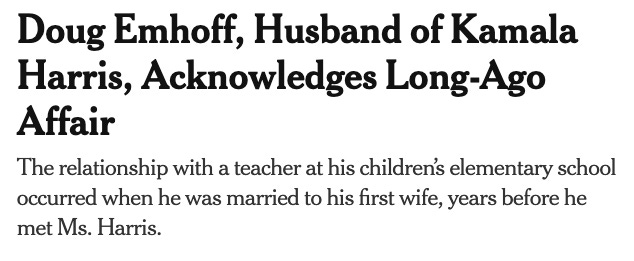
The “long-ago” aspect of it made me chuckle, as if the Times news editors are anxious to reassure any undecided voters that this is ancient history, old news. The news article’s first paragraph reports that it was “years before he met Ms. Harris,” and the second paragraph reports that the relationship was “approximately 15 years ago.”
Compare that to how the New York Times handles a news article about a flight that Justice Clarence Thomas took with a friend of Thomas, Harlan Crow. “Justice Thomas Failed to Reveal More Private Flights, Senator Says,” is the headline. That article, unlike the Emhoff one, appears in the print edition. The flight happened in 2010, which is also approximately 15 years ago.
It’s a double standard. When it’s a Democrat having an extramarital affair, the Times acts like a defense lawyer, explaining it away as “long ago” and keeping the story out of the print edition. When it’s a conservative Supreme Court justice occupying a seat on a friend’s private plane, the story winds up in the print newspaper, and there’s no Times-splaining to readers about how it was “long ago.”
How long ago is “long-ago” to a New York Times headline writer? The answer depends not on how much time has elapsed, but on whether the event involves a Democrat or a conservative.
Thank you: This is a reader-supported publication. If you value the information and analysis, please pitch in, assure your full access, and sustain our editorial independence. Help us to keep an eye on Harvard, the New York Times, the teachers unions, and other similar institutions. Thanks to those who already are paying customers.
The "democratic socialism" practiced by, say, the Scandinavian countries, does indeed seem something like neighborliness. -- something that should sell well in Minnesota. Just listening to him last night, however, makes it pretty clear that he lacks the worst feature of progressive activists, namely their scorched-earth policies and practices to get whatever they want. Of course, more and more activists on all sides have been adopting these too. But he may indeed be too nice a guy for this. We will see.