

Why Britain’s Conservatives, Unlike America’s, Uniformly Back Ukraine
Boris Johnson aims to win Donald Trump over to Kyiv’s cause

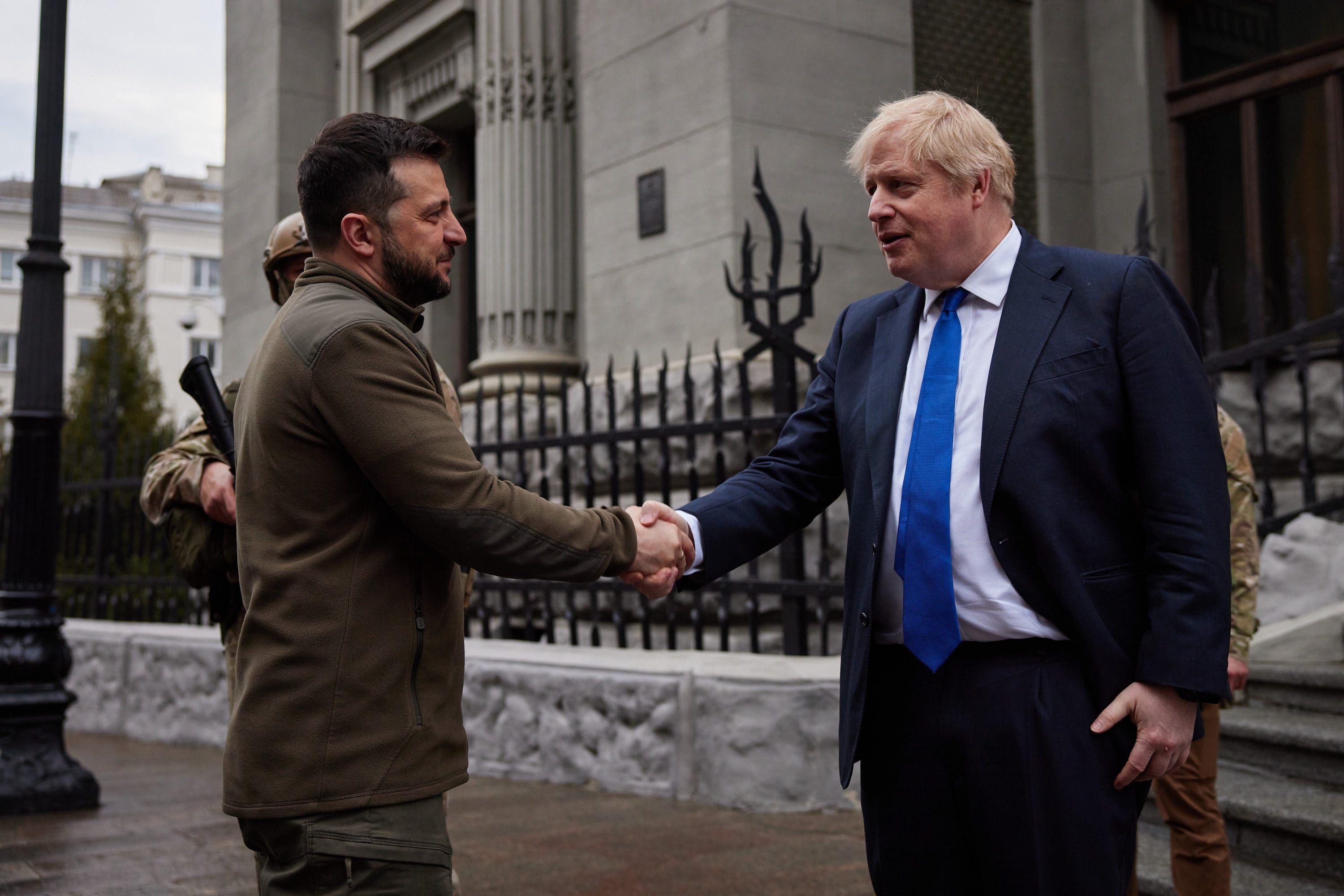
Singing from the same hymn sheet has not been a strength of Britain’s Conservative politicians in recent decades — indeed, attacking each other has seemingly been their favorite pastime.
The result is that the Tories went through five different prime ministers in eight years, four in the space of five years. The merry-go-round came to a standstill last month with the Conservative’s worst electoral defeat, at least in terms of seats won, since the formation of the modern party in 1834.
But the Tories, including all six candidates currently vying for the Party leadership, have found one policy to unite around – support for Ukraine. Ever since the full-scale invasion of Ukraine in February 2022, the Tories have taken an ultra-hawkish position on Russia’s invasion.
Then prime minister Boris Johnson, alongside his defense minister Ben Wallace, were early and loud cheerleaders for Kyiv. They were the foremost advocates of the West doing all in its power to support President Volodymr Zelensky’s struggles to maintain his country’s sovereignty. Both his successors Liz Truss and Rishi Sunak — two leaders who could agree on very little — followed the Johnson doctrine vis-vis Ukraine to the hilt.
Even their Labour successor Keir Starmer is insisting the policy remains unchanged from the previous government, although Kyiv is making noises suggesting that London’s support is slightly cooling. Starmer supported the Tory Ukraine line from the opposition benches — and here the reason was straightforward. It was another way of showing how Labour had changed from the worst days of his predecessor Jeremy Corbyn. Corbyn used every opportunity to denigrate Israel, just as he never missed a chance to put the best gloss on Putin’s action.
When the Tories have managed to rip each other apart on virtually everything else, why have they — indeed the whole British political mainstream — been so united in support of Ukraine’s cause? The stance contrasts with that of the Republican Party in America, which has has been more divided on the question of spending more money on aiding Ukraine. The Republican Party’s vice presidential candidate, Senator Vance, voted against the latest big American aid to Ukraine legislation, and President Trump has said he’d if elected he’d bring the war to a close.
Britain’s government budgets are stretched. Yet the £12.5 billion (roughly $16.4 billion) that the UK government has pledged to Kyiv since 2022 has – in marked contrast to Washington and Berlin – not been a topic of heated political debate. It is less than Germany has budgeted for in total Ukraine aid (€28 billion, roughly $31 billion) and much less than the United States — but then the UK economy is only roughly one eighth as large as that of the United States and Germany’s is a third larger.
Back in 2014, at the time of Putin’s first invasion of Ukraine and his annexation of Crimea and occupation of parts of the Donbas, Britain’s Conservatives were by no means united on the issue.
The argument of these Kyiv skeptics in 2014 was that, in the phrase of Tory MP Sir Bernard Jenkin, “Euro-neocons” — surely as mythical a beast as any yet imagined — were running the European Union. They had pursued an aggressive policy of eastward expansion which encroached on Russia’s legitimate sphere of influence. This had made Moscow feel threatened. In their view, it was the EU’s rather than Russia's expansionism which provoked the conflict. Jenkin argued that the EU has been “fomenting divisions in order to bring Ukraine into the European orbit.”
But the only prominent politician on the Right who still espouses such views is the original Brexiteer Nigel Farage. “If you poke the Russian bear with a stick, don’t be surprised if he responds,” were the words of Farage in a BBC interview during this summer’s election campaign. The Reform Party leader was lambasted as a Putin apologist by figures from across the political spectrum, most vociferously Johnson.
The Reform Party did well in the general election, picking up over four million votes and bagging its first five seats — but Reform Party insiders claim they would have done much better if it were not for Farage’s Ukraine remarks. It made voters question Reform’s motivations and think twice about the party’s seriousness.
Johnson framed support for Ukraine as a question of national sovereignty. This has particular resonance with Conservative voters in the aftermath of the 2016 Brexit referendum. In the then-Prime Minister’s explicit narrative, Brexit has been about reclaiming British independence and now Ukraine was in an existential struggle for its own independence. And this time, for all of Brussels’ aggravations, the foe is much more malign than Ursula von der Leyen or the European Commission of even the wildest of Brexiteers’ imaginings. This framing made Kyiv’s cause very appealing to Tory MPs — being in support of Kyiv was consistent with being in support of Brexit.
Johnson has a penchant for grandiose gestures, and heading for besieged Kyiv thus had an added appeal. British prime ministers like to present themselves as heroic wartime figures in the mold of Winston Churchill. It does not always succeed — the Iraq war did no favors for Tony Blair — but when the trick can be pulled off, it has resounding success. Margaret Thatcher would almost certainly have survived in office and won the 1983 election without the Falklands War, but the 1982 conflict certainly did boost the stature of the then-beleaguered prime minister.
Johnson clearly hoped that steadfastness on Ukraine might perform a similar trick for him. It did not, but in his post-prime ministerial incarnation Johnson now sees his central task to be winning Donald Trump over to Kyiv’s cause. Some have suggested he sees this as a route to political redemption and indeed possible political rehabilitation.
Johnson’s politically troubled Conservative successors could see Ukraine as one bright spot. However badly things were going in Westminster, they could still take on the mantle of international statesman in Kyiv. The support has had its limits – no serious figure has suggested that British troops should be sent to fight and die for Ukraine. But, during a period in which they can point to few other achievements, backing Zelensky over the last two years is something Tory MPs in opposition remain almost universally proud of.
Trump claims that the Ukraine war wouldn't have happened under a Trump administration. This is correct, but Trump doesn't explain why.
Trump opposed Ukraine joining NATO, which makes sense given that Ukraine had a major territorial dispute that shouldn't become a NATO obligation. Putin made it clear that putting Ukraine on the path to joining NATO meant war. Trump understood this and Biden did not. The result was that the Biden administration called Putin's bluff, and Putin wasn't making an idle threat, and invaded.
The status quo under Trump was reasonable, and would have continued if Trump had been re-elected in 2020.