

Who Is Tommy Robinson?
Imprisoned Brit championed by Elon Musk has poisonous past

[The Editors is called The Editors, plural, not The Editor, singular, for a reason. When I launched it, a shrewd friend advised, “it can’t just be you.” I’m delighted to start including some additional voices. Today’s comes from Michael Mosbacher, who is associate comment editor at London’s Daily Telegraph. He is a past editor of Standpoint and The Critic, having co-founded both British magazines.—Ira Stoll.]
Almost instantly, Elon Musk has made himself into one of the most significant figures in British politics, with constant musings on X about the shortcomings of Prime Minister Keir Starmer — his negligence in tackling Pakistani grooming gangs, tax policy and wokery.
Musk has put himself in a conflict not only with Starmer, but also with Nigel Farage and his upstart Reform UK party.
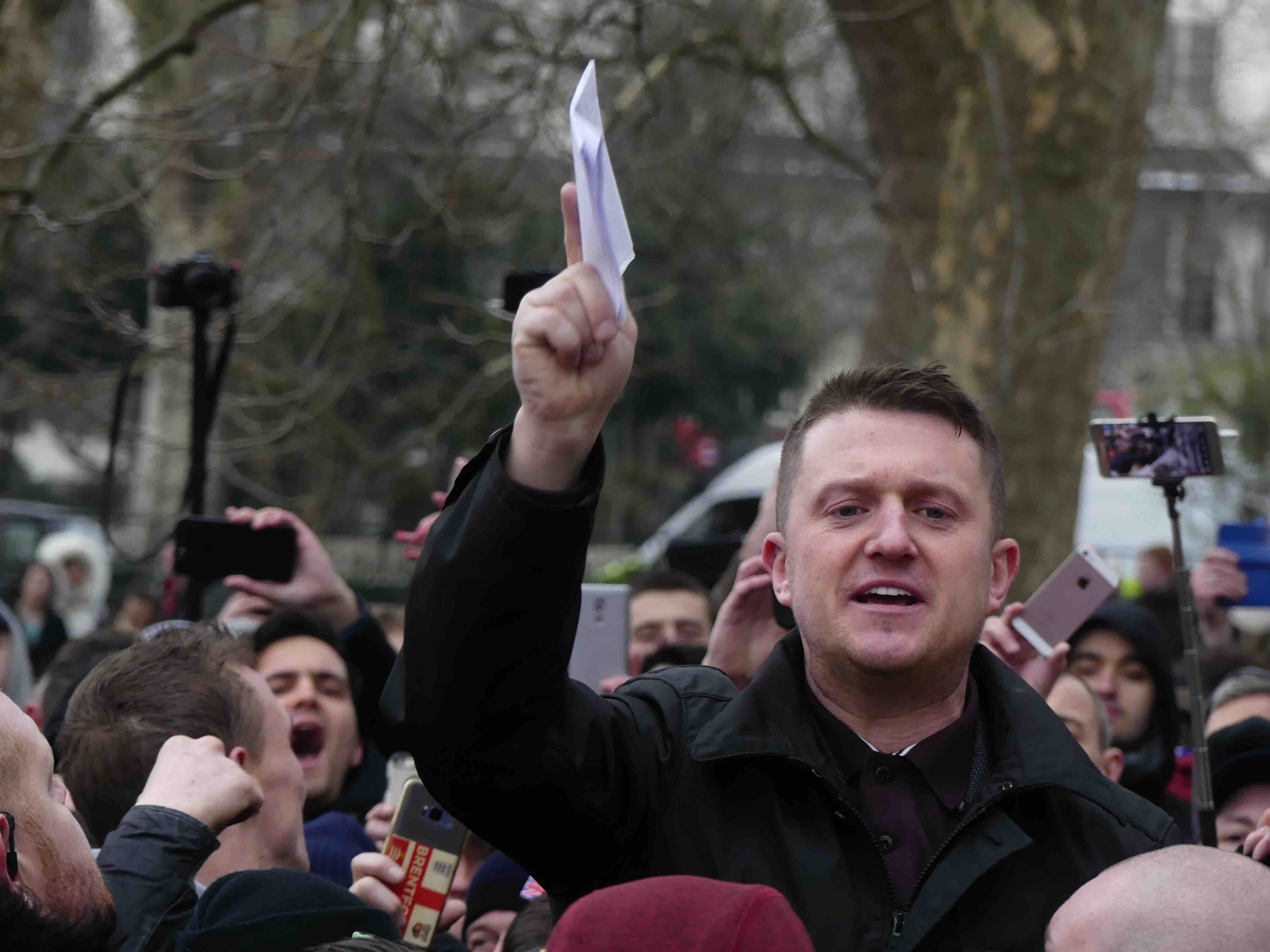
The cause of their rift is what to do about the currently imprisoned anti-Islam street agitator Tommy Robinson, also known by his actual name Stephen Yaxley-Lennon. Musk portrays him as the brave, solitary voice standing up against the Islamization of Britain and wants him to take a leading role in Reform. Farage, however, won’t countenance him having anything to do with his party.
Who is right, Musk or Farage? Why is Farage so reluctant to involve Robinson in the party, even when rejecting Robinson could cost the Reform party funding from Musk so ample that it could transform the UK political landscape and put Farage into power the way that Musk helped Trump win in the U.S. in 2024?
Farage probably has a better handle on the situation than Musk does, for reasons that have to do with differences between U.S. and British politics and culture.
The boundaries of British politics, at least on the right, are much less porous than they are in the United States. On the left, when Jeremy Corbyn was leader, he managed to bring in Andrew Murray — until weeks before a leading figure of the once pro-Soviet, and then pro-Putin, Communist Party of Britain — as his chief of staff. But there would be no equivalent leniency on the right.
In the UK, the major political parties are much more centralized than they are in the United States. British political candidates are not chosen in U.S.-style open party primaries. To put yourself forward for selection as a Conservative or Labour candidate is not just a matter of declaring yourself to be a party supporter. You need to be on the approved candidates’ list of the Tory party to even apply to a constituency; Labour’s system is different but follows the same principles. An outsider, Donald Trump-style figure could never secure control of Britain’s Conservatives — the structures just don’t allow for it.
When Farage founded Reform — after his various troubles with his previous, more democratically structured political vehicle the United Kingdom Independence Party, Ukip — he set it up to be even more centralized. It was founded as a company with Farage as the majority shareholder.
These systems mean that UK political parties feel compelled to police much more than their US counterparts what is an acceptable position to take and remain within the party — and what is not.
And this produces a different culture. UK Party leaders — as Farage has frequently found out to his cost in the past — are somehow felt to be accountable for the outlandish utterances of obscure local politicians or even just ordinary members. In Britain, a party leader will be ambushed in an interview and asked about some nonsense a councillor they have never heard of has said on social media, maybe years ago — and the usual answer is that the claims will be investigated and if found true, the person expelled.
For Farage, Robinson falls very much on the wrong side of acceptability. Both with Reform and Ukip, Farage has paid a high electoral price for having nutters among his ranks. And he certainly does not want to repeat that with the ticking time bomb that is Tommy Robinson.
So what are the issues that push Robinson beyond the pale? Firstly, in 2004 and 2005, he was a member of the racist and antisemitic British National Party. The BNP during that period was experiencing a brief period of success, nothing spectacular but holding 40 or 50 local councillors out of 17,000 or so in England. This paltry total perhaps was the electoral highwater mark for the genuinely far right in the UK, certainly more than Sir Oswald Mosley’s 1930s British Union of Fascists ever won.
Those voting for the BNP may have been motivated by legitimate fears about mass immigration, but the party leadership has always had darker affections. When the party founder John Tyndall was asked in his maturity about whether he still held with his youthful writings prattling on about Jewish conspiracies, he replied, “I believe the conspiracy has many gentile agents.” The leader when Robinson was a member, Nick Griffin, is still today blaming “zionists” for all the world’s woes.
Robinson says he left the BNP when he realized what the party was really about, but rightly or wrongly, there is no road back to respectable politics after BNP membership. Reform, and Ukip under Farage before it, bans ex-BNP members from ever joining.
After his time in the BNP, Robinson founded the English Defence League to engage in street confrontations with Islamists. And that is the second reason why Farage won’t touch him.
Much of the English Defence League’s ethos, culture, and aesthetic comes from the English football hooligan scene, with its constant undercurrent of impending violence. That is no route to electoral success. Standing side by side with Robinson may conceivably increase Farage’s popularity amongst a section of disenfranchised, angry, white working class males, but it will certainly put many more voters off. Class respectability still matters in British politics.
This queasiness about Robinson is exacerbated by the fact that he has lived on the fringes of the law and has criminal convictions which are unrelated to political agitation.
It is Farage’s ambition for Reform — now polling at around 20 per cent, just a few points behind the Conservatives, or even level pegging in some snapshots — to usurp the Tories as the primary vehicle of the British Right. Part of his strategy to achieve this is to encourage Conservative politicians to defect to Reform, giving the upstart momentum and gravitas. The plan looks set to meet with success, but admitting Robinson would kill it stone dead.
Farage is correct that cozying up to Robinson would dash Reform’s ambitions. Not even tens of millions from Musk would change that. As Farage himself put it in a response to Musk on X, “Elon is a remarkable individual but on this I am afraid I disagree. …My view remains that Tommy Robinson is not right for Reform and I never sell out my principles.”
Any time a politician talks about principles it brings to mind the quip attributed to Groucho Marx: “Those are my principles, and if you don't like them... well, I have others.” In this case, though, Farage’s principles are grounded in a pragmatic understanding of just how far British voters will, or won’t, go.
Trump’s election has twice reset views of what is possible among the American electorate. The U.K., though, is a different story. For Farage and his Reform party to emerge victorious would be a big change. Doing it with the negative burden of Tommy Robinson attached would be impossible.
perceptive and correct
Getting these details of how the system works in the UK is very helpful in making it so Americans are not blindsided by events as they play out. One worries that as Elon Musk takes on too many responsibilities there will be a tendency to get sloppy and not benefit from such wisdom.
Another interesting part of the UK system is the degree to which members of parliament have a role in selection of party leaders. The details have varied over the years. In the Labour party there was a period in which MPs had a large role, and the party leaders tended to be quite electable because they were picked by MPs, who were by definition electable. In other periods the trade unions had a large role in choosing Labour leaders, who tended to be hard-left and unelectable.