

White House Launches “Media Bias Offender Tipline”
Plus, anti-Israel student posted Summers Harvard classroom video

Program note: Tomorrow (Friday December 5) at about 1 p.m. eastern time we’re planning to be going “Live” with Jonathan Mahler, author of “The Gods of New York: Egotists, Idealists, Opportunists, and the Birth of the Modern City: 1986-1990,” and with Douglas Century, author of “Crash of the Heavens: The Remarkable Story of Hannah Senesh and the Only Military Mission to Rescue Europe’s Jews During World War II.” To tune in it’ll help to have the Substack mobile app installed. If you can’t catch it on short notice, don’t stress—I’m hoping to post a recording of it later—but it should be fun, so if you can join us, we’d love to have you. There should be an alert when it starts with info on how to join.
The Trump White House has launched a “media bias offender tipline” offering ordinary Americans the opportunity to “help expose the worst of the worst” by proposing skewed news items and the journalists responsible for inclusion in an “offender hall of shame.”
The White House website has a new section at https://www.whitehouse.gov/mediabias/ listing a “media offender of the week,” and a database of reporters, publications, and categories such as “lie,” “misrepresentation,” “bias,” “omission of context,” and “left-wing lunacy.” A leaderboard tracks publications with the most offenses, and a “repeat offenders” graphic lists those outlets that “don’t just get it wrong – they do it over and over again.”
As a longstanding press critic, I appreciate the spirit of this. Pushing back on a public website against inaccurate or tilted coverage is a less heavyhanded approach than another tactic President Trump has floated, canceling the broadcast licenses of networks whose correspondents ask him or his guests impertinent questions. It certainly beats the Chinese approach of throwing the journalists in jail (as they did with Jimmy Lai), or the Saudi approach of killing the journalists (as they did with Turki Al-Jasser and Jamal Kashoggi.)
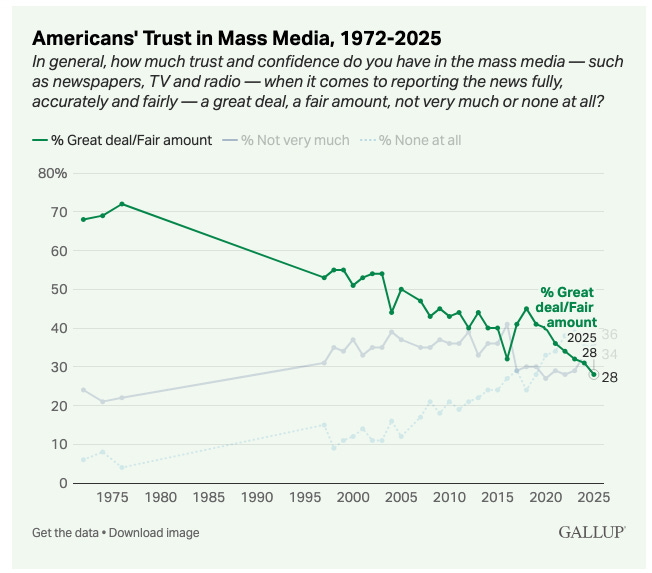
As far as the usefulness of the White House database as a guide for consumers—the way that third-party reviews and ratings might help a prospective buyer choose a hotel or a washing machine or a restaurant—the main takeaway so far seems to be that almost every outlet is skewed. The graphic of “repeat offenders” already includes CBS News (notwithstanding that Bari Weiss and David Ellison are now in charge over there), ABC News, NBC News, the Washington Post, and the Wall Street Journal. In a sense the White House is confirming what survey data indicate Americans are already sensible enough to understand. Gallup, which has been measuring trust in news media in polls for more than half a century, in October 2025 released a poll showing that “Americans’ confidence in the mass media has edged down to a new low, with just 28% expressing a ‘great deal’ or ‘fair amount’ of trust in newspapers, television and radio to report the news fully, accurately and fairly.” The Pew Research Center, which has been asking similar questions since 2016, also released October 2025 data indicating a decline: “Overall, 56% of U.S. adults now say they have a lot of or some trust in the information they get from national news organizations – down 11 percentage points since March 2025 and 20 points since we first asked this question in 2016.”
That tracks with declining trust in a wide range of institutions (with the exception of the police, where surveys show rising trust). It poses some risks for the health of a democracy. The First Amendment has helped to protect the press’s ability to serve as a watchdog against corruption, malfeasance, misfeasance, incompetence, waste, fraud, abuse, overreach, and other injustices. Yet without earned trust, the press’s ability to perform that function is eroded. If no one believes the watchdog when it barks, it’s not a particularly functional watchdog. The best cure is probably a press that views criticism not as an attack to be defended against from a defensive crouch, but as part of the back-and-forth and free exchange of ideas that clarifies facts, informs the public, and leads closer to the truth. In a healthy free market, the ordinary workings of competition perform a lot of these functions without a lot of government intervention. We are doing our best to participate in that market here.
It’ll be interesting to see whether a Democratic president keeps a White House media bias tipline and database up and running, and whether the platform is used to track actual bias and inaccuracy or instead to denounce articles that displease the White House by portraying or highlighting, accurately, negative outcomes of administration policies. Technology does help to level the playing field. A modern White House need not start its own broadcast television network at great expense or contract to publish a print newspaper. The Internet has made everyone a publisher and everyone a critic. So the White House, while it has a larger communications platform than most, is adding to a conversation about news that, for all the risks of social media and foreign-backed fake news, is in some ways more lively than ever. The steep decline in trust in news, in other words, may not indicate a steep decline in quality of the news, but rather Americans improving our understanding of longstanding shortcomings. Which is worse: Americans not trusting the news, or Americans being excessively confident in news even when that news fails to accurately reflect reality? The best outcome, for sure, is news good enough that it earns trust. An appropriately skeptical—not cynical, but skeptical—readership could contribute to progress in that direction.
Summers Harvard classroom video was leaked by anti-Israel student: New York magazine’s Irin Carmon surfaces the news that video from Larry Summers’s Harvard class was posted to social media by a student, Rosie Couture, who attended the class despite not being enrolled. The article concludes with a demand by Couture that “Summers should resign himself. Not in a few months. Now.”
New York magazine and Carmon do not mention it, but potentially relevant is that The Canary Mission website has an image of Couture in a keffiyeh at the anti-Israel encampment in Harvard Yard, and the Crimson student newspaper reported in May 2024 that Couture “was called before the Ad Board for the first time this semester for her participation in the encampment.”
It’s ironic. In September 2024, Harvard rolled out an anti-doxing policy, in part to mollify anti-Israel students who did not want external accountability for their positions and actions. “Doxing occurs under these policies when a community member publicly shares an individual’s personal information without their permission with the intention and effect of intense harassment.” The sharing publicly could include “posting or reposting it on social media” and the personal information could include a community member’s class schedule or video likeness. As far as the intention and effect, it sure looks like Couture intends to pressure Summers to resign. The policy refers to actions that “denies the [targeted] individual an equal opportunity to work.”
Some people at Harvard, Couture apparently included, are apparently concerned that Summers, a former U.S. Treasury Secretary and former Harvard president, violated norms in his interactions with Harvard donor Jeffrey Epstein. What about the norms against undergraduates crashing classes and then posting in-classroom clips from the classes to social media as part of a pressure campaign to force out a professor who has been outspoken against antisemitism on campus? Just as the release-the-Epstein-files push has been driven in Congress by anti-Israel activists such as Rep. Thomas Massie and Ro Khanna, some of the anti-Summers activism at Harvard has also been driven by anti-Israel activists.
Whether Couture’s action rises to a violation of the anti-doxing policy or any other Harvard policy I don’t know, and the wisdom of the policy is itself a separate question. But it certainly skates close to crossing the spirit of the guidelines.
And there’s additional language in the Harvard College Student Handbook about this:
Unauthorized Recording
Harvard prohibits unauthorized recording of any kind; this includes audio, video, or photographic recording. Any recording or attempt to record, inside the classroom or elsewhere, requires prior consent from all those being recorded. Secretly recording any conversation is not permitted, whether in person, over the phone, or by any other medium.
COURSE RECORDINGS In the interest of cultivating an environment most conducive to the free and unencumbered exchange of ideas, the activity of recording in the classroom is generally prohibited.
It’ll be interesting whether Harvard College is as stringent in enforcing the no-recording-in-class rule here as it was about rule-enforcement when it interrupted Summers’s speech at a pro-Israel gathering back on October 23 to ask him and his audience to move so that the anti-Israel students could have a four-foot radius to disassemble the large lie-filled anti-Israel structure that they had erected at a central campus location.
Thank you: The Editors is a reader-supported publication that relies on paying customers to sustain its editorial independence. If you know someone who would enjoy or benefit from reading The Editors, please help us grow, and help your friends, family members, and associates understand the world around them, by forwarding this email along with a suggestion that they subscribe today. Or send a gift subscription. If it doesn’t work on mobile, try desktop. Or vice versa. Or ask a tech-savvy youngster to help. Thank you to those of who who have done this recently and thanks in advance to the rest of you.
One of my favorite Cold War jokes is relevant here:
• In America, everything is allowed unless it is prohibited.
• In Germany, everything is prohibited unless it is allowed.
• In Italy, everything is allowed even if it is prohibited.
• In the Soviet Union, everything is prohibited even if it is allowed.
The lack of consistency about enforcing rules at Harvard is taking on some character of Italy and the Soviet Union. There should of course be some discretion in applying rules, but it should be on the basis of the details of the infraction and not the identity and views of the person in question.
Since when do broadcast networks have “licenses?”