

What Seth Klarman Could Learn from Leo Strauss
Plus, Biden in Wisconsin; after fundraising in Greenwich and East Hampton, Biden bashes Park Avenue

Money manager and philanthropist Seth Klarman offered this statement about President Biden, as reported in the New York Times. “The most important thing President Biden — and all of us who have supported him to date — can do is prioritize the defeat of Donald Trump in this election...I trust President Biden, who has been a truly great president, will continue to keep this at the center of every decision about the path forward.”
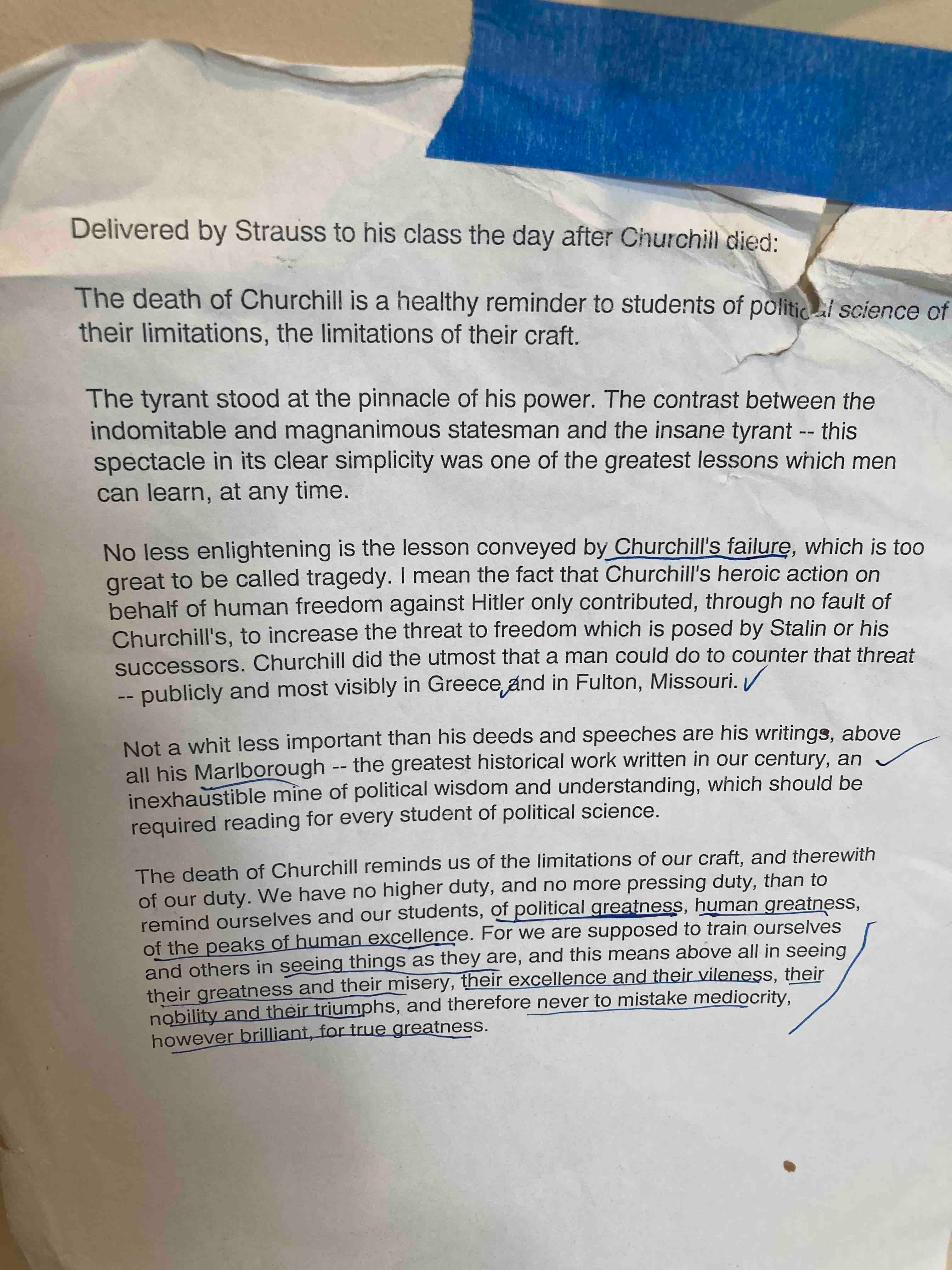
The line about Biden having been “a truly great president” made me smile and think of some comments by Leo Strauss, the political philosopher, scholar of Maimonides, and professor at the University of Chicago. Strauss is said to have delivered the remarks to his class in 1965 the day after the death of Winston Churchill. “We have no higher duty, and no more pressing duty, than to remind ourselves and our students of political greatness, human greatness, of the peaks of human excellence. For we are supposed to train ourselves and others in seeing things as they are, and this means above all in seeing their greatness and their misery, their excellence and their vileness, their nobility and their triumphs, and therefore never to mistake mediocrity, however brilliant, for true greatness.”
Anyone, including Klarman, describing Biden as “a truly great president” is making the error Strauss warned of, mistaking “mediocrity, however brilliant, for true greatness.”
Klarman may be calculating that the benefit to the country and the world of flattering Biden out of the presidential race is worth the costs of damaging Klarman’s own credibility as a truth-teller and of stretching to the breaking point the definition of greatness.
Klarman may have even talked himself into believing somehow that Biden really has been a great president. Biden has, after all, presided over a national comeback from the Covid-19 pandemic, kept the economy at low levels of unemployment, restored order after the worst of the Black Lives Matter and January 6 protests, mostly prevented the Democratic Party from lurching left into the worst of Sanders-Warren-Ocasio-Cortezism, and helped back Israel and Ukraine in their wars. Biden’s avoided losses of U.S. troops in combat on the scale of a Vietnam or an Iraq War, and he’s avoided a major economic depression or financial crisis.
But true greatness? This is what the electoral map of a truly great president looks like:
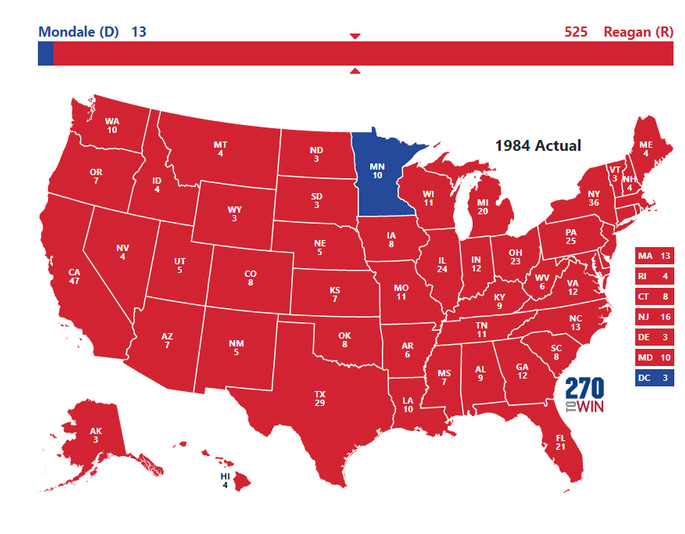
If Biden’s projected map looked like that, no one would be talking about dumping him off the Democratic ticket in exchange for a last-minute substitute.
On the substance, there are just too many Biden failures to qualify for greatness. The ones President Trump has been criticizing him for involve the loss of control over the country’s borders and the abrupt and chaotic American withdrawal from Afghanistan, a withdrawal that sent a message of weakness that emboldened Russia to invade Ukraine. Biden has publicly held back arms from Israel in wartime, and he’s backed Ukraine sufficiently to stave off Russia but not quite enough to repel or roll back the Russian invasion. He unilaterally tried to forgive $400 billion in student loan debt, a move the Supreme Court ruled exceeded his legal authority. His spending and regulatory binge helped fuel inflation. He’s running a roughly $2 trillion deficit on a roughly $7 trillion budget. He’s let Russia hold captive with impunity two Amercans, a Wall Street Journal reporter and a Radio Free Europe/Radio Liberty reporter. If Biden qualifies as a “truly great president,” one shudders to contemplate what a less-than-great presidency looks like. What a low standard of expectations.
Klarman gives away a lot of money—Klarman Hall at Harvard Business School, the Klarman Building at Beth Israel Deaconess Medical Center. The most recent (2022) tax return of the Klarman Family Foundation lists its assets at $995,513,060. He interacts with journalists like Bari Weiss and Bret Stephens (“I called Seth Klarman, one of the world’s most successful hedge-fund managers, to think through questions of risk”). He helped found and fund the Times of Israel.
In the money management business, there are feedback mechanisms for bad decisions. Eventually, if your stock picks don’t go up, you get fired. In politics, there are also feedback mechanisms. Eventually, if you don’t do a great job as president, the voters figure it out, and you don’t win re-election, or your party loses control of the White House or Congress. The feedback mechanisms for publicly violating Strauss’s injunction about mistaking “mediocrity, however brilliant, for true greatness” are more subtle and indirect but they do exist, too; a quiet but unmistakable erosion of reputation.
One might reply that Trump isn’t truly great either, but is also a mediocrity. The way things appear headed at the moment, America and the world are going to have another opportunity to find that out, or Trump is going to have another chance to prove or disprove it.
And one might argue, too, that Strauss’s distinction between mediocrity and excellence is a false dichotomy. Most political leaders have flashes of both. As I read it, Strauss’s point, informed by his own life experience—he was born in Germany in 1899—was that in a confrontation with Nazism or Stalinism or some similar threat, the difference between excellence and mediocrity in leadership is the difference between freedom and tyranny. So, for those of us in journalism and academia who observe political leadership and comment on it, that distinction between mediocrity and greatness is worth emphasizing rather than obfuscating.
Biden in Wisconsin: Biden held a campaign event in Madison, Wisconsin today. For a politician trying to assuage concerns about his age, it was a very strange opening: “Gaylord Nelson, I’m back,” he began, looking toward the ceiling of the middle school gym and making a reference to a politician who was governor of the Badger State from 1959 to 1963 and a U.S. senator from 1963 to 1981. Then Biden said he would beat Donald Trump “again in 2020.” Also in the appearance, he said, “We’re gonna protect our children from getting weapons of war off our streets.” At the event, he also acknowledged Rep. Mark Pocan, who has been one of the most viciously anti-Aipac and anti-Israel members of Congress. This all went down in a 17-minute appearance in the middle of the day, when Biden is said to be at his most lucid.
The background music as Biden worked the ropeline at the end of the rally was the Tom Petty and the Heartbreakers song “I won’t back down,” an apparent reference to Biden’s determination that, as he put it, “I’m staying in the race.”
Heartbreaking indeed—not because I have any particular stake in Biden dropping out, but because Biden’s communications skills in this format seem so limited, more Bush-like or Dole-like than Reagan-like or JFK-like or Churchillian.
Public communications aren’t the only part of a president’s job but they are an important one.
Biden bashes Park Avenue: From President Biden’s statement today on the June jobs report:
Congressional Republicans have a different vision that sides with billionaires and special interests and will supercharge inflation. They’ll impose high consumer tariffs that will cost middle class families thousands of dollars each year, give a giant tax cut to the wealthy, repeal the Affordable Care Act, and allow big corporations to keep ripping off Americans. While they fight for Park Avenue, I’ll keep fighting for working families like the ones I grew up with in Scranton.
Biden was campaigning in Greenwich, Connecticut on June 3. On June 29, he was in East Hampton. The i-dea, as Biden himself might put it, of publicly bashing Park Avenue while running around doing fundraisers in Greenwich and East Hampton is just really too much. Does whoever is writing this stuff for him have a level of cynical contempt for the voters such that they think we’re not smart enough to notice or pay attention? Maybe they think the class warfare shtick is good politics, but the risk is it makes Biden look like a phony. As I’ve observed before, Park Avenue runs a long way, and there are plenty of potential Biden voters there:
Park Avenue runs all the way up into Harlem and the Bronx. Even in the fanciest blocks of the Upper East Side, Park Avenue includes plenty of doormen and building workers and immigrant taxi-drivers and even residents who grew up in Scranton and worked hard and took risks and created value and earned their way onto Park Avenue.
Jill Biden says, “Joe is asking the American people to come together to draw a line in the sand against all this vitriol….this anger and animosity and divisiveness…it’s not who we are.” Meanwhile, Joe is bashing Park Avenue. It muddles the anti-divisiveness message to the point where it raises doubts about the sincerity.
Thank you: Here at The Editors we aspire to excellence rather than mediocrity, and, at the very least, we try to be trustworthy about analyzing the distinction between the two. Please support our growth by becoming a paying subscriber today. Thanks to those of you who already have.
I don't understand this fixation on greatness. Personally I'd be happy if Trump were above average. Or just a good or very good President. You seem to think it's either an A+ or an F--. Churchill was a great PM. England has a lot of other PM's. Some were bad, some were OK, some were very good, some were excellent A few were great. You remind me of the introduction to Lake Woebegone where all the children are above average.
Biden isn't anywhere near great or good or even average.