

War Clouds Scud in East Asia
State Department protests as Yu Wensheng gets a three-year sentence

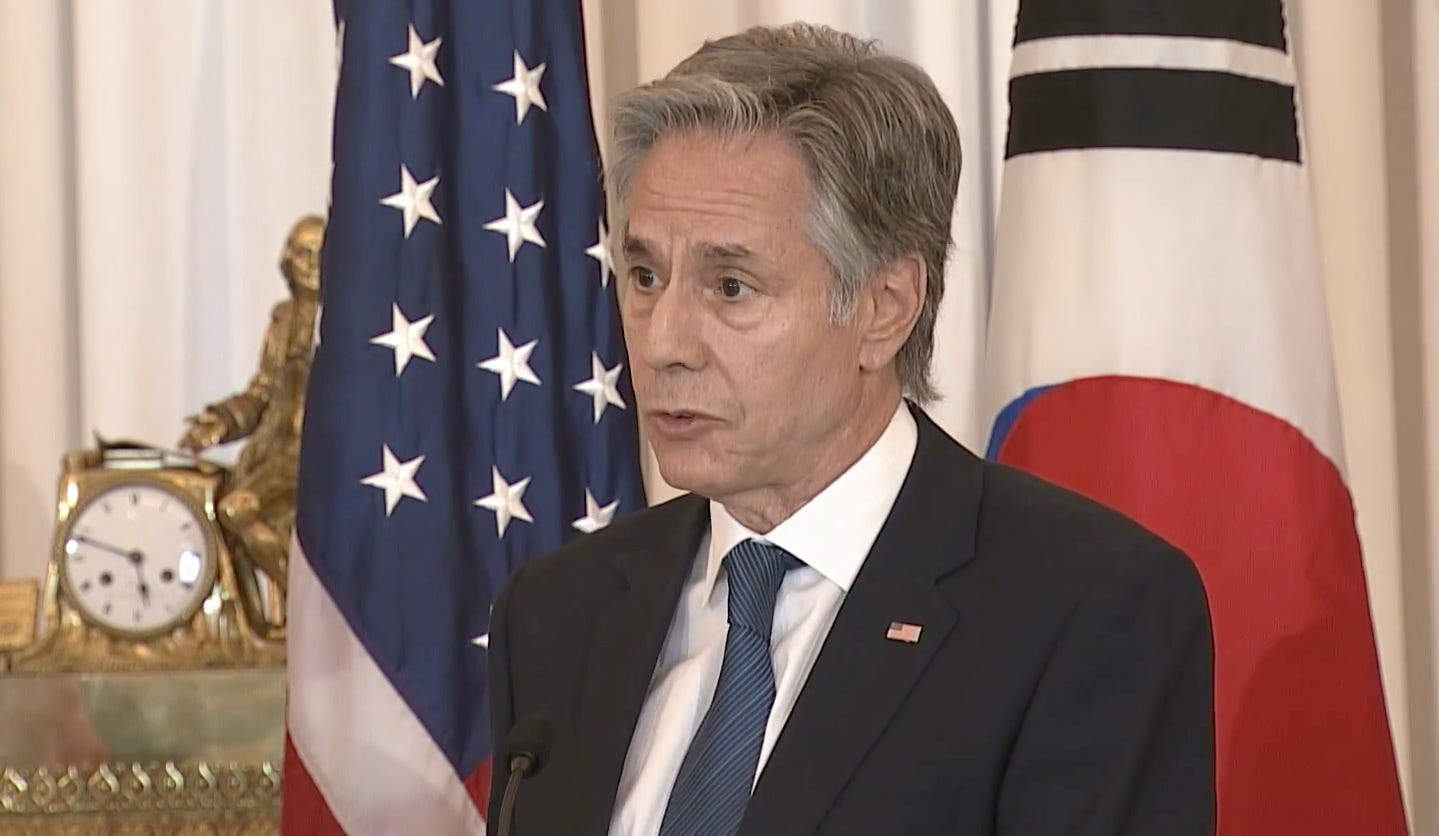
While the press and the public focus on the U.S. presidential election and the war in the Middle East, the situation in Asia is deteriorating.
Over the past few days, a series of events has underscored the problems.
North Korea launched an intercontinental ballistic missile. “We condemn it in the strongest terms, the latest launch of many and other provocative actions that it’s taken, flagrant violations all of multiple UN Security Council resolutions,” said Secretary of State Blinken on Thursday. I usually refrain from commenting on the physical appearance of policymakers, but the bags under Blinken’s eyes in the photo above tell you the story of America’s challenges in the Middle East, in Ukraine, and versus Communist China more eloquently than any sentence I can write. Blinken’s strong condemnation will probably have roughly the same effect that it has had on Russia’s invasion on Ukraine, on the Hezbollah and Iranian missile and drone attacks on Israel, on the Houthi attacks on international shipping—that is to say, not enough.
On October 29, courts in Communist China sentenced human rights lawyer Yu Wensheng to three years in prison and his wife, Xu Yan, to a year and nine months for allegedly “inciting subversion of state power.” A State Department press release reports, “These sentences demonstrate the PRC’s continuing efforts to silence those who speak out for human rights and the rule of law. During Yu and Xu’s trials, authorities barred the attendance of diplomats from several foreign missions, including those from the United States, undermining transparency that is critical to ensuring respect for Yu and Xu’s right to a fair trial.”
The statement says, “We call on the PRC to immediately and unconditionally release Yu Wensheng and Xu Yan. We also reiterate our request for the PRC to release all those unjustly detained or imprisoned. The United States continues to stand with those who bravely fight for human rights in the PRC and around the world.” The request is likely to be ignored, but credit to the State Department for at least making it publicly.
On October 31, a federal grand jury in Boston indicted a citizen of China, Xiao Zhang of Shanghai, for allegedly stealing trade secrets from a global investment management firm based in Boston.
“It is alleged that Zhang then utilized the stolen items with the intent of establishing his own investment firm in the PRC,” a press release from federal prosecutors says.
President Trump is sending mixed messages. At his Madison Square Garden rally, he said that in a war with China, “we would kick their ass.” Yet he’s also denouncing Liz Cheney as a “radical war hawk” and running, along with Senator Vance, as the peace candidate. As for Vice President Harris, we’ve seen for the past four years what her leadership has brought.
Some sort of test from Communist China against the new administration—whomever it is—is widely expected. A new secretary of state may be better rested at the start of an administration than Blinken is now, but unless the American public, national security establishment, and economy are better prepared for a conflict, 2025 may be a year that puts new wrinkles on the faces of a lot of Americans, inside and outside the State Department. Not to mention the effects on people in South Korea, Japan, Taiwan, or Australia. That’s not to say that America and its allies are without great strengths in comparison with Communist China or North Korea, or that freedom and democracy will not eventually prevail. But the challenges are mounting.