

Wall Street Journal Page One Slurs Israel as Child-Killers
Plus, White House aide in in Harvard negotiations leaves to start firm

When Israel-hating socialist New York mayoral candidate Zohran Mamdani gave a recent interview depicting Israel as child-killers, we made it a headline here (“Mamdani, in New Interview, Calls Israelis Child-Killers,” July 20, 2025), noting that “The stereotype of Jews as bloodthirsty child-killers has been a staple of hateful anti-Jewish propaganda for centuries.”
Now the Wall Street Journal’s Page One is piling on against Israel alongside Mamdani. An above-the-fold, front-page article in the August 5 Journal declares that “A large proportion of those who have been killed during the war, 60,000 in all, have been minors, according to Gaza health authorities who don’t say how many are combatants.”
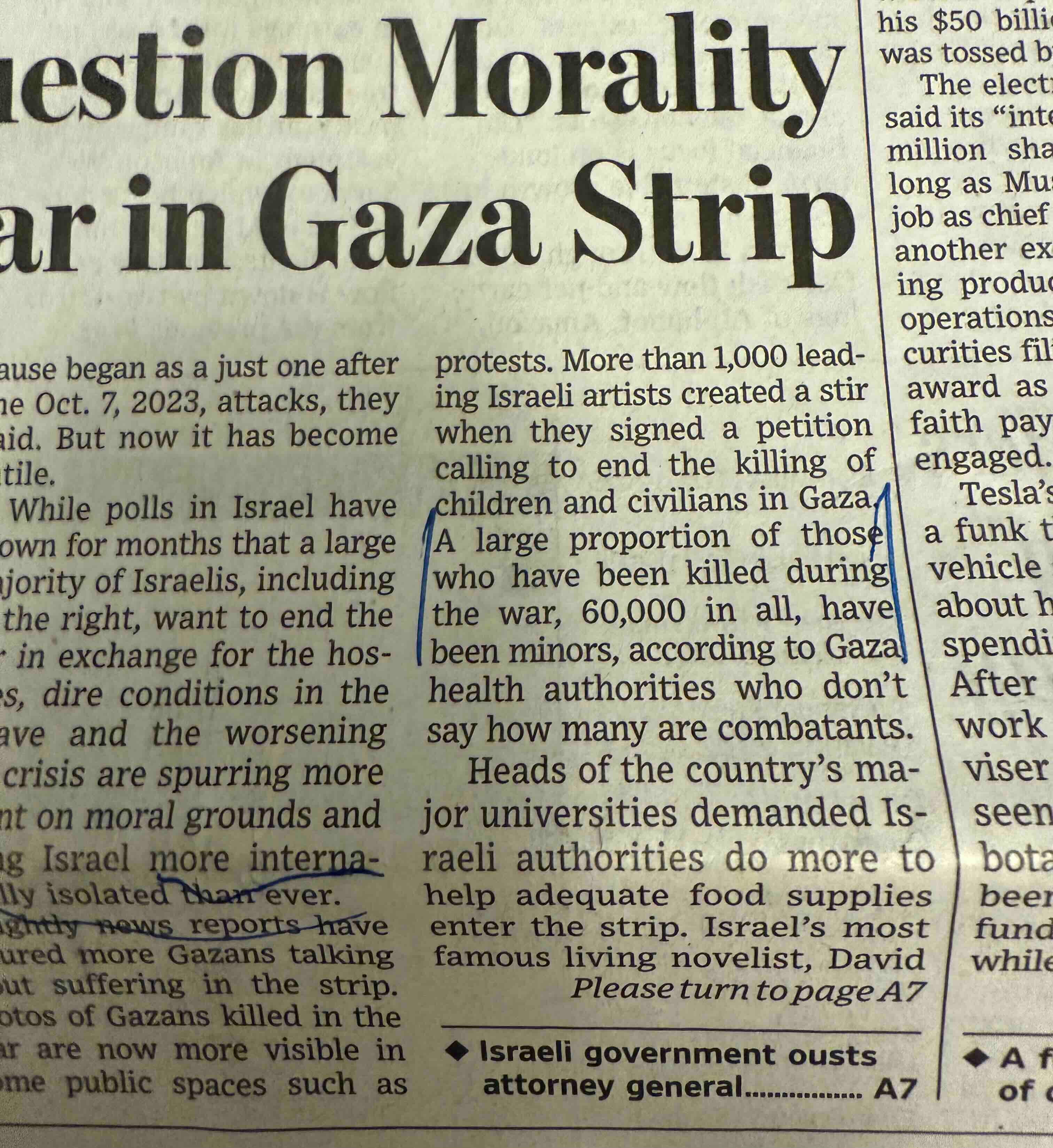
That formulation misleads readers in several significant ways. Let me explain:
One question that comes to mind is what proportion, exactly, of the Gaza deaths were minors? The Journal does not say, other than to characterize the proportion imprecisely as “large.”
The Washington Post, not affectionately known in pro-Israel circles as Al Jazeera on the Potomac owing to the large number of alumni from the Qatar-owned propaganda outlet staffing the Jeff Bezos-owned newspaper, recently published a list of what it said were 18,500 children among the 60,000 Gazans killed.
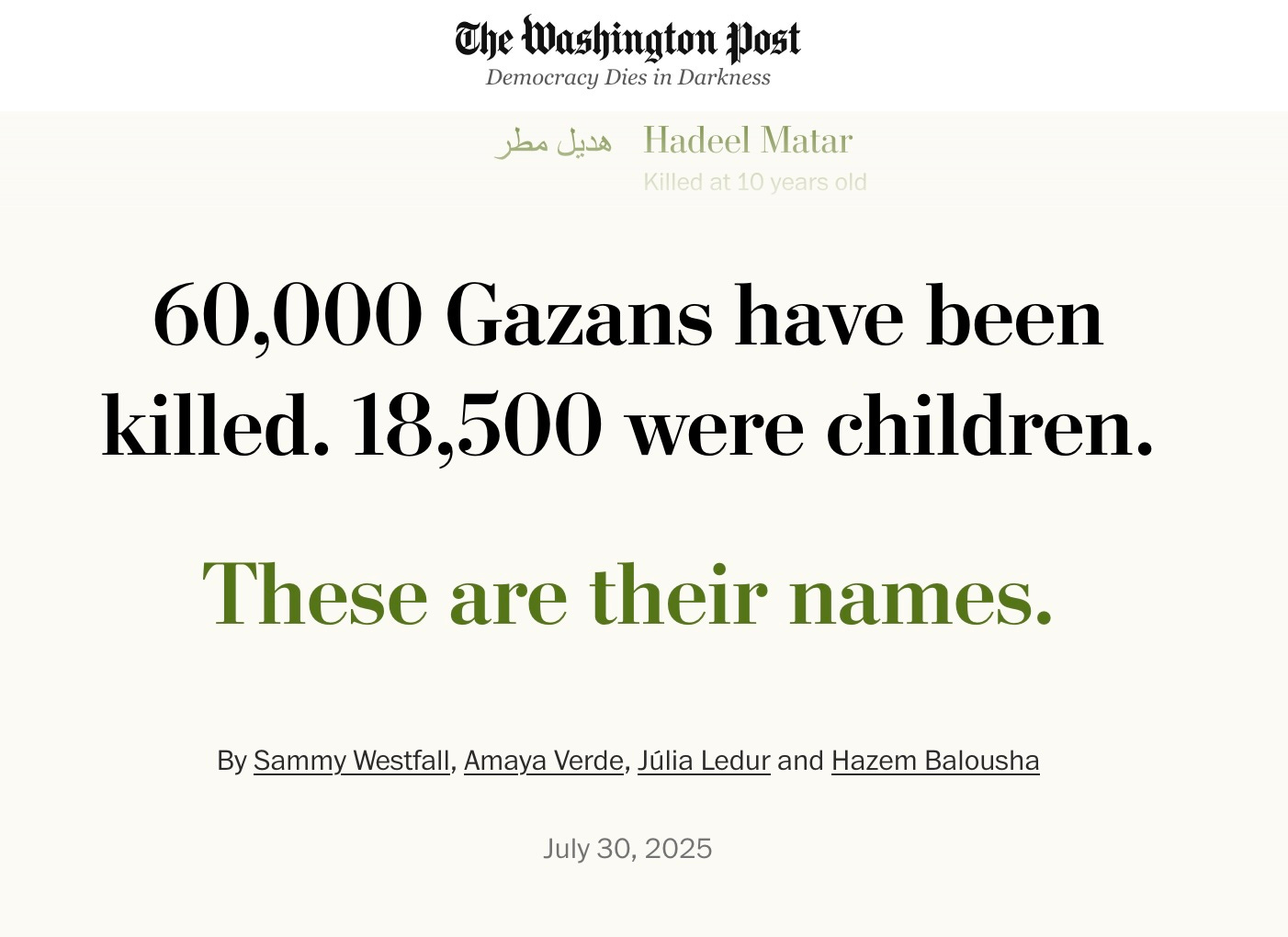
That works out to 30.8 percent of the total. The Post also sorted them into groups by age. The largest group was 17-year-olds, of whom the Post counted 1,218. The second largest group was 16-year-olds, of whom the Post counted 1,212. That’s consistent with reports from Israeli sources of Hamas in Gaza recruiting older teenagers as fighters as the supply of available older-than-18 fighters dwindled. The Journal does not provide that context.
If one uses the Post numbers and backs out the 15-, 16-, and 17-year olds, one winds up with 15,006 children 0 to 14 among the 60,000 Gazans killed, or almost precisely 25 percent.
That might appear to be a “large” proportion—until one realizes that the population of Gaza is 38.8 percent aged 0 to 14. According to the CIA World Factbook, in 2024 the median age in Gaza was 19.5. Here is the population pyramid for Gaza, according to the CIA World Factbook:
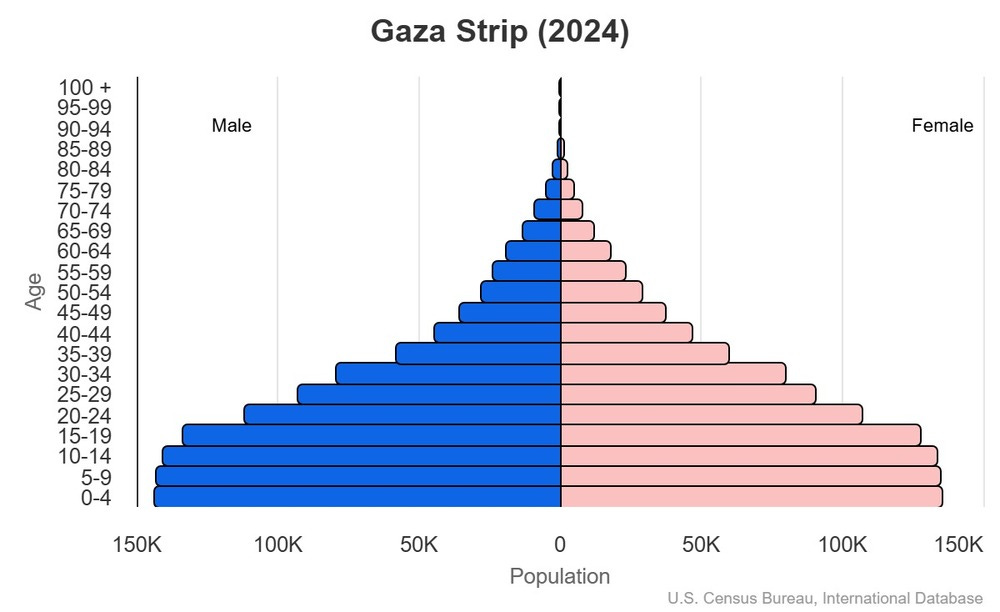
The Journal does not provide that context, either.
In other words, even if you believe the statistics from the Hamas-controlled Gaza health ministry—which the Journal does not identify as Hamas-controlled—Gazan children are being killed at a rate significantly lower than their presence in the overall population. The Journal does not provide that context.
Gaza child casualty statistics have a history of dramatic revisions to rival the U.S. Bureau of Labor Statistics. As Elliott Abrams of the Council on Foreign Relations noted, the U.N. revised its statistics in May 2024 practically overnight to 7,797 children killed from 14,500 children. And the Hamas tactic is to surround themselves with civilians, including children, as human shields. The Journal does not provide that context, either.
The Journal is asking readers to believe simultaneously that Gazans are starving and without a functioning health care system or reliable electricity and also that they have a health ministry capable of maintaining scrupulously precise casualty counts with accurate age information. Where are the editors asking for skeptical treatment of these statistics rather than pejorative adjectives?
Every slain child is a tragedy. Some of them may have been victims of Hamas friendly fire, of accidental explosions of improvised explosive devices, or of Hamas or Islamic Jihad missile misfires. Some of them may have died of natural causes and have been lumped in with the war deaths. I’ve also heard Israeli reports that Hamas deliberately sends Gazan children out into combat zones as scouts in an effort to draw Israeli soldiers into ambushes.
The Journal headline is “More Israelis Question Morality of Continued War in Gaza Strip,” but omitted is any discussion of the morality or immorality of Hamas. That terrorist organization is prolonging the war by refusing to release the Israeli hostages and refusing to surrender. The Journal omits that context, too.
The same article reports that Israel is “more internationally isolated than ever.” That is not accurate. Israel now has diplomatic agreements with many countries—Jordan, Egypt, the United Arab Emirates, Bahrain, Morocco—that it did not have relations with in the past. It still has strong ties with the U.S.—the speaker of the House, Mike Johnson, is visiting Israel this week.
The same Journal article reports, “While Hermann’s poll found that 86% of Israeli Arabs are personally troubled or very troubled about the humanitarian situation in Gaza, this group had stayed mostly quiet up until recently, due to heavy-handed Israeli policing over shows of support for Gaza, even on social media.” I read the poll mentioned and it says nothing about the motivation of Israeli Arabs for having “stayed mostly quiet.” Maybe they are quiet not because of “heavy-handed Israeli policing,” (talk about heavy-handed editorializing in a news article) but because they don’t want to be perceived as disloyal and because they know they are way better off as Israeli Arabs than as Arabs in Gaza or the Palestinian Authority.
The news section of the Wall Street Journal has often gotten a pass on this sort of thing because the opinion pages have been so excellent on the Israel story. The opinion page today has Gerald Baker’s column under the headline, “Hamas Starves Jews and Palestinians, and Israel Gets Blamed.” When I first saw it, I chuckled and thought it was a reference to the Journal’s own news coverage.
White House aide in in Harvard negotiations leaves to start firm: May Mailman, a lawyer in the White House who has reportedly been involved in negotiating with Harvard over antisemitism and the university’s research funding, announced that she is leaving “to launch MPL strategies, a government affairs shop.” CBS News reported that her last official day at work was Friday though she “will become a special government employee to tie up loose ends on some of the policy work she's been involved with.”
She has a website up offering “insider insight,” “legal resolutions,” “strategic consulting,” and “public relations and communications.” Seems like a possible use case for the Glenn Harlan Reynolds revolving door tax, “to put a surtax — 50%, say, or maybe 75% — on the post-government earnings of federal officials in excess of their government salaries for the first five years.”
Thank you: The Editors is a reader-supported publication. If you are learning things here that you are not getting elsewhere, please consider becoming a paid subscriber. Paid subscribers have full access to all the content and are helping to sustain our growth and editorial independence. Thanks to those who have already pitched in, at a price of as little as $1.54 a week. If you have trouble making it work on a phone, try a desktop, or if you have trouble on a desktop, try a phone. Or ask some youngster (hopefully not a Mamdani voter) to give you a hand.
Know someone who would enjoy or benefit from reading The Editors? Please help us grow by forwarding this email along with a suggestion that they subscribe. Or send a gift subscription:
I saw the headline in the WSJ this morning and decided I couldn't read it on an empty stomach. I wish that somehow there could be a thorough study of the internal management at the WSJ to understand how the WSJ's reporting could turn out to be so virulently and dishonestly anti-Israel. It is not particularly surprising that some of the paper's front page reporters, particularly those who may have recently been hired, could turn out to be hostile to Israel. It is more difficult, however, to fathom how the paper's editors could be either so inept or so irresponsible to allow such transparently false reporting to pollute the WSJ's coverage of the Gaza war. Finally, even while accepting that there ought to be a separation of the reporting and editorial sections of the paper, I can't understand how those in charge of the editorial page could stand by and fail to attempt an intervention to salvage the WSJ's reputation. Maybe such an effort has been made, but if so it clearly has not produced results.