


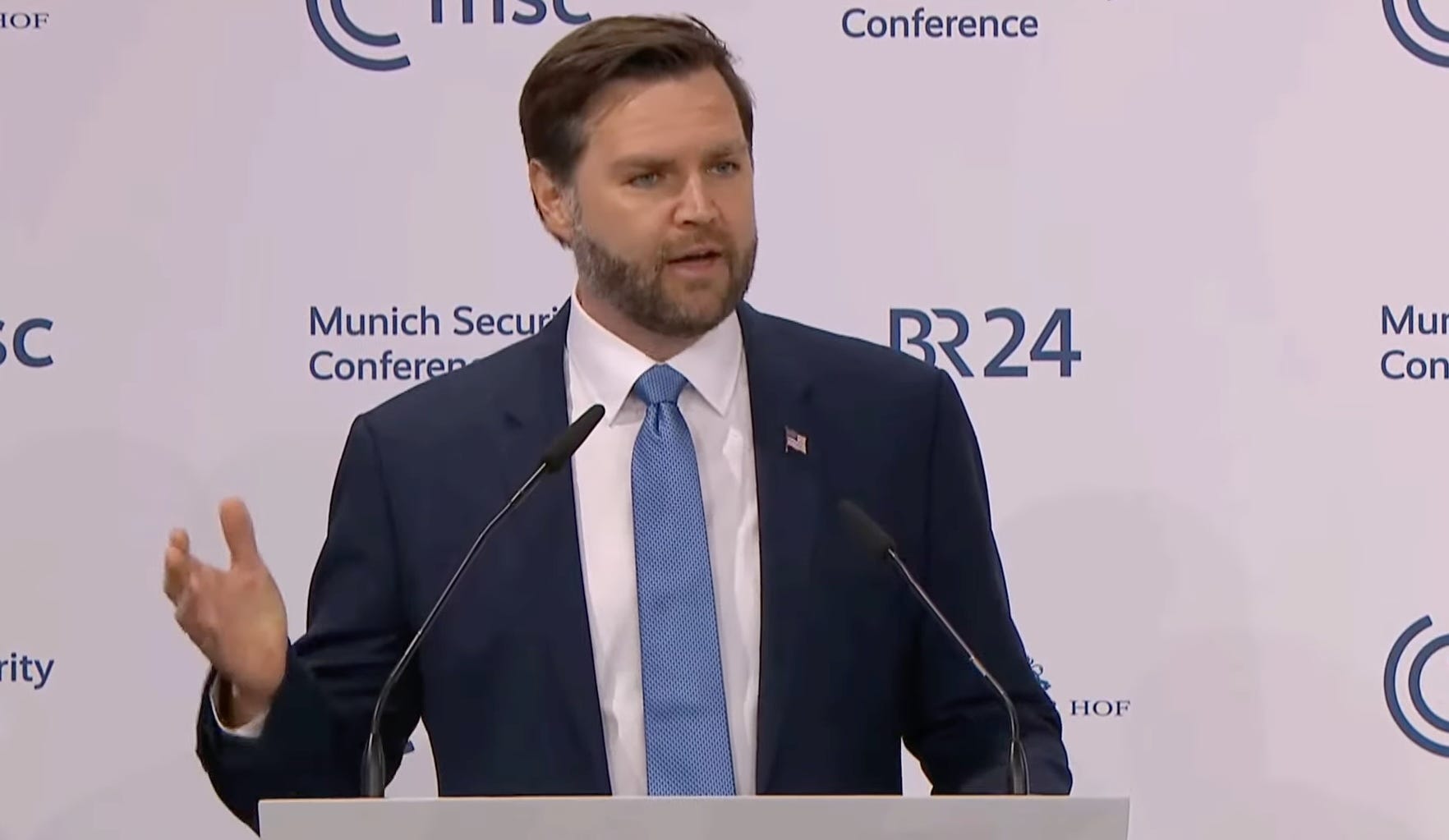
For a glimpse of both the possibilities and potential pitfalls that characterize the second Trump administration’s approach to foreign policy, take a look at Vice President Vance’s visit to the Munich Security Conference.
Vance’s speech was, in certain respects, perceptive. The White House doesn’t seem yet to have posted a transcript, but there is a video on YouTube and the Spectator has posted the full text. The most insightful passage, I thought, was this:
I’ve heard a lot about what you need to defend yourselves from, and of course that’s important. But what has seemed a little bit less clear to me, and certainly I think to many of the citizens of Europe, is what exactly it is that you’re defending yourselves for. What is the positive vision that animates this shared security compact that we all believe is so important?
Vance asked the question with more clarity than he answered it, though he spoke of the importance of democracy and free speech and of elites listening to the people rather than trying to ignore or silence them.
And then, on the sidelines of the conference and on “X,” Vance wound up attacking the Wall Street Journal for its news headline that said, “Vance Wields Threat of Sanctions, Military Action to Push Putin Into Ukraine Deal.” In the interview, Vance had responded to a question about “instruments of pressure” on Putin by saying, “there are economic tools of leverage, there are, of course, military tools of leverage. There’s a whole host of things that we could do.”
Vance posted, “The fact that the WSJ twisted my words in the way they did for this story is absurd, but not surprising considering they have spent years pushing for more American sons and daughters in uniform to be unnecessarily deployed overseas.”
What a spectacle. Rupert Murdoch, according to new reporting from the New York Times, has told his own family, “Fox and our papers are the only faintly conservative voices against the monolithic liberal media. I believe maintaining this is vital to the future of the English-speaking world.”
Yet Vance lashes out against the Journal, sounding like some cheese-eating surrender monkey. Would Vance be happier if the Wall Street Journal sounded even more like the monolithic liberal media? It’s almost as if Vance were deliberately weighing in, siding with reportedly more left-leaning James and Kathryn in the Murdoch family drama.
Vance pal David Sacks, a San Francisco tech investor who is the White House AI and Crypto czar, posted, “With Americans becoming exhausted with the Forever Wars in the Middle East, the ‘democracy promotion’ grifters at USAID, NED, and the rest of the NGOs needed a new cause. Ukraine was perfect. As the most corrupt country in Europe, it would allow them to expropriate billions…No wonder that NGOs and think-tanks on both sides of the Atlantic are freaking out in response to the possibility that this easily-avoided war might end. They will never see a gravy train like this again.”
Robert F. Kennedy Jr., in the Oval Office with Trump on February 13, complained that USAID “has been captured by the military-industrial complex.”
President Trump may take a look at the situation and conclude the one “unnecessarily deployed overseas” during the past week was Vice President Vance.
The comments by Sacks and Kennedy notwithstanding, America’s international presence is not all a matter of grifters, a gravy train, or the military-industrial complex. Academia and the left-wing press is all riled up against Trump, but some elements of the Trump crowd appear to have adopted the hard-left Marxist critique of American imperialism. As Eli Lake might say, they sound like Noam Chomsky.
Before Munich was the site of a security conference it was known infamously as the place where, in September 1938, British prime minister Neville Chamberlain signed an agreement with Hitler that turned parts of Czechoslovakia over to Hitler’s Nazi Germany. Not everything is another Munich. But not everything is another Iraq or Afghanistan or Vietnam, either.
The thing about “unnecessary” deployments of American forces or other allied resources overseas is that sometimes by the time one discovers that they are necessary, it is too late.
Ira needs to read James Piereson's article in the latest New Criterion. He's living in the past as regards uncle NED.
I agree Vance should not go after the WSJ on this since the difference between what he said and what they said he said does not seem all that great. Perhaps he thinks he has a tightrope walk to do between the Trump coalition winds on both sides of his high wire act. In any case, this account seems to me to downplay the importance of what Vance did do in that speech. It electrified and stunned the crowd, it seems to me, with a wake-up call to the real internal dangers European civilization faces. It also seems it was such a clear message from the New World to the Old. America doing what America does best (even though we have our own struggles against the same forces of erosion).