


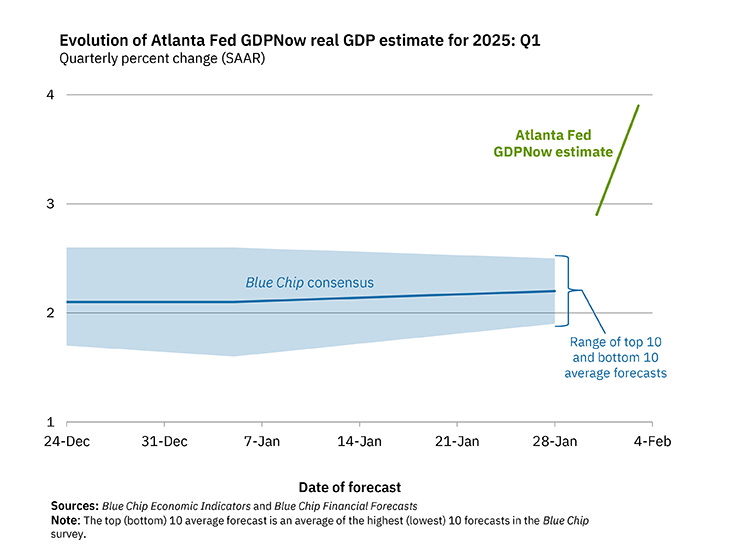
The Atlanta Fed’s “nowcast” estimate of growth in gross domestic product says the American economy is growing at 3.9 percent in the first quarter of 2025.
If that estimate bears out, it would mark a sharp leap ahead of the economy’s performance in 2024, when the growth rate was 2.8 percent for the full year, according to the U.S. Bureau of Economic Analysis. The BEA’s advance estimate for the 4th quarter was a real annual rate of 2.3 percent, on a seasonally adjusted basis.
If the 3.9 percent figure bears out, it would shatter consensus forecasts, exceed the most ambitious Trump administration goals, and constitute a significant upside surprise. There’s some risk that better-than-expected growth would encourage the Federal Reserve to keep interest rates at current levels rather than cutting, but the law tells the Fed to target price stability and full employment, not growth.
Politically, strong growth would be a win for Republicans, who can claim credit as they now control the White House and both houses of Congress.
For the federal budget picture and also at the state levels, the strong growth is also a win, as it will likely translate into higher-than-expected tax receipts and lower-than-expected spending on welfare programs. That could make it easier for Trump and Congress to pass tax and spending legislation.
For markets, while GDP gains don’t always translate directly into stock market rallies, stronger growth could both indicate and fuel strong corporate profits that will eventually translate into market capitalizations. The growth is fueled not only by political policies aiming at lower taxes, less regulation, and less federal government spending, but also by technological innovations such as artificial intelligence, dynamic pricing of credit and labor, and smartphone-fueled productivity growth. Banks look to be in excellent shape notwithstanding some increases in credit card delinquencies, and beyond the banks there are vast sums of capital available from nonbank lenders.
Trump’s Treasury Secretary, Scott Bessent, has talked about a 3-3-3 plan to increase economic growth to 3 percent, reduce the deficit to 3 percent of GDP, and increase U.S. energy production by the equivalent of 3 million barrels a day of oil.
Other officials and analysts have been throwing around even lower growth targets and projections. A January 17, 2025 report from the Congressional Budget Office says, “In CBO’s projections, economic growth cools from an estimated 2.3 percent in calendar year 2024 to 1.9 percent in 2025 and 1.8 percent in 2026 amid higher unemployment and lower inflation.” Also on January 17, 2025, the International Monetary Fund increased its annual growth forecast for the U.S. to 2.7 percent, from the previous forecast of 2.2 percent.
A January 24, 2025 outlook from Vanguard, the mutual fund, ETF, and retirement giant, said, “Vanguard’s 2025 for the United States includes expectations for continued growth just above 2%.” Goldman Sachs Research’s November 2024 postelection outlook for U.S. GDP growth in 2025 was 2.5 percent, which it described as “well ahead of the consensus at 1.9%.”
Chairman Jerome Powell, announcing last week that the Fed would hold, declared that the economy is “growing at two to two and a half percent.”
The New York Fed’s own staff “nowcast” of January 31 put first quarter 2025 GDP at 2.92 percent, but also shows a 68 percent probability of 4.54 percent and a 50 percent probability of 4 percent (there are identical probabilities of a downward miss.)
Whether the U.S. can pull off 4 percent real growth for the first quarter of 2025, or for the full year, remains to be seen. But I would not be surprised if the Atlanta Fed GDPNow forecast comes closer to reality than the Congressional Budget Office or Goldman Sachs forecasts. There is so much catastrophizing in the press and on social media around the Trump presidency and the tariff threat. Won’t it be something if at least in economic terms, the actual outcome is an upside surprise?
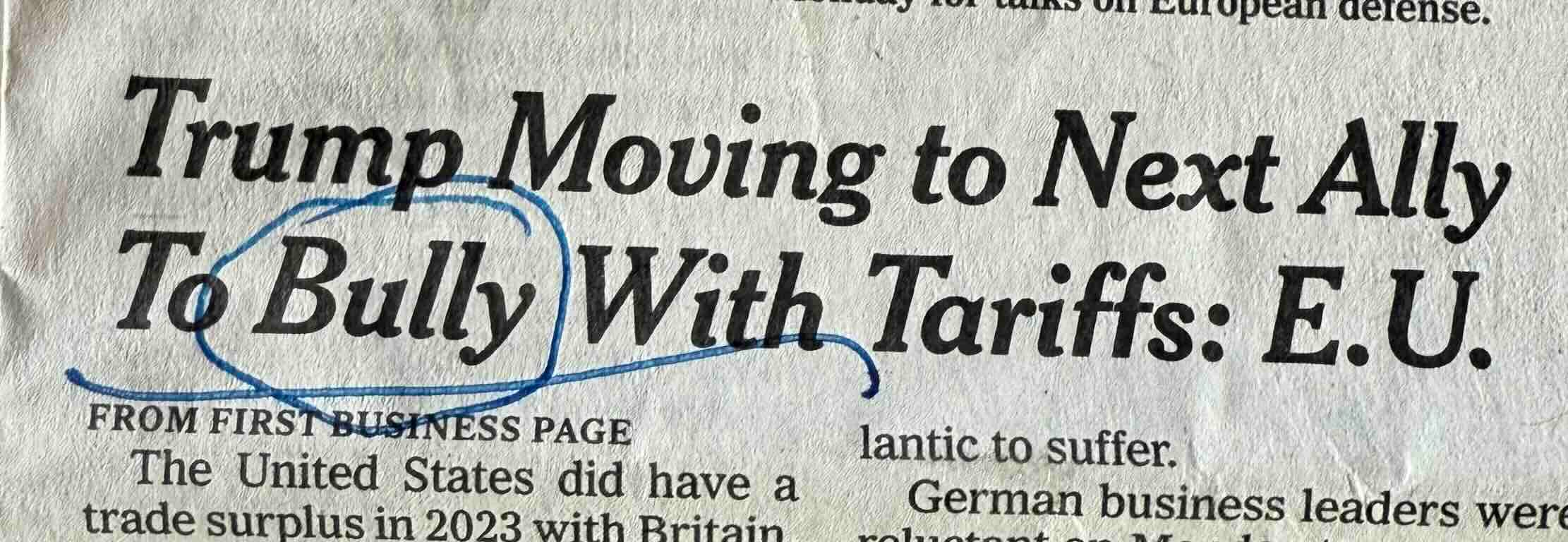
New York Times bias: “Trump Moving to Next Ally To Bully With Tariffs: E.U.” is a headline in the print New York Times business section this morning. Funny, I can’t find any record in the Times archives of the Times using the verb “bully” when President Biden imposed tariffs on China or sanctions on Russia.
It made me chuckle at the reference in the Times opinion section, where Bret Stephens was going on about how nonprofit news organizations “won’t work unless readers of any political color trust what they are reading.”
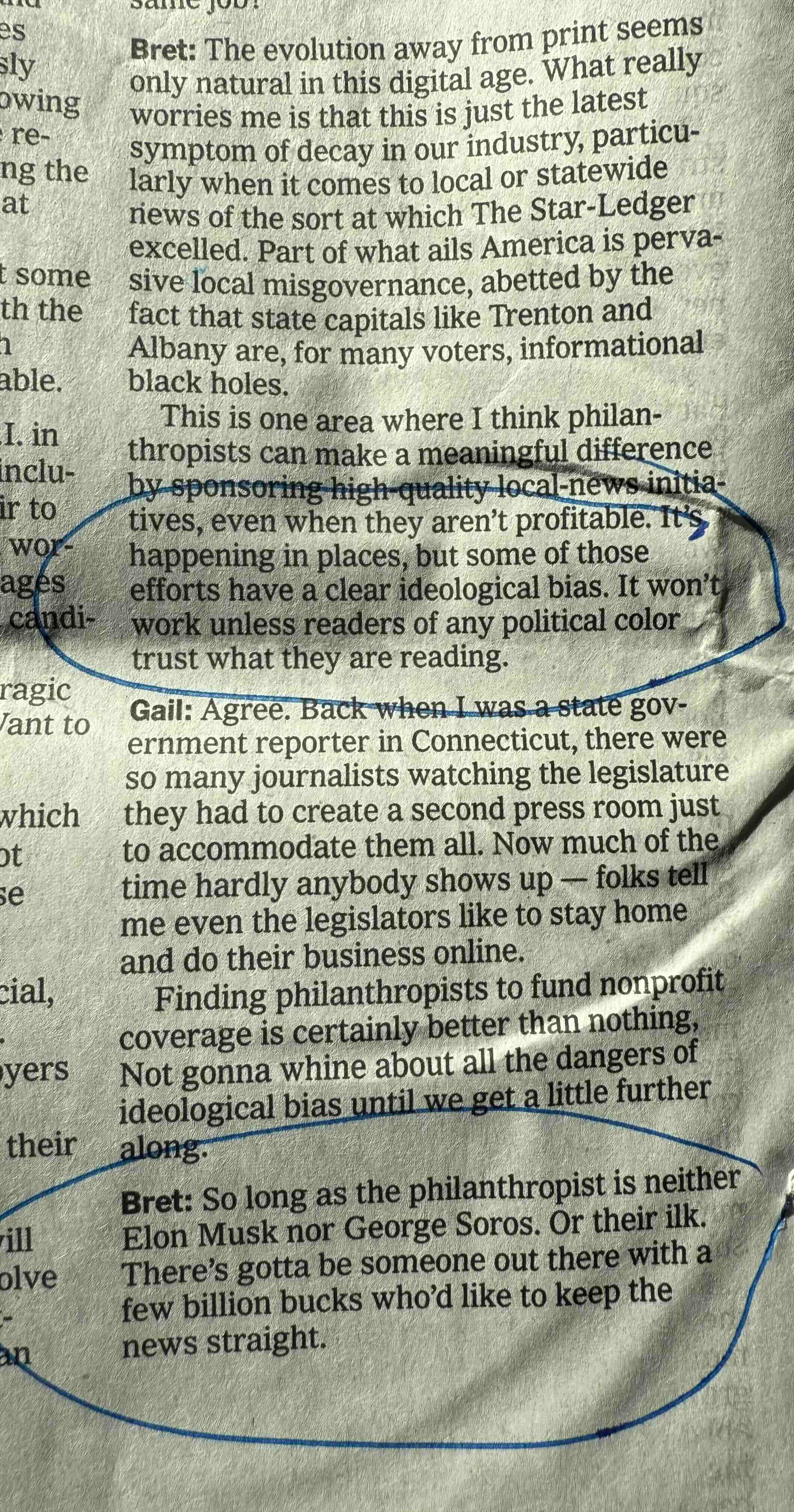
If the same “keep the news straight” standard is to be applied to the New York Times itself, in the case of the “bully” headline, the Times fell short.
Purdue newspaper helps anti-Israel activists hide identities: Speaking of press bias, a Purdue university student newspaper, the Purdue Exponent, has published an unsigned staff editorial announcing that, in an effort to prevent the Trump administration from enforcing immigration laws against pro-Hamas students, it is going to undertake a Soviet-style effort to purge its own records. “To protect the identities of pro-Palestinian students, we are removing the names, images and likenesses of every such student from our website published since Oct. 7, 2023,” the editorial says. “Further, in future coverage, no such information or images will be published online or in print by the Exponent.”
The student newspaper mentions the First Amendment: “The Exponent, as a member of the press and — more importantly — a student publication, refuses to be party to such a blatant violation of the First Amendment rights of potentially hundreds of Purdue students.” There’s no First Amendment right of foreign students to lie on a U.S. visa application about their support for terrorism. For the newspaper to actively help the foreign students cover up such a potential lie raises questions about what other steps they might be prepared to take that place interfering with a law enforcement investigation ahead of maintaining a complete, full, and accurate journalistic record of campus events. For what other potential crimes, if any, are the student journalists prepared to purge their newspaper of names and faces?
Thank you: At The Editors, we are growing at a rate that far exceeds 4 percent. Thanks to all of you who have become paying customers. If you haven’t yet done so, please subscribe today to support our independent journalism and ensure your full access to all the content. The price is less than 27 cents a day.
The Constitution grants Congress, not the President, the authority to levy tariffs, so Congress should exercise this authority.
Hiding identities of participants in demonstrations has been widely practiced by newspapers since the "peaceful protest" riots of 2020. Even public information such as the names of people arrested was withheld by a wide variety of publications.
Part of the reason that 10 students in the Harvard Gaza encampment talked with me for an hour (https://segal.org/gaza/harvardprotesters/) was that I made no effort at all to identify them; I didn't ask for names or take photographs. But they did ask for me to identify myself and they did web searches about me.
BTW there is no right to force suppression of photos taken in public. Many years ago a newspaper printed a photo of a baseball game attended by someone who had called in sick to work. He got fired, and the court said tough luck.
I have, though, gone back and deleted a news photo on the Advocates for ROTC web site. A student who had won an aviation award was getting teased by fellow pilots about looking very affected by a flight in a MiG and I agreed to a request to disappear the photo.