


Shaul Magid was named in July 2025 to a new post as Harvard Divinity School’s first ever “Professor of Modern Jewish Studies in Residence.” Magid’s latest book, “The Necessity of Exile,” declared that “Israel is mired in an increasingly chauvinistic ethnonational project,” and said that he doesn’t think “that liberalism and Zionism can be seen as compatible in any easy way.” The book, he writes, is “in some sense, anti-Zionist” or “more precisely…counter-Zionist.”
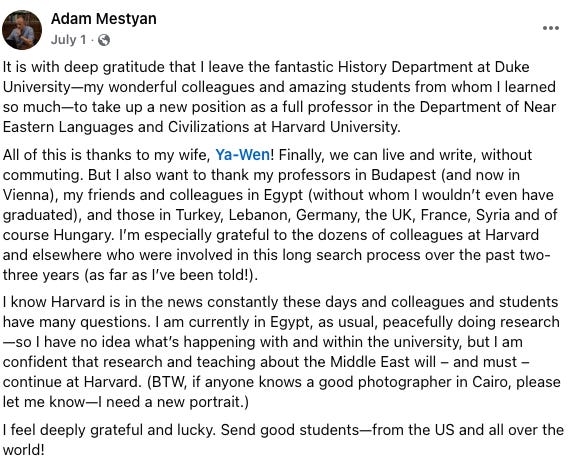
Adam Mestyan also started at Harvard this year as the newly arrived Ford Foundation Professor of Middle Eastern Studies. He signed a 2014 petition favoring a boycott of Israeli academic institutions, and his social media feed included photos of a 2024 protest “against the occupation Massacres in #Gaza.”
What do Magid and Mestyan have in common, other than opposition to Zionism or Israel and being recruited as exceptions to what Harvard says is a university-wide hiring freeze?
They both have spouses who already worked at Harvard.
Magid “is married to Prof. Annette Yoshiko Reed,” the far-left Israeli newspaper Haaretz reported in August 2025. Reed joined the Harvard Divinity School in July 2022 as Krister Stendahl Professor of Divinity and Professor of New Testament and Early Christianity. Before that, from 2017 to 2022, she was a professor at NYU in the Skirball Department of Hebrew and Judaic Studies. That NYU department was also the longtime base of another boycott-Israel professor, Hasia Diner, who is now coming to Harvard Divinity School as a visiting professor to teach a new class on “American Judaism.”
As for Mestyan, his wife is Ya-Wen Lei, a professor of sociology at Harvard. When Mestyan posted to social media announcing his move to Harvard from Duke, he explained, “all of this is thanks to my wife…Finally, we can live and write, without commuting.” I emailed Mestyan asking, “What did you mean by that? Would you not have been hired at Harvard if your spouse did not work there already?” He did not respond to my inquiry. Maybe he was just graciously thanking his wife for her support in his career, and worded the thank-you with suboptimal clarity.
Universities often do create positions to accommodate two-career couples, but at Harvard that has sometimes meant finding a trailing spouse a job at Boston University, Northeastern, or Brandeis rather than creating one in Cambridge. Anything else risks fueling resentments that a coveted faculty line is being used for a spouse rather than for the world’s best scholar findable for given position. The alternative is that people are asked to believe that the world’s absolute best scholar findable for a given position just coincidentally so happens to be married to someone already on the Harvard faculty. That is sometimes, though rarely, indeed the case—like attracts like, and “assortative mating” is a thing—but the personally involved faculty members tend to think it is the case more frequently than reality.
In recent years, Harvard and other elite universities have pushed to hire more women and minority faculty. Men have found themselves more frequently wearing the “trailing spouse” hat. The Editors reported in July about a situation involving a two-scholar couple, Jessica Marglin and her husband Nathan Perl-Rosenthal:
The Near Eastern Languages and Civilizations website also lists a new-to-Harvard scholar, Jessica Marglin, as Visiting Professor of Near Eastern Languages and Civilizations (Academic Year 2025-2026). Harvard had aspired before the hiring freeze, and apparently still aspires, to lure Marglin to Harvard on a more permanent basis, but she is still also listed at the University of Southern California as the Ruth Ziegler Chair in Jewish Studies and Professor of Religion, Law and History, where she writes, “I specialize in the history of Jews in modern North Africa and the Mediterranean, with a focus on law.” Reached by email, she declined to comment to The Editors. Marglin’s father, Stephen Marglin, a graduate of the Harvard Class of 1959, has been a member of the Harvard economics faculty since 1965.
Part of the issue with closing the deal on bringing Jessica Marglin to Cambridge permanently appears to be her husband, a distinguished scholar in his own right, Nathan Perl-Rosenthal. He has been tagged in the Harvard context with the dreaded academic label of “trailing spouse”—that is, an academic who is less coveted by the hiring institution than his wife. Perl-Rosethal, a son of longtime New Republic art critic Jed Perl, is professor of History, French and Italian and Law at USC. Harvard typically sets trailing spouses up at Boston University, Northeastern, Wellesley or Brandeis, or finds some non-full-professor job for them at Harvard, but if Harvard is sufficiently slow, condescending, arrogant, and alienating along the way, Marglin and Perl-Rosenthal might just decide after the academic year to return to L.A. where the weather is better and where the deans and department chairs are flexible, friendly, and accommodating rather than rigid. Reached by email, Perl-Rosenthal declined to comment to The Editors.
These are complex situations. I can see the case for a university being strictly meritocratic and not taking family connections into account at all. And I can also see a humane desire to make accommodations, where possible, to allow family members to be geographically proximate and to compete for star talent against other institutions that may be more flexible in hiring. It doesn’t seem fair to hold it against a job applicant that their spouse is an employee, though there are some extremely high quality institutions—at least one elite law firm I’m aware of—whose anti-nepotism policies and strictly-merit-only culture are so strong that they do take such an approach.
That said, to an Israeli student or pro-Israel student stuck with an anti-Israel professor on a campus such as Harvard, where undergraduates just voted 63 percent to 23 percent in favor of divesting from Israel and where the “ethics” columnist at the college newspaper is advising people they “are justified” in dumping their Zionist friends, it may be less than entirely reassuring to sit in class wondering whether the professor is there entirely because of research and teaching merit, or whether, at least in part, it is all thanks to the professor’s wife.
Thank you: The Editors is a reader-supported publication that relies on paying customers to sustain its editorial independence. If you know someone who would enjoy or benefit from reading The Editors, please help us grow, and help your friends, family members, and associates understand the world around them, by forwarding this email along with a suggestion that they subscribe today. Or send a gift subscription. If it doesn’t work on mobile, try desktop. Or vice versa. Or ask a tech-savvy youngster to help. Thank you to those of who who have done this recently and thanks in advance to the rest of you.
If you dig into those Harvard survey numbers, however, as in this Crimson article, https://www.thecrimson.com/article/2025/11/20/college-students-favor-divestment-from-israel/, you see that only 8% of students voted in favor of divestment, fewer than 600 students, with the rest not answering the question, choosing the 'don't know' option, or opposing it. It increasingly seems like the impression of consensus is counterfeit, and that even Gen Z is getting bored of Gaza. Which makes the question raised here even more pertinent - if noisy anti-Israel scholars are being imported on the power of their spouse's work, then even the supposed imprimatur of Harvard is counterfeit.
However, the truth is that Harvard faculty (or Princeton, etc.) are no longer as world leading as they once were, and are as likely to be hired into a history or comparative literature department precisely on their views on Israel as on their scholarship. Even if their expertise is Roman religion, Asian-American studies, or Shakespeare. Long gone are the days when good Ivy men moved between good Ivy departments - now good Ivy PhD graduates are scattered far and wide, from Miami to Montana, and getting hired to a TT Ivy job in the social sciences and humanities at Harvard et al. is highly correlated with having the approved opinions. Opinions matter at lesser-ranked places too, but if you are productive enough, your silence can be read as mere studiousness and thus forgiven.
I realize this is a catty aside, but I had to laugh at Mestyan's appeal for info about a good photographer in Cairo to take a portrait of him. Does he lack a cell phone to take a mug shot? Or are Harvard profs now like Renaissance popes or princes? What sort of narcissistic world is academia? They are all oh-so concerned about genocide in Gaza, but let's not forget the really big deal in life -- how you look to the denizens of that Versailles Palace known as Harvard. Sorry for venting. I sometimes can't help it.